


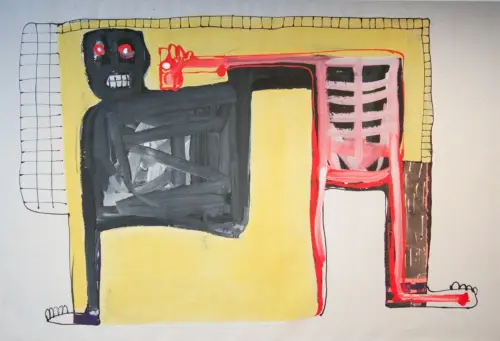
Amadou Sanogo
“Like a wave of heavy rocks crashing onto a pebbly beach, the roll of thunder rises muffled and threatening in the distance. It is a warning that a thunderstorm will soon erupt. In the dark clouds that the storm gathers, enormous electrical voltage builds that then suddenly strikes the ground as lightning. In an instant, it heats the air around it and a shock wave forms whose echo reaches us as a mighty clap of thunder. Plasma physics recognises the roar of thunder as a harbinger of a sudden rise in temperature that charges matter and changes it into a different state of aggregation. The rumbling that gives the rising thunder its dark, dull, sinister sound is an internally smouldering state that bodes ill.”
Sighard Neckel (Emotions and Society)
“Nietzsche suggested that conscience is not originally a moral faculty. Rather, it is aggression redirected against the self. The animal that once bit others now bites itself.”
Cobus Kleynhans (When Anger Turns Inward)
“The world is systematized horror, but therefore it is to do the world too much honour to think of it entirely as a system; for its unifying principle is division, and it reconciles by asserting unimpaired the irreconcilability of the general and particular. Its essence is abomination; but its appearance, the lie by virtue of which it persists, is a stand-in for truth.”
Theodor Adorno (Negative Dialectics)
“Who is the rebel? A person who says no. But even if he refuses, he does not renounce; he is also a person who says yes, from the very first movement. A slave who has taken orders all his life suddenly finds a new command unacceptable. What is the content of this ‘no’?”.
Albert Canmus (The Rebel)
There is now in the U.S. and UK, and to some degree in Europe as well, a new moral panic. Although strictly speaking its not new at all. In the U.S. in particular there is a constant recycling of moral tropes — going back to the founding of the Nation. Going back to the Salem witch trials. After WW2 the rise of McCarthyism was the materialization of an absolute fear of communism gripping the nation. But communism was a symbolizing of deeper festering fears. Nazis were welcome, forgiven (if that was even necessary) and integrated into society. The ‘red scare’ was the new witch trials. The HUAC hearings were the American Inquisition. And behind this, though, was the engine of sexual terror. And this is why Klaus Theweleit’s book Male Fantasies is so useful. But lets jump ahead to the Russell Brand case (and the EU sanctioning of Clay Bowes and thirty some other journalists for being too pro Russian. Not just a slap on the wrist but a complete freezing of bank accounts and passports etc). They are all part of the same cloth.
Jean Seberg, the American actress who rose to fame in Godard’s Breathless, was a target of the FBI because she supported the Black Panthers — but more specifically she was a pixie-like gamine young blond who apparently was attracted to black men (in the minds of the white establishment). This was the actual crime. Mandingo-ism. So before digging more into the past, I want to pivot to the psychoanalytic psychic geography of contemporary westerners.
Lets set these ruminations against the backdrop of sharply declining birthrates, the fact that young people have less sex but watch considerably more porn, and in exist in a Q code culture of intense isolation.
Looking at the Brand case, if the woman is young and attractive AND a victim — then men will rush to her defense. This is a kind of internet era gallantry, the armchair knight in shining armour. It is also social media virtue signaling armchair heroism. If the woman is young and attractive but not a victim of anything, then these same men will scorn her, avoid her probably, reseht her because they find her attractive, and secretly want to victimise her themselves.

Louis Edouard Fournier (Funeral of Shelley, 1889)
If the woman is married with children these same men will silently hate her for not choosing them (and want to kill the children). One can see how the unresolved Oedipal complex plays alongside this. This reads like a Fairy Tale and that is not incidental. A figure like Brand is the target of so much scorn by these same men because, rather obviously, they want to be Brand. Even critics who see the profound flaws in the Brand trial, will preface all criticism of the British courts and the trial by saying ‘ Brand may be a scumbag, but the trial….etc etc etc etc’. He is always a creep and scumbag first. There has been over the last ten years or so an intensification of ‘othering’. And so much of interior life now is expressed indirectly on social media.
“Today, linguistic research agrees that the German noun Groll presumably came from the Middle High German adjective grel, meaning coarse and irate. In fact, a grudge is a quiet, secretive relative of anger or wrath; it is passive and turned inward, whereas its affective sibling actively turns its agitation outward. Holding a grudge against someone does not take place out in the open. Consequently, it is not easy to recognise and even more difficult to overcome. Such rancour is a deep-seated emotion. It carries around anger, displeasure, a deep antipathy or silent hatred for a long time. It is a constant guest in a person’s emotional household. Anger and outrage have their respective triggers and their specific object. They are loud, heated and eruptive in making themselves heard. Once someone shouts out the injustice they experience, the anger and outrage can evaporate, but a grudge continues to smoulder below the surface of one’s behaviour. Third parties sometimes become aware of it when it eats its way into the body of the aggrieved person as latent aggression. A comment might come out too harshly without there being any apparent reason for it, and facial expressions stiffen and take on contemptuous features.”
Sighard Neckel (Ibid)
This current moral panic is one of the symptoms of Capitalism today, or of the crisis of capitalism today. Neckel, in a different book, examines the idea of ‘exhaustion’, which strikes me as particularly relevant.

Breathless (À bout de souffle) 1960. Dr Jean Luc Godard. Starring Jean Seberg
“Yet what do the eras of exhaustion have in common? If we follow Patrick Kury’s analysis, periods during which fatigue syndromes are frequently diagnosed usually follow after rapid social change. Thus, neurasthenia as a trendsetting illness was diagnosed on a massive scale in the wake of the profound social upheavals from the middle of the nineteenth century onwards – that is, following urbanisation, industrialisation, and advances in communication and transportation. Another example is the ‘manager disease’ rampant in Germany during the 1950s which followed the end of the Second World War and the German ‘economic miracle’. The present era is also marked by rapid social change. Since the 1990s, lifestyles have undergone extreme acceleration as a result of digitalisation, and the financialisation of the economy has driven the idea of competition into the very centre of social life, to name just two among a multitude of changes that shape contemporary social experience.”
Sighard Neckel, Anna Katharina Schaffner and Greta Wagner (Burnout, Fatigue, Exhaustion)
By these standards, today’s moral panic suggests a coalescing of symptoms that find their expression in various collective panics and hysterias. Covid was certainly one, and MeToo another, and now Russell Brand. The Ukraine/Russia conflict qualifies as well. The genocide in Gaza is more like the inverse of this. Electronic or digital media is a constant back and forth battle between propaganda machines and reality.
Grudge is a feeling that wants to be larger than it is. Wants to break out of its prison of the self (per Neckel). Grudge is the logical precursor to revenge, but revenge in the administered society is largely a fantasy, so the grudge turns in upon itself.

Marian Wawrzeniecki (1910)
“As Heinz Weiss, co-director of Frankfurt’s Sigmund Freud Institute, explained in his studies: ‘It is difficult to interpret resentment without giving renewed cause for hurt and offense. On occasion, it seems almost impossible to interpret humiliation without exposing the patient to a renewed experience of it’ (Weiss, 2019). Weiss also suggested using the role of the gaze to differentiate feelings of offence such as rancour, shame and rage. Rancour involves an upward gaze from below that is accusatory, chronic and reproachful. On the other hand, someone who is ashamed is faced with a situation of being looked down on in a humiliating way. Rage, in turn, directs the gaze downward from above, self-righteously judging the behaviour of others from this elevated position. These modes of seeing and being seen correspond to emotional reactions. In rage, we are sure of ourselves and make a judgement about others. The force of rage comes from the assumption of being in the right. Shame signifies that we are exposed, unmasked, becoming the object of humiliation. A grudge expresses a feeling of having suffered injustice, which demands compensation and redress.”
Sighard Neckel, Anna Katharina Schaffner and Greta Wagner (Ibid)
The fall of the USSR, and the neo liberal war on post colonial fights for independence are both critical factors in this weird psychic homelessness and erosion of identity.
“Most newly created ‘individuals’ toil within poorly imagined social and political communities and/or states with weakening sovereignty. They not only suffer from the fact that, as Tocqueville wrote in another context, ‘traditional ties, supports and restrictions have been left behind along with their assurances about a person’s self-worth and identity’. Their isolation has also been intensified by the decline or loss of postcolonial nation-building ideologies, and the junking of social democracy by globalized technocratic elites. Thus, individuals with very different pasts find themselves herded by capitalism and technology into a common present, where grossly unequal distributions of wealth and power have created humiliating new hierarchies.”
Pankaj Mishra (Age of Anger)

Tiitian (Rape of Europa, 1560)
Mishra is, I hasten to add, is a kind of almost pop-theorist. His insights, and he has many, exist in the strange p.o.v. of a westernized Indian (from a Brahim family). He often is described as a socialist, but this seems far from accurate. He did write a great review of Niall Fergusson’s idiotic history Civilization: The West and the Rest and ridiculed Jordan Peterson, so he can’t be all bad. But back to the topic at hand.
The trial of Russell Brand has triggered barely suppressed anger in the ruling class (and their enablers, the western liberal). And how the really salient point of the Brand trial is not the fact that he was stitched up by the Murdoch media, or by the billionaire class — that is obvious —no, the critical aspect is two fold but overlap. The first is legal. Getting wrongly convicted in commonplace at this point, but it was the manner of his stitch up. Strictly speaking this is another nail in the coffin of due process. It is also the latest and perhaps among the very worst open attack on the entirely of the legal system as handed down from Roman Law. It is worse even than the Milosevic trial in that respect. The ruling class now, in the UK and as it exists in the US, want to install a Star Chamber system of assumed guilt. There has been an ongoing war on due process so this isn’t new, but it is, as noted, among the worst. And of course it comes in the guise of a moral reformation. And here is where resentment and grudges and rancour become important. Increasingly I find strange blind spots in the collective reading of public narratives. The fact that the Brand conviction was the culmination of a four year investigation by Murdoch Inc to find something to hang on Brand seems to be of scant interest to the court. And of even less interest to the public. This is a dubious precedent. If giant corporate interests target you, of course eventually they will ‘find’ something. And then the manipulation (which wasn’t hard) to find a pliable (and Zionist) judge to preside over this spectacle also barely registers in the group hive mind lapping it all up.
“Following Luc Boltanski and Ève Chiapello, this kind of criticism can be identified as an ‘artist critique’: It is aimed at bureaucratic and Taylorist forms of work organisation and calls for autonomy and self-fulfilment. Its primary target is not the injustice of capitalist economic organisation, but the servitude and inauthenticity to which capitalism gives rise and its lack of opportunities for personal self-developmen. { } Activity, self-transformation, and commitment are the new values in the workplace. The desire to secure personal success through high levels of motivation and continuous exertion leads employees to link self-fulfilment with self-exploitation in a dangerous way. Thus, the prospect of self-fulfilment lures the individuals concerned into a trap: the more inadequate the working conditions, the more the identification with work drives the subsequent burnout victim to ever-greater commitment, which eventually leads to an exhaustion breakdown.”
Sighard Neckel, Anna Katharina Schaffner and Greta Wagner (Ibid)

Woodcut illustration of Marlowe’s Dr Faustus, 1620
Frantz Fanon noted that one must decolonize the mind. This is hugely important here when looking at the plague of resentment and grudges that seem at epidemic levels across western consciousness. The curated self image of liberal and MAGA alike on social media is reflective of much deeper problems. Both emotional and political. There is a discussion, too, to be had about the ascension of porn in contemporary culture. Allow me an interesting mini critique here:
https://x.com/alon_mizrahi/status/2123549220020080925?a=w16LNU5IHg8cJyzE5qc&s=46
“Signs of contempt directed at the lower classes are not only found in conservative circles. The liberal milieu also sends signals of disdain to those who do not share its way of life and its worldview. Hillary Clinton’s ‘deplorables’ are just one example of this. It has been widely regarded as arrogant. There is an obvious reason why such kinds of resentment do not apparently have the traits of grudges. In case of resentment towards those ‘below’, the balance of power is reversed. There is no feeling of one’s own weakness in the liberal milieu from which the grudge feeds its fantasies of revenge. This could be one of the reasons why resentment top down is emotionally associated much more often with scorn and disgust than with rancour and grudges.This is an example that illustrates it is useful for the sociology of emotions not to lump resentment and its emotions into one, but to differentiate between different emotional expressions of it. Scorn and disgust are typically the companions of top-down resentments, grudges typically for bottom-up. This can also be seen in protests and social movements directed against obvious injustices and powerful opponents. The more powerless such movements are, the more likely it seems that resentment towards the supporters of unjust conditions will arise because of the enduring hurts. So, it is not surprising that from the labour to the women’s movement, from the anti-colonial struggles in the 1950s and 1960s to the US civil rights movement and Fridays for Future today, we repeatedly come across signs of rancour and grudges resulting from having to accept existing unjust conditions as they are. To mention just two recent examples: the often-heard statements that the boomer generation has destroyed the planet or that White people are racists by definition who should check their privileges – such statements certainly have some traits of resentment, too. In this respect, a problematic turning point in social movements has been reached when resentment is used by self-proclaimed strong leaders to delegate their adherents’ perceived weakness to them in order to overrule it. This is the authoritarian temptation that can also arise in non-authoritarian movements.”
Sighard Neckel (Emotions and Society)

Alfred Sohn-Rethel (Bremen, 1960s, in front of the brick elephant landmark)
The subjective suffering of all classes today feels as it is reaching a tipping point. The billionaire class, nearly all of whom are only relatively recently billionaires (or trillionaires). They have not created dynasties or family institutions. They create only power and more wealth. Well, they create more capitalism actually. Their lack of dynastic fortune means they can pass nothing on to future family members, offspring and relatives who will expand their name and mythology. And here I want to circle back to the backlash (by the state primarily) to the Brand decision.
“Capital accumulation does not consist in amassing riches – that is to say, objects desired for their use-value, their ostentatious function, or as signs of power. The concrete forms of wealth (property, plant, commodities, money, etc.) have no interest in and of themselves and can even, by dint of their lack of liquidity, represent an obstacle to the only objective that really matters: the constant transformation of capital, plant and various purchases (raw materials, components, services, etc.) into output, of output into money, and of money into new investments.”
Luc Boltanski,Eve Chiapello (The New Spirit of Capitalism)
“If, as psychoanalysts have discovered, traumatic events tend to stir up unconscious vestiges of the immature needs and desires of childhood; and if, as suggested above, the Civil War was the most traumatic event in American history, then the likelihood is that the Civil War aroused in many people childhood urges, including the very strong wish of childhood for parental guidance and control. If it is now recalled that judges and courts frequently serve as unconscious parent symbols…then it is conceivable that the unconscious wish for parental direction and control presumably stirred up in many people by the Civil War may have caused these people to be more willing than before to accept…judicial review of congressional legislation.”
C.G. Schoenfeld (Psychoanalysis and the Law)
The wish for parental control (I am reminded of David Foster Wallace’s observation that his generation were like kids at an out of control party who wanted for nothing more than their parents to come home early) feels acute today, although the stand in for parents is some form of fascist power formation. So looking at resentments, at rancour and then at the dynamics of our legal system and then the class structures of fascism — this is intimately related. The collective unconscious (for lack of a better word) has reached some sort of critical mass. The reading of events is infantile. In one sense the Chay Bowes story is a great example. No crime, no real accusation beyond the EU maintaining he engaged in pro Russian journalism. No court, no hearing, but he and his family literally cannot buy food. Russell Brand is arrested and presented to some Star Chamber court charade, with accusations dating back two decades and no forensic evidence that is not normally seen as hearsay, and all from a highly dubious source who remains anonymous. The right to face your accuser is waived. No cross examination. It’s as if one asks one’s parents ‘why?’ and the parent says because I said so.

Karl Friedrich Schinkel (Terrace, Orlanda Palace, Crimea)
“It must first be made clear what aspect of Nazi fascism is under analysis here. Naming it ‘Behemoth’, Franz Neumann* has masterfully dissected and portrayed the Nazi regime. In all essentials I am in agreement with him and would wish his conclusions to stand as a basis for this study, in particular his analyses o f the bourgeois power base represented by its three pillars, monopoly capital, the army and the state bureaucracy. What concerns us here is above all the fourth pillar which does not stem from the arsenal of bourgeois tradition: the fascist party and the connections o f its power with the economy. For the class structure of Nazi fascism becomes comprehensible only from a theoretical analysis which derives the setting up of a fascist dictatorship in Germany from the reaction of monopoly capital to the collapse o f its own effectiveness in the world-wide economic crisis o f the 1930s. This crisis was something essentially different from the usual periodic cycle, the upsetting and the subsequent restitution of market equilibrium . It was a structural crisis which put the survival of the whole system in jeopardy. { } The terroristic power of the fascist party serves not only to eliminate political enemies. It is the suspension of bourgeois laws which is the hallmark of fascism and it is by this means that it finally guarantees that the state can wield its entrepreneurial function smoothly and can aid and abet monopoly capital in its state of peril. The fascist regime emerged through the actions of private monopoly capital which had to re-group itself for this purpose; it was thus its responsibility, and, in a manner of speaking, its own free decision. But in this freedom there lurked a dialectic which was at complete variance with it, that perverted it into nothing more than the freedom to dispense with its freedom. “
Alfred Sohn-Rethel (The Economy and Class Structure of German Fascism)
Sohn-Rethel was the son of a quite accomplished and well known painter also named Alfred Sohn-Rethel. But the junior Sohn-Rethel was linked to, but not part of the Frankfurt School (he was closest to Adorno) and his study of the class structure of National Socialism is a quite neglected book. He was also a remarkably elegant prose stylist. Read the below paragraph and think of Clay Bowes the thirty others sanctioned by the EU…
“The state takes over the entrepreneurial, managerial function but capital remains, as ever, private. What is produced, how and by whom, with what profit margins and at what prices, all this is decreed by the state: the state determines imports and exports for each firm, the procurement and distribution of their raw materials; it calls a wage-freeze for the population as producers and a price-freeze for them as consumers; it decides what building, what textile production, what means of transport, what machine construction should be promoted or scrapped, what terms of credit the banks should assent to and which ones they should refuse, what promissory notes should be endorsed and which should be cancelled. But the profits and losses of all this are entered as private profits and private losses of capital although the proportion of consumption to accumulation of private profits is again decided by the state.”
Alfred Sohn-Rethel (Ibid)

Terrace at Berghof, from Eva Braun’s photo album.
Today the Trump presidency is increasingly resembles a Beavis and Butt-head version of Versailles. But the stunning appearance (in Europe, too) of deeply uneducated and visibly not bright officials has normalized a certain vulgarity : from Trump himself to Hegseth, to Vance to Kaja Kallas and Van der Leyn, and Giorgia Meloni to Markwayne Mullin and Katherine Guilfoyle — to Melania and the Mar-a Lago party girls, to the British royal family, and on and on and on…. it is a kind of Hunger Games parody.
We are watching the inevitable revanchist presentation of the Court of Louis XIV, but as a grotesque. And here I think is exactly where the mutilated psyche of western consumerism, the branding of everything including oneself, the Spectacle — brings together the rise is OnlyFans homemade ‘amateur’ porn (and really prostitution) with aspirational fantasies that are, largely, infantile and immature, from MMA fights on the White House lawn (the crisis of masculinity) to porn entrepreneurs, to the cosplay politicians surrounding Trump — and the panic about the release of the Epstein files. And the fall out from a dozen different Mossad honey traps (Charlie Kirk to Jensen Huang to Kash Patel). The rise of so called ‘cuck porn’ and now the Russell Brand show trial. The unconscious cauldron of ambivalence and contradiction which runs from Space X delusions to an epidemic of social media virtue signaling. Oneline ‘incel’ culture and also a egressive nostalgia, on both left and right. The right’s nostalgia is of a Norman Rockwell white suburbia, the Ozzie and Harriet family sitcom come to life. For the left it is the endless deployment of hammer and sickles, always in red, and then 20s constructivist imagery — the recreation of the Bolshevik Revolution but with whole grains and natural fibers. And remember these public mood swings are taking place against the historical backdrop of Puritanism. This is a collective societal borderline state.
“The genuine value categories of social life grow out of the roots of its reproductive economy. Fascism has to distort them into the opposite to dedicate the economy to war values. But one cannot deny that in Germany there were masses who flocked to the cry of Nazi propaganda as if, indeed, they had been waiting for it. Without a fascist party there can be no fascism. The party must first create the necessary mass basis for monopoly capital’s unconstitutional form of rule and erect a smokescreen for a ‘Volksgemeinschaft’ (national community). But the social strata and classes which promoted the Nazi ascendancy and their election successes on their way to power are not the ones which served the Nazis when actually in power. The class structure of the first must therefore be strictly differentiated from that of the second. Nazism itself provided proof of this when, in the course of the war, Hitler passed laws which contributed more to the economic annihilation of his former voters than any other regime had ever dared before. And yet, to the great disappointment of many soothsayers abroad, this did not noticeably weaken the Nazis’ inner power position.”
Alfred Sohn-Rethel (Ibid)

Genesis Tremaine
In this borderline collective consciousness there is a new weaponized resentment. Social media has opened a shunt to the unconscious through ersatz anonymity. Virtue signling is both a form of anger at the playacting involved, anger at the ‘other’ for being better or richer or more beautiful. That princess costumes remain the most popular Halloween costume for little girls is not insignificant. And the resentment directed at those made you want to be a princess, and those didn’t allow for you to become a princess, or a super hero (the whole comic book realm is predicated on resentment). The outrage at Brand is really not about compassion for the victim (Laura Brand is the target of endless smears and insults). It is rather a resentment that the outraged ones were never invited to the parties. Social media has always encouraged a relaxing of impulse control for many. People blurt out all kinds of things bcause again, its anonymous. There are no consequences. And now this note on Fairy Tales:
“A recent opinion poll has revealed that they terrify people under the age of 30, who consider them horribly inappropriate for children. Some 77 per cent of those surveyed believed – with a crushing inevitability – that they were ‘sexist’. Nine in ten said they are old-fashioned and outdated.”
Rod Liddle (The Spectator2022)
Outdated. Ponder that.
“Needless to say, the fascist party was not anti-capitalist. On the contrary, it thrived on capitalism, — on a capitalism struggling desperately for survival. Only when things went economically wrong for bourgeois society did the Nazi Party flourish and vice versa. Their election successes and membership rose and fell in exact parallel to the unemployment figures. During the years of prosperity between 1924 and 1928 the Nazis as good as disappeared from the political arena. But again, the deeper the capitalists subsided into crisis, the more firmly did the fascist party sit in the saddle over them. Thus it was that the Nazi propaganda painted the weaknesses and misfortunes, the contradictions and sicknesses of bourgeois society in as black a tint as possible. Communist propaganda did the same. Both often sounded the same trumpet, slipped into the same groove, poured their critical bile into the same wounds and only competed to see which one could do it louder and more brashly. And more often than not, it was Goebbels’ ‘Angriff’ (Attack) rather than the ‘Rote Fahne’ (Red Flag) that won. Of course the jargons of their anti-capitalism — the genuine one of the Communists and the fake one of the Nazis — were worlds apart: class concepts here, racial ones there.”
Alfred Sohn-Rethel (Ibid)

Nicholas Party
“Fairy tales are the purest and simplest expression of collective unconscious psychic processes.”
Marie-Louise von Franz (The Interpretation of Fairy Tales)
It is interesting today to look at the attacks on free speech in Europe. Most of it seems a prelude to the imagined coming war with Russia. All dissent is being squashed. There is an actual collective war fever in much of the populace and certainly in the political leadership. There is also a majority of people in Europe who do not want war of any kind but their voices are being drowned out. Just as most people support Russell Brand and know the trial and sentence were farcical. There is also a massive propaganda campaign about AI, the threat of AI and how AI will make us all slaves (as one headline put it). I think most people want to get rid of AI. I think nearly everyone hates the stuff. And yet the ruling billionaires have a lot invested in AI, just as many do (and their political representatives) in war. And those who want AI see it as the parent coming home early.
“I’d rather they be American killer robots and not Chinese killer robots.”
Ted Cruz (interview with Dasha Burns, 2026)
Cruz was being asked about the threat of AI. And it occurs to me that AI is now a generalized symbolic threat. The psyche of the West today is increasingly debilitated by unconscious contradictions, or more accurately by an inability to unify the unconscious material that continues to force its way to the surface of consciousness. AI is like a machine for keeping everything on the surface, sort of pseudo conscious. Asking Grok, for example (as I saw someone do) if Glenn Diesen is lying (the Norwegian journalist who is being smeared by major Norwegian publications as a Kremlin assett, and no I’m not making this up) and of course Grok said yes he is. No examples of his lies were presented by the questioner or by Grok.

Rumpelstiltskin, illustration by Monro Orr, 1931
One the most significant aspects of fairy tales is the landscape created, the atmosphere, the world. A world in which dogs speak to tigers, or witches live in a forest. If there is a forest in which no GPS can guide you, something changes in you. Also, one cannot stay forever in the world of the fairy tale, and most fairy tales indicate this at the end. You must return to ‘your’ life. And this is a message of renewal. If we travel down into the grotto, or the darkening forest, or even to the underworld, the fairy tale (or myth and certainly they overlap often but that’s an entire other conversation) the message is to return. And the return nearly always posits a home to which one is meant to return. In Rumpelstiltskin, in the Brothers Grimm version, the ‘little man’ (‘männlein’) is the real trial that the Miller’s daughter must face. The King (due to her father lying about her talents) shuts her in a tower and spin gold from straw. She, of course, can do no such thing, but then a little man appears and spins it for her. The ultimate price extracted is the promise of her first born child — which, of course might well be Rumpelstilltskin’s own. The story takes place in a tower, removed from the world — like Jack and the Beanstalk, when we get to the land of the Giant at the top of the beanstalk. Eventually the King marries the girl. They have a child and the ‘little man’ reappears. For nobody forgets anything in fairy tales. Least of all debts.
It is never an accident that world leaders ‘retire’ for rest to their personal estates. Reagan had his ranch, Rancho del Cielo, a small boutique fantasy ‘ranch’ in California, with a boutique lake on which Ron liked to canoe. Hitler had the ‘Eagle’s Nest’, adjacent to the Berghof retreat. At the tip top of the mountain. Trump has Mar-a-Lago, which is really a country club golf resort. But then Trump is the anti-Fairy Tale. JFK had Hyannis Port and the Bush cabal had Kennebunkport, Maine. And Truman had a former navel station on Key West. France grants is Prime Minister rights to Fort de Brégançon, Bormes-les-Mimosas, France, which is rather perfectly fairy tale like and part of the job package. But I digress.
The de-fairy tale-ing (sic) as it were, of today’s leaders and national cultures seems symptomatic of something — though I admit this is a vague idea, really. But this has been the rationale of the West after its second world war. And of Hiroshima, the atomic age, the weapons of mass destruction. The age of technology. Tech is our god and goddess. Our sacred radar lands on circuit boards and laboratories. And it is my feeling that the laboratory, the hermetically sealed off hyper sanitized working area for all things biological, pharmaceutical, or medical segued nicely into the world of Silicon Valley. And the ‘tech bros’ of computer science, the de natured puer aeternis that are Sam Altman or Bill Gates (who is simultaneously an old crone in the forest), or Steve Jobs or, well, Jensen Huang. None have large families, none of these men (and we can include grifters like Bezos and Musk) have created anything of cultural importance. The smart phone does not qualify. They feel like dwarfs if one dreams them. Like small spirits who are evil sprites or elves.

Arthur Johnson, illustration for pro Nazi Kladderadatsch magazine. Satirizing communists.
“It can be said that in every civilization there is a Weltanschauung with a central God-image which dominates that civilization, and with that goes a certain habit or style of life, a feeling style, and that Eros style in society influences how people relate to one another. The feeling tone of this collectivity would be the queen who accompanies the king; for instance, in the Middle Ages the Gothic idea of Christ would be incarnate in the king of that time, while the representations of Eros—to be found in the poems of the Troubadours—would be manifested in the Virgin Mary, who is the Queen of Heaven related to the King—Christ. She set the pattern for feminine behavior, the pattern for the man’s anima as well as for women. In Catholic countries women still naturally tend to adapt to that pattern, and men try to educate their anima to fit into this style of erotic behavior and this style of relationship.”
Marie-Louise von Franz (Ibid)
“Psychology has placed itself inside a Skinner box—a place with an empty interior where psychologists map the brain and observe activity.”
Glen Slater (Introduction to Hillman’s Senex & Puer)
Slater’s sort of snide aside is deeper than even he knows or thinks.
“Perception readily occurs without awareness of what is perceived, and learning without awareness of what is learnt. Therefore, Chalmers reasonably asked: ‘Why is the performance of these functions accompanied by experience? Why doesn’t all this information processing go on “in the dark”, free of any inner feel?’ Science’s failure to answer this question raises the possibility that consciousness does not form part of the ordinary causal matrix of the universe.”
Mark Solms (The Hidden Spring)
Adorno and Ernst Bloch both were fascinated by Fairy Tales.
“In this sense Bloch and Adorno are strange heirs to the Grimms’ legacy of folk and fairy tales. Both Bloch and Adorno agreed that something was missing in contemporary society—had always been missing—that engendered utopian longing. Adorno tried to elaborate a theory of negative dialectics in his Aesthetic Theory toward the end of his life, and it is clearly why he proposed to Bloch that “at any rate utopia is essentially in the determined negation, in the determined negation of that which merely is, and by concretizing itself as something false, it always points at the same time to what should be.” Though Bloch felt that the world had become completely devoid of a utopian conscience and utopian presentiment, he believed that “utopia cannot be removed from the world in spite of everything, and even the technological, which must definitely emerge and will be in the great realm of the utopian, will form only small sectors.” In other words, utopia was not only in the determined negation but in the anticipatory illumination. Glimmers of hope for this utopia were projected and are projected through the fairy tale, but the conditions for its realization must be adequate. As Bloch wryly stated toward the end of his conversation with Adorno, “People must first fill their stomachs, and then they can dance. That is a condition sine qua non for being able to talk earnestly about the other without it being used for deception. Only when all the guests have sat down at the table can the Messiah, can Christ come. Thus, Marxism in its entirety, even when conveyed in its most illuminating form and anticipated in its entire realization, is only a condition for life in freedom, life in happiness, life in possible fulfillment, life with content.”
Jack Zipes (Grimm Legacies)
“We are living in what the Greeks called the kairos—the right moment—for a “metamorphosis of the gods,” of the fundamental principles and symbols. This peculiarity of our time, which iss certainly not of our conscious choosing, is the expression of the unconscious man within us who is changing.”
Carl Jung (The Undiscovered Self)

Andrea Buttner
I began with Neckel’s description of thunder, the rolling claps and ground heating of certain thunder storms. Rolling Thunder continues to be a popular title and this somehow does not seem surprising. The thunder is coming. It is already here in some respects. This deep paranoia and even deeper resentment is the story of our age. If we’ve left the age of schizophrenia, and are now fully into the age of autism, then we are also entering the age of the interior thunder of a deep strip mined psyche, of psychosis in fact. This is the underground reality that AI cannnot reach. AI slop is like a contagion, an aesthetic virus that self replicates. AI wont make us slaves, it just makes us blind and stupid.
To donate to this blog use the paypal button at the top of the page. Donations also help fund the Aesthetic Resistance podcasts.
https://aestheticresistance.substack.com/p/podcast-235

Speak Your Mind