


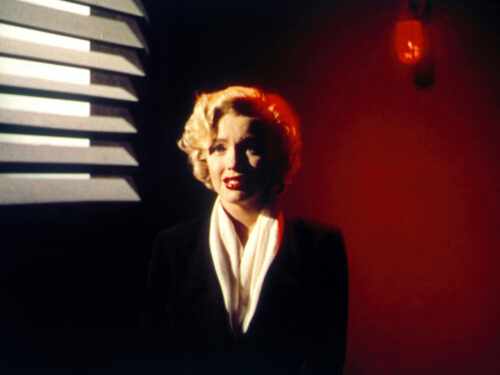
Niagra (1953 Henry Hathaway dr. With Marilyn Monroe)
“Curiosity is better described as risk, with all that implies; and that implies not knowing what it implies.”
Adam Phillips (Is Curiosity Good for You, LRB 2026)
“Dream time, time expressed as a spatial network, rhythm—these are the elements that compose the theatre in which dreams are enacted.”
Salomon Resnik (Mental Space)
“…certain that human laughter is intimately connected with the accident of an ancient fall, of a physical and moral degradation.”
Charles Baudelaire (The Essence of Laughter)
“According to the Nazi director of broadcasting, writing in 1935, the “sacred mission” of television was “to plant indelibly the image of the Führer in the hearts of the German people.”
Jonathan Crary (Tricks of the Light)
I have been wondering at how dreams change as we age. My own dreams increasingly have taken on a quality of great visual clarity, but one of emotional ambiguity. Milton Kramer writes “As the dreamer ages, characters in the dream decrease, the dreamer is less likely to be the center of the dream action, and there are more family characters in the dream report. Social interactions in dreams are more commonly aggressive then friendly and least common are sexual interactions.” ( Milton Kramer Dreaming and dreaming disorders in the elderly). The problem is, for me, not one of those things is true. I remember my dreams far better today than ever. I am nearly always now the center of the dream action. Social interactions in my dreams have always been aggressive, largely. And even today I feel there is a sexual component to nearly all my dreams.
But also I find a very specific quality occurring in my dreams as I age, a quality I associate with texture. And I wonder that this is exactly because of my age. My experience now fills in certain parts of the dreamscape. And my sense is that my dreams now, over the last ten years say, are richer in detail, at least in detail of a certain kind. Earlier dreams were often very vivid, sort of a 1950s saturated three strip Technicolour. (See as a prime example the 1953 Marilyn Monroe film Niagra) Interestingly these early 50s colour films are often referred to as hyper realism or artificial — and this raises a couple other questions.
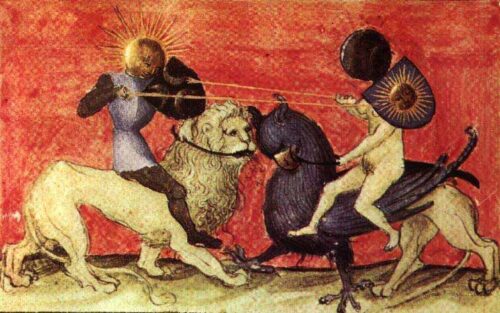
Aurora Consugens illustration (1430)
Dreams are, in theory, the product of the unconscious. And few would probably associate the unconscious with realism. But why is that? What do these words mean? One might substitute naturalism for realism and maybe that’s a bit better, but its largely kicking the can further down the road. David Batchelor has a wonderful book called Chromophobia, which is probably more profound than even he realizes.
“There is a kind of white that is more than white, and this was that kind of white. There is a kind of white that repels everything that is inferior to it, and that is almost everything. This was that kind of white. There is a kind of white that is not created by bleach but that itself is bleach. This was that kind of white. This white was aggressively white. It did its work on everything.”
David Batchelor (Chromophobia)
This is from a family of whites often used in museums and galleries. He later quotes from my favourite book…
“Is it that by its indefiniteness it shadows forth the heartless voids and immensities of the universe, and thus stabs us from behind with the thought of annihilation, when beholding the white depths of the milky way?”
Herman Melville (Moby Dick)
The problem with the use of terms like naturalism or realism is that nobody knows what they mean. The way we experience the world around us is neither natural or artificial. It is something else. Human perhaps. People will say artificial is that which is not found in Naturre but this only opens a whole other can of worms.
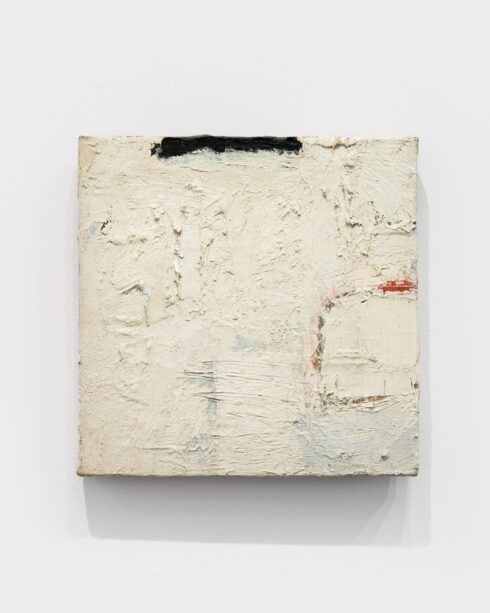
Robert Ryman
The colours in my dreams have changed over time. I dream darker landscapes of the mind these days, and often figures move in near darkness. This is not to say I ever dreamt in Technicolour, but there has been a pronounced change.
“Adorno wrote in Aesthetic Theory: ‘At the present time significant modern art is entirely unimportant in a society that only tolerates it. This situation affects art itself, causing it to bear the marks of indifference: there is the disturbing sense that this art might as well be different or might not exist at all.’ And: ‘Aesthetics, or what is left of it … can no longer rely on art as a fact. If art is to remain faithful to its concept it must pass over into anti-art, or it must develop a sense of self-doubt that is born of the moral gap between its continued existence and mankind’s catastrophes, past and future.’ Adorno’s remarks were published a couple of years before Stella said his piece on the radio. I can’t imagine that they knew anything about each other, but the two sets of remarks have something in common. They were spoken with different voices, among different contemporaries and to different audiences, but they say something similar about the importance, or the unavoidability, of doubt.”
David Batchelor (Ibid)
This is a profound paragraph. Doubt is hugely significant and yet rarely discussed. Stella’s remarks (I have quoted before on this blog) were “I knew a wise-guy who used to make fun of my painting, but he didn’t like the Abstract Expressionists either. He said they would be good painters if they could only keep the paint as good as it is in the can. And that’s what I tried to do. I tried to keep the paint as good as it was in the can.”
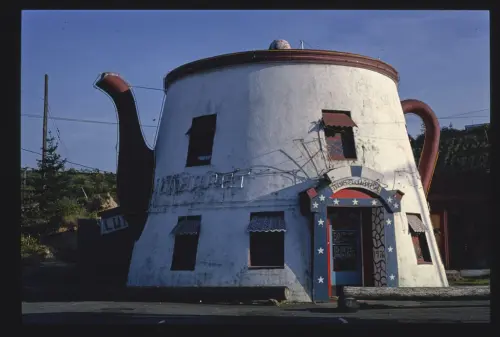
John Margolies, photography (Tacoma 1979)
And allow me another quote from Batchelor here…“Not pure art, but not the end of art, either. Not elevated, detached and exclusive, but not the ‘sublation of art into the praxis of life’. Rather, something between these absolutes, something less certain of its self and of its place in the world. ” This connects to ideas about dreaming. We don’t control our dreams. Our dreams dream us. And that art, and really culture overall, must find a space between extinction and exclusivity. And I have felt this for a while. Audiences feel uncertain about their own feelings vis a vis artworks. And this is partly a result of an age of marketing and consumerism, where everything is being sold, everything is a commodity — and how to escape this sense of commodification which has grown to the extent that people are, in many cases (see social media) selling themselves. Increasingly people see themselves as a brand.
And branding exists in the age of digitalized colours. These are industrial colours, they are vivid and (probably) vulgar by most standards, and they are urban and decidedly non natural (sic). And presumably more people today dream in industrial colours. What affect this has on the meaning of dreams, or on dream formation is an interesting question.
“Flat and often shiny. Flat and shiny: this is one of the paradoxical attractions of commercial paints and materials: the double quality of the dead and the dynamic, the bland and the brilliant. A shiny surface gives depth to flatness at the same time as it emphasizes that flatness. But it is a kind of depth which is entirely the opposite of the atmospheric depth of traditional easel painting. This is an inexpressive, mechanical depth. It is not psychological or emotional, at least not in the traditional sense, not deep and not heavy. Indeed, any light-reflecting surface will always convey lightness (which is why mirrors can feel abnormally heavy when they are carried). A shiny surface also reflects not an imaginary inner world but an actual external space, the contingencies of the environment in which the work is situated: the viewer’s space. But it is vivid, nonetheless. It is sharp, hard and live, in a vulgar kind of way, and its vulgar sharpness is part of its attraction.”
David Batchelor (Ibid)
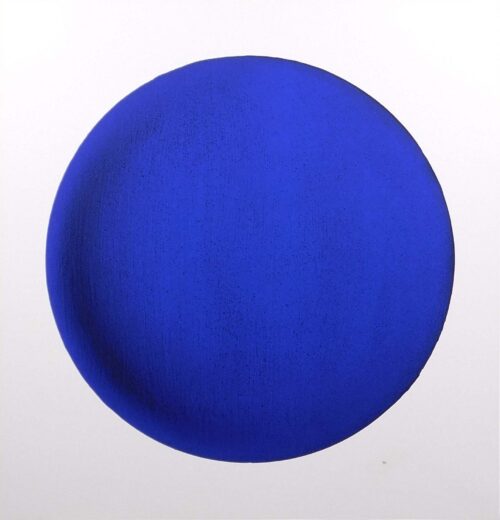
Yves Klein
“The mirror, however, is an appropriate metaphor when we refer to the development of imagination. For Winnicott (1958b), the first mirror we know is our mother’s face when we look into her eyes; it is a very special mirror in that it reflects not only the baby himself, but also what the mother is feeling. For Melanie Klein, the creation of an imaginary world (psychic reality) is in itself a relationship experience, and the transference originates in such infantile experiences in the early stages of development (Klein, 1952). The term “transference”, as I have pointed out, takes on a specific meaning in the psychoanalytic setting, precisely because of the fact that it has to do with relationship. It is for this reason that in psychoanalysis the concept of mental space is not synonymous with internal world; it includes the external world and interpersonal communication with others.”
Salomon Resnik (Ibid)
This is a telling paragraph. First, in terms of the ubiquity of screens today. People look at smart phone screens a good deal more than each other. Second, I think our dreams construct spaces (and colours) that exist in a relationship with the world around us, but also with parts of the unconscious that are archaic. It is possible, or even likely, that whatever I am identifying as archaic is also embedded in some fashion in contemporary non imaginative life. Or rather it is embedded in unconscious ways — the archaic is like a triggering mechanism. And to return to three strip Technicolour film, the creation of this hyper vivid saturated colour was only possible because of its opposite. At the time black and white TV was an emerging technology and earlier film had been black and white as well. And black and white film was to begin its journey into an honorary whiteness. The colours, industrial colours, non atmospheric colours, was a kind of judgement on black and white.
Smart phone photography can take in more light than the human eye (why certain low light events look better on your smart phone). Now this probably has an effect on the dreams of the elderly (sic) where the rods and cones in the eye are degrading. I suspect I am dreaming more low light landscapes now because during the day (night) I see less. In low light in general the eye prioritizes motion and shape. NOT colour. Now dedicated cameras use ‘raw format’ that allows for later editing, and simply, presumably, records what is there. Smart phones use AI, and as I have written of before vis a vis space cameras (the James Webb Space Telescope et al) the image is at least partially manufactured according to what engineers imagined should be there. There is also a discussion to be had regarding LED lighting. I strongly feel that LED has ideological implications. We return to ‘white’ as a topic again. LED light is authoritarian, it is sanitizing and hermetic. It is the logical conclusion to lighting the Spectacle.
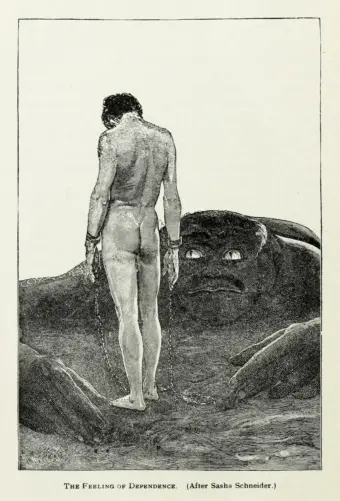
Paul Carus (illustration for History of the Devil, 1899)
“ T.J. Clark has made one of the most influential contributions to a historical understanding of spectacle. In his book The Painting of Modern Life, he uses the images of Edouard Manet to identify the conditions of possibility for its emergence. Writing about the 1860s and ’70s, Clark explores the inseparability of Manet’s art from a newly emerging social and economic configuration. This society of the spectacle, he writes, is bound up in “a massive internal extension of the capitalist market—the invasion and restructuring of whole areas of free time, private life, leisure and personal expression.… It indicates a new phase of commodity production—the marketing, the making-into-commodities of whole areas of social practice which had once been referred to casually as everyday life.” In Clark’s chronology, then, the spectacle also coincides with the rise of late nineteenth-century Western imperialism, that is, with two parallel expansions of a global marketplace, one internal, one external. Although he rightly calls “neat temporality” impossible, he does sees elements of the spectacle taking shape in the late 1860s and ’70s, citing the emergence of commercialized aspects of life and leisure that are themselves due to a shift from one kind of capitalist production to another. This shift, he says, was “not a matter of mere cultural and ideological refurbishing but of all-embracing economic change.”
Jonathan Crary (Tricks of the Light)
Crary points out that Debord (in an aside, really) remarked the late 1920s as the birth of the Spectacle. Forty years after Clark’s suggestion. Both are true in a sense. Crary also notes that the late twenties on into the early thirties saw the arrival of fascism. I think this is a perceptive observation.
“ Goebbels also introduced the airplane into politics, making Hitler the first political candidate to fly to several different cities on the same day. Air travel thus functioned as a conveyor of the image of the leader, providing a new sense of ubiquity. As part of this mixed technology of attention, television was to have played a crucial role. And as recent scholarship has shown, the development of television in Germany was in advance of that of any other country. German TV broadcasting on a regular basis began in 1935, four years ahead of the United States.”
Jonathan Crary (Ibid)
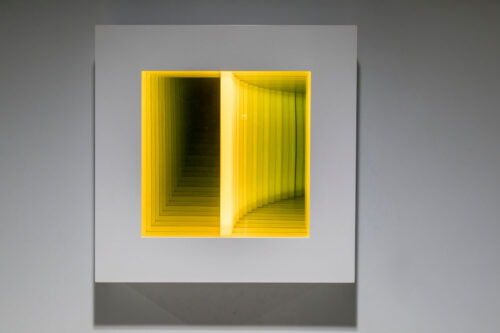
Chul Hyun Ahn (SCAD Atlanta – Fall 2017)
Both Debord (in his 1988 remarks on the Spectacle) and Foucault stress the panopticon model for authoritarian capitalism. And while this is clearly true, I think the missing element here in 2026, is the stagnation of surveillance technology. I’m a minority voice in this, but most of what I see in surveillance tech doesn’t work. There is certainly more of it, and it costs more, but it also breaks down more often, and even when it doesn’t there are more mistakes. And the increased role of AI looms as hugely problematic. AI largely doesn’t work, at least as advertised. And I suspect one of the consequences of these errors is going to be, and already is in many cases, a fallback position of more brutal repression from the state.
The debacle of the US military aggression against Iran is an example of technologies’ shortcomings. The more complex the tech the more difficult it is to fix. The more dependent on spare parts and technicians everyone becomes. And the failures of Capitalism’s need to expand, and to progress, even if their information and training is poor.
“The Taoist Zhuangzi classic offers a fascinating story on this topic. A scholar named Zigong, while traveling, notices an old man working in a garden digging trenches, repeatedly going over to a well and returning with a jug full of water. “There’s a machine,” Zigong tells the farmer, “which could irrigate a hundred plots like yours in a day. Would you, good sir, like to try one?” The farmer shows some initial interest, and Zigong explains to him how it works. Suddenly, the farmer’s face flushes, and he retorts: “I’ve heard that where there are machines, there are bound to be machine worries; where there are machine worries, there are bound to be machine hearts. With a machine heart in your breast, you’ve lost what was pure and simple; and the loss of the pure and simple leads to restlessness of the spirit. Where there is restlessness of the spirit, the Tao no longer dwells. It’s not that I don’t know about your machine—I would be ashamed to use it!” This colorful story highlights a deep-rooted mistrust of technology, driven not necessary by a reactionary fear of change but by a worldview that values, above all else, harmonization with the Tao in all one’s activities.”
Jeremy Lent (The Patterning Instinct)

Graciela Iturbide, photography
Lent notes two discoveries of the Chinese, stirrups and gunpowder. Neither had any appreciable impact on Chinese society or culture, while both, once they were traded with Europe, came to be factors in altering history. It is tricky and dangerous to make too much of such stories, but its also safe to say a certain kind of mania of science and progress took over the European mind. Freud came out of Europe. Chinese thought took far different avenues; as did all Asian philosophy and practice. How are the trace elements of an archaic unconscious impacted by technology and industry? One dreams a dream of journeys, or journey — for perhaps it is always one journey — and every dream is about homesickness even for those without homes. Every dream is also a repetition compulsion (this is my opinion, though not Freud’s). And its possible that technology is the dream of a society that collectively forgot the journey. We are reminded in the West, by Kierkegaard, by Melville, by Dostoyevski and Goya — but few listen or pay attention. It is very hard not to see the Trump phenomenon in Fairy Tales or Mythology terms. Obama did almost all the same things as Trump, Hillary was as demonic as Stephen Miller, and yet Trump feels like the next step. And in part this is because (as Bly said when analysing Jack and the Beanstalk)…’we are in the realm of the Giant now.’ This is the land found at the top of the beanstalk. Obama and Bush and Clinton, America at the tail end of the 20th century and the first years of the 21st, was still climbing the beanstalk. And a danger to make too much of this distinction. Jack looked down while climbing and the genocide in Gaza was well underway, the Evangelical madness was growing, and militarism was growing ever faster. And maybe Jeffrey Epstein was the servant to the Giant. (the Giant didn’t have a servant, but never mind). For the Epstein narrative is some kind of deep allegory. Epstein was the Devil’s men’s room attendant.
“The Attis myth, which is older than the myth of the crucified God in Christianity, represents this in specific form. Attis, the beloved son of the Great Mother and himself the type of divine youth that does not grow old and decay, represents the pattern of the puer aeternus, the perenially young God, eternally beautiful, the figure which cannot suffer sadness, human restriction, disease, ugliness, and death. Like this god, most young men who have a decided mother complex feel, at some moment in their lives, that the process of life does not allow for such a state of being eternal; it has to die. In the plenitude of life, life lies ahead with its meaningfulness and splendour; but we know that this never lasts—it is always destroyed by the dark side of life. Therefore this young god always dies early, nailed to the tree, which is again the mother; the maternal principle which gave birth to him swallows him back in the negative form, and he is reached by ugliness and death. You see this sometimes in the case of a young man who should marry or choose a profession, or who discovers that the fullness of youth is leaving him and that he has to accept the ordinary human fate. Many at that moment prefer to die either by an accident or in war, rather than become old. ”
Marie-Louise von Franz (Shadow and Evil in Fairy Tales)
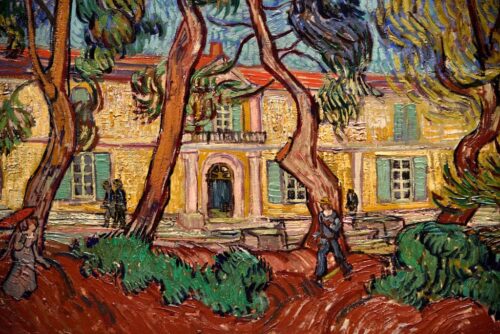
Vincent Van Gogh (Hospital of St Paul, 1889)
“…the way in which space can be seen as an expression of temporality. This is the kind of time we encounter in dreams, or in certain places—Venice, for example, where my own dream-place is. When we visit a given locality at different times of the day, we see a different scene each time; this is scenery in ample, where my own dream-place is. When we visit a given locality at different times of the day, we see a different scene each time; this is scenery in motion, kaleidoscopic dynamics, where dream time is represented by a specific organization of space—Proustian space. { } I would like to turn to the oneiroid aspects of the transference, a topic that will bring me back to the idea of analytic space and setting. I will argue that three-dimensionality is a prerequisite for a space for thinking and feeling; in the psychotic experience the problem is the loss of depth or thickness through refusal of this space (and the resultant retreat into two-dimensionality).”
Salomon Resnik (Ibid)
This is a pregnant comment these many years later — the psychotic experience is without depth. How does the screen differ from the printed page? The screen necessitates another register of engagement with narrative. Books are pure imagination, in a sense. Film and TV are also a mimetic engagement but not one that allows the temporal, or more the durational conceptual mimetic re-telling of the story. ‘You’ read the book, at your leisure, as it were, but the movie is screened — it is then screened again and again but you are somehow its servant.
“One month before this session, Maurice had lost his father; he was, in fact, very depressed, sometimes with feelings that he was as yet unable to accept as his. sometimes in a cold, psychotic kind of depression. “I’m thinking of my dead father, I can see his cold corpse. When he was alive, he was often cold, distant, absent.” A pause, then: “I see a blank space, unexpected, inside me. It makes me think of a night sky without stars. I feel flat again, turned into a strip of celluloid. I think I’ve lost my father.” True psychotics are incapable of such nuances. One of my schizophrenic patients told me at the end of her analysis: “When I think of the delusions I had, I would say that my thinking had no subtlety to it, only unyielding dogma.” I interpreted to Maurice that he had to be helped to deal with mourning and the loss of the object. What he was lacking inside was the internal presence of an absent father, a living memory, however distressing it might be. He felt deflated and needed this living presence to help him organize a space for himself to live in. An appropriate metaphor would be that of a house: how can we structure space inside if there are no columns or pillars—in other words, the phallic structuring function of a father? My term for the container-house plus central pillar is “structuring combined parents”, as contrasted with the fantasy of “persecutory combined parents” described by Melanie Klein. { } Maurice said, “I’m afraid of suffering and of finding disorder inside myself, like a mental asylum.”
Saloman Resnik (Ibid)
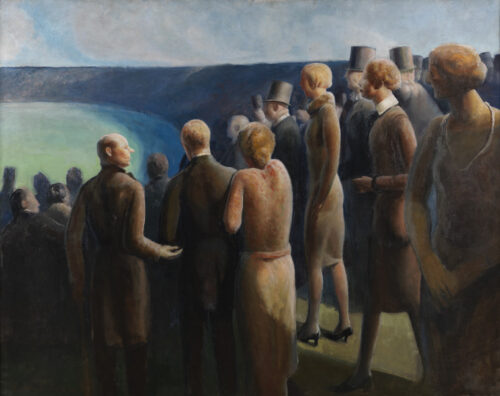
Guy Pene de Bois (1927)
“Thus the subjectivity of the subject (which Freud had managed, as it were, to bracket off) makes its reappearance in contemporary analytic theory. It returns explicitly in Pasche who gives it an existential dimension, and in Lacan, who, following the structuralist movement, insists on its impersonal character and relates its effects to those ofa non-representable set of combinations which he calls the order of the Symbolic. Elsewhere, and from different cultural perspectives, Hanmann, Jacobson, Spitz, Winnicott, Kohut, and Lichtenstein have distinguished, for varying reasons, the ego of Freudian theory from the concept of the self. But the self, which approximates the academic notion of the subject, is unrelated to the function of the subject as viewed from a structuralist perspective { } The question of the object must therefore be posed in terms of its historical evolution, since the object in psychoanalysis, the analysis of the psychoanalytic object, and the object of psychoanalysis itself are closely interrelated issues. In Freud (rg~gc) the object is part of a setting, a montage, to which it is simultaneously internal and external. It is internal insofar as it forms a constitutive element of this montage, as one of the components of the drive apparatus. For if there is a psychic apparatus, it is because there is a drive apparatus. The source, the pressure, the aim, and the object of the drive comprise this apparatus. However, the source and the pressure have a physical origin and as such are not displaceable; the displacement or the replacement of one source by another does not eliminate the problem of pressure at the original source.”
Andre Green (Private Madness)
Green rightly notes….“To be sure, Freud’s scheme of libidinal development contributed a good deal to this situation. In consequence, analytic theory began to grow rather less psychoanalytic, rather more psychological. Attention shifted from libidinal development to the development of the ego, whose relationship to reality became (ideally) equivalent to the post-ambivalent genital relationship.” This echoes a lot of what Russell Jacoby (and a scant few others) have noted. From Id to Ego. From depth to surface. From psychoanalysis to psychology, from truth to adjustment.
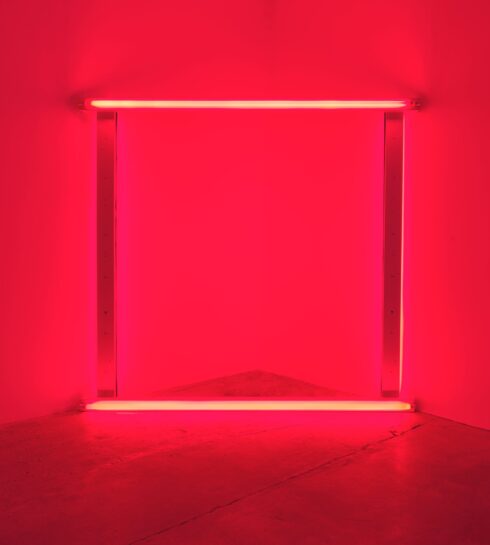
Dan Flavin
Allow me one more follow up on this topic from Green:
“It is easy to see that Winnicott has in fact described not so much an object as a space lending itself to the creation of objects. Here the line itself becomes a space; the metaphorical boundary dividing internal from external, that eitherlor in which the object has traditionally been entrapped, expands into the intermediate area and playground of transitional phenomena. “
Andre Green (Ibid)
For the purposes here, the point is about ‘space’. And Winnicott (and in another way Klein with her particular notions of projection and introjection) are finding something innate and resistant to displacement in the psyche. And it means largely the focus is on the unconscious. But this also prefigures quantum physics. Much of Freud, certainly much of the early followers work (Ferenczi, Klein, Abraham, Fenichel, Reich et al) were prophets of a sort. The analytic object is always a Schrödinger’s cat phenomenon.
“I proposed the hypothesis that the analytic situation is characterized by the fact that each of its two partners produces a double of himself. What the analysand communicates is an analogue, a double of his affective and bodily experience; what the analyst communicates is a double of the effect produced on his own bodily, affective, and intellectual experience by the patient’s communication. Thus the communication between analysand and analyst is an object made up of two parts, one constituted by the double of the analysand, the other by the double of the analyst. What is called the ‘therapeutic alliance’ or ‘working alliance’, which I prefer to call the analytic association, is, in my belief, founded on the possibility of creating an an analytic object formed by these two halves. This corresponds precisely to the etymological definition, in Robert’s Dictionary, of a symbol: ‘an object cut in two, constituting a sign of recognition when its bearers can put together the two separate pieces’. In my opinion this is what occurs in the analytic setting. The analytic object is neither internal (to the analysand or to the analyst), nor external (to either the one or the other), but is situated between the two. So it corresponds exactly to Winnicott’s definition of the transitional object and to its location in the intermediate area of potential space, the space of ‘overlap’ demarcated by the analytic setting. When a patient terminates his analysis, it is not only that he has ‘internalized’ the analytic interplay, but also that he can take away with him the potential space in order to reconstitute it in the outside world, through cultural experience, through sublimation and, more generally through the possibility of pairings or (let us rather say) of coupling.”
Andre Green (Ibid)
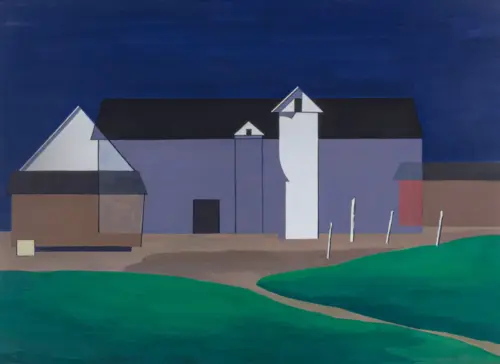
Charles Sheeler
Forgive me another quote here from Green… because I think this is relevant:
“This structure, which invokes the notion of the double, must also make room for the absent. The absent one in analysis is none other than the analyst’s own analyst1 – which goes to show that analysis always proceeds across generations. As I said before, even if it is his first analysis, the analyst has already been analyzed. In the analytic inter- play, the absent metaphorically represented by the analyst’s analyst is connected with two other modes of absence: that of past reality, in- accessible as such both to analyst and to analysand, and that of an equally inaccessible present reality.”
Andre Green (Ibid)
The absent one relates to narrative, too. To the idea of endings and resolution, and recuperation. Again, why Fairy Tales are so useful for understanding dreams. The entertainment industry cannot abide a story with an absent voice — the culture industry must de-mythologize its product. The reliance on formula is a way to sanitize the narrative of the uncanny. And I wanted to return to this idea of ‘doubt’ again quickly. For doubt is, or should be, built into our writing — since theoretically this blog is about aesthetics. Doubt is what allows for the Schrödinger’s cat aspect. Writers like Kafka and Dostoyevski foregrounded doubt, they made it into the theme of their writing in many ways. There is so much we cannot know, which begs the question of wanting to know. Of curiosity. Adam Phillips has a nice essay in the current London Review of Books on curiosity. Careerism discourages doubt. And careerism is a genuine plague today. Careerism is the Ouroboros of contemporary life, and it has an ideological role, too. Trump is the first president (because of senility, mostly) who free associates at press conferences. He is like an absurdist play, Pere Ubu or Ionesco. And Ionesco was a devout anti-fascist it should be noted.
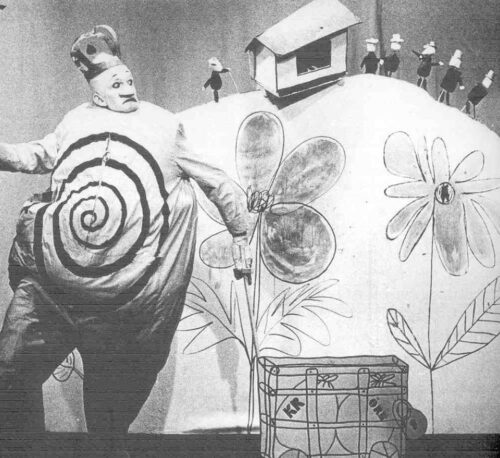
Ubu Roi , by Alfred Jarry(Jean-Christophe Averty dr. French TV 1965)
“There is nothing more conventional, in a sense, than our curiosity; or rather, there is nothing more conventional than our official and admired curiosity, the curiosity legitimated by our parents, education and the cultures in which we find ourselves. Through the method of free association, Freud’s psychoanalysis revealed the sheer scale of unconscious censorship that the modern individual was subject to, and in a sense, victimised by (the most powerful and insidious forms of censorship being those that we do not regard as censorship, but think of as merely the way ‘we’ live). Be curious, Freud suggests, about what you have been discouraged from thinking and feeling about yourself and other people; but be curious in the full knowledge that you can never know beforehand what the effect of following your curiosity will be. Or you can rationalise, legitimate and justify this belief in curiosity, as Freud seems to do, by saying that, as a scientist and a doctor and a willing heir of the Enlightenment, it is in the service of the cure – our curiosity is good for us. And yet Freud was notably reticent, when he wasn’t implicitly or explicitly defending psychoanalysis, about what exactly curiosity might be good for. We haven’t been interested in ourselves, but only in disciplining ourselves; we haven’t been curious enough about our curiosity.”
Adam Phillips (Ibid)
To donate to this blog (and to the Aesthetic Resistance podcasts https://aestheticresistance.substack.com/
use the paypal button at the top of the page. Support is appreciated.
Speak Your Mind