


William Mortensen, photography
“Tarrou agreed he’d predicted a disaster, but reminded him that the event predicted by him was an earthquake. To which the old fellow replied: “Ah, if only it had been an earthquake! A good bad shock, and there you are! You count the dead and the living, and that’s the end of it.”
Albert Camus (The Plague)
“The Trump presidency can be understood in its totality through an examination of the administration’s cosmetic surgeries.”
Stan Goff (Plastic Surgery Politics)
“I have killed lots of Arabs in my life and there is nothing wrong with that.”
Naftali Bennett (Speech to Knesset, 2015)
“There were eight of us in the cell, and all of us in a state of panic and paranoia. There was complete loss of appetite, hallucinations. I saw blood pouring from the walls, and the boys turning into skeletons right before my eyes, and the camera later turned into a dogʼs head. I felt like I was going crazy.”
Whitey Bulger (Interview regarding his participation in MK-Ultra LSD experiment in The Atlanta Federal Prison)
“The human subject is bewitched by the idea of its own freedom as if by a magic spell.”
Theodor Adorno (History and Freedom)
I have had a growing sense of a cultural tipping point having been reached. I began to feel this unease probably a decade ago, or more, but it has been growing more acute this last two or three years. The Gaza genocide is certainly a foundational aspect of this feeling but it is also the entire Epstein files story and my growing sense of an MKUltra like project that is embedded in it all. And all the ritual kitsch Satanist imagery actually masks something far more sinister, though I cannot, admittedly, explain this in any reasonable way (as if child trafficking and the sexual abuse of children and massive blackmail schemes is not sinister enough). This was a week in which Christa Pike survived two lethal injections that were meant to kill her. A part of another American ritual, that of Capital Punishment. The state now must decide what to do with Ms Pike. In the same week Secretary of Defense (er, War) Pete Hegseth, announced that the paraplegic mass shooter from Ft. Hood was to be shot by firing squad and that this execution was going to be televised. There was also a press conference, or Oval Office photo op that featured Susan Dell, wife of billionaire tech mogul Michael Dell. And Ms Dell’s appearance birthed a thousand memes on social media. And not without reason. For Susan Dell appeared as the most extreme example (or one of them) of the so called ‘Mar a Lago face’, the exaggerated cosmetically achieved signifier for MAGA wealth and status. Only Ms Dell exhibited something more, the same sense of ‘more’ I referred to in relation to the Epstein files (and Michael Dell was a member of Epstein’s inner circle). Ms Dell looks traumatized more than just mutilated. There was something deeply disturbing in Susan Dell’s appearance, something that transcended just self mutilation. And even if Ms Dell’s ‘look’ was part of the twisted codes of status in America today, the fact that these codes include the appearance of deep trauma is itself a kind of allegory.
Rebecca Purdum
A whole host of questions arise in relation to all the public events just listed. The first question is the alleged Satanic rituals involving the very wealthy inner circle surrounding Epstein. Rituals that include cannibalism and toture (one rumour is an alleged tape of Hillary and her girl-toy Huma Abedin, that involves the skinning and raping of a child. Said video was allegedly found on Anthony Weiner’s laptop and there are allegedly NY police officers who have seen it). I will only add that this particular rumour has a lot of traction and at some point this story will surface again. And since I have no particular access to any of the insiders involved I won’t dwell on the particulars here except to say that even having a rumour such as this circulate to this degree is by itself deeply alarming. And such alarm is what I meant at the top of this post when I referred to a ‘tipping point’. For clearly Epstein is not a mirage. There are core facts involved (such as former Israeli Prime Minister Ehud Barak visiting Epstein regularly and the mountain of allegations against him including rape of children) that feature a number of celebrities and billionaires and politicians. And one has the feeling that the public at large do not, at this point, quite know what to do with this information. There is constant demand to make the files public but I sort of doubt that will ever happen. EVER. There is too much power contained in those files.
But what I do feel I can write about is the cultural state of contemporary America in light of all this. And when I say that I mean a kind of broad philosophical autopsy of ‘American’ life today. I was listening to an old speech of the late Christopher Hitchens this week. In it he referenced Reinhard Gehlen, the chief of intelligence for Hitler, who ran the intelligence service for Nazi Germany for five years, and who later worked closely with the CIA and headed up the post war Gehlen Organization (OG). Hitchens said something uniquely evil entered into Western society by way of incorporating this high ranking Nazi. Gehlen had ties to the formation of NATO as well. His knowledge of the USSR drove U.S. intelligence to use his services in their rabid hatred and fear of communism.

Reinhard Gehlen
“…from the Times, which didn’t say how it knew, but one was glad to have it. Since it was the CIA which arranged the hiring of SS General Reinhard Gehlen and Klaus Barbie to supervise its Cold War discipline, which organised the arrest of Nelson Mandela, the Phoenix programme in South Vietnam, the military coup in Greece in 1967, the arming and financing of Fascist elements in Italy and Japan, the mass murder of the Left in Indonesia and the deployment of death squads in El Salvador and Guatemala, to say nothing of its open collusion with the Mafia and the narco-underworld in the United States itself, I don’t know that journalistic association with it (of the kind undertaken by Sir Peregrine Worsthorne) would be anything to brag about, or indeed anything to condone. And Peter Wright and his associates confirm what is known from other sources – that British secret policemen did place themselves at the service of a foreign power in the attempt to destabilise an elected British government. Mr James Angleton may not have been – was not, in my opinion – as foul as the men of Dzerzhinsky Square. But the point of protesting about ‘moral equivalence’ is surely not to blur moral choices on ‘our side’. Is it?”
Christopher Hitchens (London Review of Books, 1995)
That the U.S. ruling class never disliked National Socialism is hardly debated at this point, but Hitchens is certainly correct that the wholesale rehabilitation of former Nazis for service in western governments and business (and Academia) was to inject something particularly amoral and obscene in Western culture. Of course the absence of a moral compass was already well established in the times of the ‘Indian Wars’ (sic) and the indelible racism that tainted nearly everything both of a macro and micro aspect in the daily life of this former slave owning society, but these former Nazis made more solid and tangible the transgressive quality of American society. And Hitchens also rightly saw what Reagan represented…

Guido Mocafico, photography.
“I still remember the irritation I felt at my own emotion when Reagan last summer made his D-Day anniversary speech in Normandy. I knew that I was being got at, but I swallowed and blinked all the same when he asked the assembled leathery veterans: ‘Where do we find such men?’ I might have been better-armoured had I recognised the line from The Bridges at Toko-Ri. Likewise, in the New Hampshire primary debates in 1980, when Reagan upstaged his rivals by chirruping, ‘I’m paying for this microphone,’ few of those present recognised the plagiarism of Spencer Tracy’s State of the Union. All the President’s lines – but not all of them so subliminal. Launching his latest nuclear fantasy, he told the press corps that ‘The Force is With Us.’ Then, rather oddly, he complained at having his ‘Strategic Defence Initiative’ nicknamed Star Wars. Defending his inventive tax-reform bill, and challenging the Democrats to make something of it, he gurgled: ‘Make my day!’ But comparisons between his style and that of Dirty Harry are daily discouraged by a pained, overworked White House press office. The apotheosis of all this (‘Where’s the Rest of Me?’ ‘Let’s Win This One for the Gipper!’) came, Rogin believes, in 1981. ‘To confirm the President’s faith in the power of film, John Hinckley, imitating the plot of the movie Taxi Driver, deliberately shot the President on the day of the Academy Awards.’ It so fell out that Reagan had already recorded a breezy, upbeat salute to the audience at the Oscar ceremony: ‘the television audience watching a screen saw a Hollywood audience watch another screen. One audience saw the other applaud a taped image of a healthy Reagan, while the real President lay in a hospital bed.’”
Christopher Hitchens (London Review of Books, 1985)
Reagan literally did not know the difference between his screen life and real life. Trump does, but he has no real movies to poach from. So in a sense Trump is pretending to be IN a movie. Susan Neiman’s recent book looks at this idea of Evil, which is really what I think I am writing about. She quotes Adorno and then comments on the quote …
“The house is gone. The destruction of European cities and the concentration camps merely continued the processes that the immanent development of technology decided for the houses long ago. ‘It is part of my happiness not to be a homeowner,’ wrote Nietzsche in The Gay Science. One must add today: it is part of morality not to be at home with oneself.”
Theodor Adorno (Minima Moralia)
“Most important notes of the Critical Theory developed by the Frankfurt School were sounded here. Auschwitz was the completion of a process inherent in the modern, not a departure from it. Through that process we lost something too deep to be entirely fathomed. It’s a process in which we are always complicitous, if not entirely responsible. Nothing in Western culture is untouched by it; ”
Susan Neiman (Evil in Modern Thought: An Alternative History of Philosophy)

Luca Signorelli (Deeds of the Anti-Christ. 1505 detail)
There is always a temptation in such discussions to create hierarchies of Evil. A competition between transgressions. The colonial era saw much worse genocides than the (so called) Holocaust. Look at Tasmania and German South Africa, as well as Native American tribes, and we have the genocide of the Armenians, and it is difficult not to create tiers in your head. But Adorno and Horkheimer were escaping from horrors of the Third Reich. It was personal. And they were critiquing Enlightenment values and beliefs, with the wisdom to do so dialectically. That the reason hailed by Enlightenment thinkers also carried within a deep scalding form of unreason. An unreason that was not only pagan and rife with superstition, but also dangerously irrational.
And Frankfurt scholars were the first to acknowledge Nietzsche’s influence in this area. The battle over the very idea of transcendence is one borrowed (to a degree anyway) from Nietzsche but repurposed with Adorno and Horkheimer.
“The spectacle has two main foundations: “incessant technological renewal” and the “integration of State and economy.” And in its most recent phase it has three main consequences: “generalized secrecy; unanswerable lies; an eternal present” .
Guy Debord (Commentary on Society of the Spectacle)
This was written in the eighties. Now, besides the obvious prescience of this formula, it points to the unique quality of unease experienced today — for as Anselm Jappe notes in his very good book on Debord: “The spectacle is thus not a pure and simple adjunct to the world, as propaganda broadcast via the communications media might be said to be. Rather, it is the entirety of social activity that is appropriated by the spectacle for its own ends.”

Hans Emmenegger
Everything, in other words, becomes *spectacularized*. And violence is front loaded in today’s spectacle. ICE agents video taped on smart phones, and domestic police the same, with added footage from body cams. Entertainment runs on images of violence although that has evolved into another category akin to the ubiquity of porn. In fact violence and porn have almost merged and certainly have overlapped for a while now.
And the Gaza genocide was again the quintessential example of this — the videos made by IDF soldiers were operatively very close to porn videos. The voyeuristic objectification of Palestinians feels like much of the porn made today (by companies owned by Israelis, unsurprisingly) and the sadism directed toward women.
So, generalized secrecy; and here I think most people are unaware of just how secret is much of the world. Just something as banal as where electical lines run through your city. This in addition to the actual management of daily life, the decisions and policies. Unanswereable lies: look no further than the government. The US government lies about literally everything. And an eternal present; well, yes, the erasing of history is done in part to facilitate this sense of ‘now’ — a cornerstone of marketing. As an aside I want to mention the Hans Emmenegger painting above. I love this painting. Emmenegger is best known for his studies of forests, mostly in shadow, on vertical canvases, but also still lifes and a number of landscapes. The above work is from 1918. It’s funny how a small sort of minor work can so capture one’s imagination. I ponder that lit window at times, and also the very Fritz Langian perspective on the building. End aside.
Evil. I have always avoided the word. I think most people acquainted with philosophy tend to avoid it, actually. In general popular usage, of course, it is wildly overused. But in the week of continuing Zionist terror, of a botched execution of a woman, one whom had been on death row for decades, the promise of a US government snuff film, AND the appearance of Ms Dell, I am feeling a lot more comfortable with the idea of *evil*.
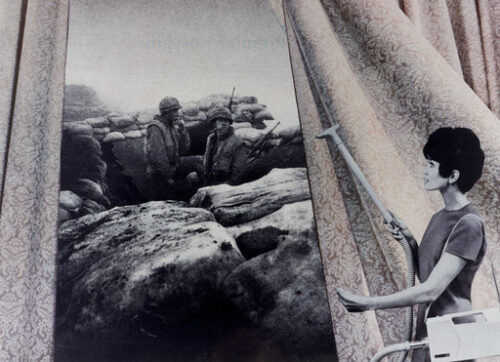
Martha Rosler (1967)
“These terms, countersubversive tradition and political demonology, are not in common discourse. I use them to call attention to the creation of monsters as a continuing feature of American politics by the inflation, stigmatization, and dehumanization of political foes. These monsters—the Indian cannibal, the black rapist, the papal whore of Babylon, the monster-hydra United States Bank, the demon rum, the bomb-throwing anarchist, the many-tentacled Communist conspiracy, the agents of international terrorism—are familiar figures in the dream-life that so often dominates American politics.”
Michael Rogin (Reagan; The Movie)
I think Rogin’s basic insight is worth a quick revisit in light of the Trump presidency, but more than just Trump and his particular MAGA mafia, these ideas run through the entire culture.
“American demonology has both a form and a content. The demonologist splits the world in two, attributing magical, pervasive power to a conspiratorial center of evil. Fearing chaos and secret penetration, the countersubversive interprets local initiatives as signs of alien power. Discrete individuals and groups become, in the countersubversive imagination, members of a single political body directed by its head. The countersubversive needs monsters to give shape to his anxieties and to permit him to indulge his forbidden desires. Demonization allows the countersubversive, in the name of battling the subversive, to imitate his enemy.”
Michael Rogin (Ibid)
The idea of an American demonology is pretty insightful. And today you have David Icke and his followers who believe reptilian alien forms have made a secret pact with the U.S. government. Even Tucker Carlsen has said he believes this. This idea can trace its roots back to the early cold war. And again, MKUltra is relevant here. Reagan warned Nicaragua, if it became a Communist outpost, would drive millions of people in South and Central America across the border into the U.S. That countries like Brasil and Honduras and Bolivia would turn communist. It is interesting that today Israel is colonizing all those countries, or trying to, to prop up today’s ‘countersubversive’ front. Trump is really the legatee of Reagan, a point not noted nearly enough. The fear of communism, by the 1950s, was already an apocalyptic struggle. Today’s lizard like aliens are part of the anti-communist mythology. And hence ‘evil’. In American discourse the religious manichean struggle is always just barely beneath the surface.

Hieronymous Bosch (The Garden of Earthly Delights, detail)
Now it may well be that Trump’s single biggest mistake, politically, is in destroying and selling off the National Parks. For Rogin rightly points out the idea of ‘nature’ in the American cosmology looms very large. Westward expansion (and the removal of Indian tribes) was infused with a sacred justification; that of preserving American nature. Andrew Jackson is one of Trump’s favorite icons, though he clearly has learned nothing from him. For Reagan, as for Bush Jr., the ‘West’ was a symbolic abstract idea, closely aligned with religious belief. It was also the West of the cinema. This was the birth of making your own movie. The expansion was the core of American Exceptionalism. Trump has lost that thread, too, if he ever had it, really, and his cynical insider deals, especially the selling of parkland, will I believe backfire (if it hasn’t already). Disenfranchised white men see hunting (and guns) as their last refuge from the disrespect urban American has for them (see the ruling class and the haute bourgeoisie).
“Lincoln characterized his presidency, Nixon reminded us, by the violations of law necessary to save the Union. But his speech to the Young Men’s Lyceum at the outset of his political career warned against the tyrant who would violate the law and destroy the Union. Our “fathers,” said Lincoln of the men who made the Revolution, founded a “temple of liberty.” The sons, mere “legal inheritors of these fundamental blessings,” had to maintain it. The great man, however, “denies that it is glory enough to serve under any chief.” He will not be satisfied “supporting and maintaining an edifice that has been erected by others”; for him the temple of liberty is a prison. “Towering genius disdains a beaten path. .. . It sees no distinction in adding story to story, upon the monuments of fame, erected to the memory of others. .. . ft thirsts and burns for distinction; and, if possible, it will have
it, whether at the expense of emancipating slaves, or enslaving free men.”
Michael Rogin (Ibid)
The hatred and fear of communism has continued unabated. The MAGA movement is deeply invested in their desire to weed out anyone or anything that can, in any way, be linked to communist sentiments or beliefs, even if they only very vaguely have any idea what those beliefs are. The precursor for this is found, as Rogin does, in the Jackson/Lincoln era of American history. The religious aspect has shifted since the time of Lincoln, however. And even since the time of Reagan. And this shift has to do with the Evangelical Protestant movement in the U.S. and now more critically in Latin America. (I wrote about this here https://john-steppling.com/2026/03/the-messenger-of-god/.
The CIA has clearly been helping and funding a lot of the Pentecostal narco syndicates that are rampant in Brasil, particularly (but also in Mexico and parts of Central America). The tentacles of the CIA have never diminished even if their visibility has been lowered. But Evangelicals do not have the same reverence for Nature that Purtians did. The Evangelicals are (per Debord) ‘spectacularized’ Protestants. Their piety is for success and grandiose presentations of virtue. Success means money. And perhaps most significantly the Evangelical movement is acutely almost insanely racist.

Rafal Milach, photography
“It was the Church Committee’s report in April 1976 that brought MK-Ultra to public attention. The programme, which ran from the early 1950s through to the mid-1960s, had investigated forms of mind control that might be deployed on civilian populations. A particular interest had been taken in LSD, which was tested on such ‘expendable’ populations as prisoners and refugees, on the general public and, extensively, on the programme’s own agents. Many of the subjects were dosed without their knowledge or consent – including Frank Olson, who had ‘leaped to his death’ in ‘what appeared to be a serious depression’ after his Cointreau was spiked with LSD at a CIA retreat. The Church Committee concluded that the full extent of MK-Ultra’s work, especially outside the US, would never be known, since records of it had been destroyed. As it turned out, however, there was much more to come. In the late 1970s, John Marks, a journalist who specialised in intelligence matters, filed a Freedom of Information request that uncovered a trove of 16,000 documents, most of which hadn’t been sent for shredding because they were filed as financial records. In the course of examining thousands of invoices and bills of sale, Marks and his team of researchers unearthed some unexpected gems. The diary of George Hunter White, a dead Federal Bureau of Narcotics agent, was particularly startling. White had worked as Gottlieb’s fixer in the underworlds of New York and San Francisco, conducting drug experiments on unknowing subjects in brothels or at parties he held in CIA safehouses. In his diary, White wrote frankly about the corruption, drugs, sex and violence in which he happily participated: ‘Where else could a red-blooded American boy lie, cheat, rape and pillage with the sanction and blessing of the All Highest?”
Mike Jay (Lace the Air with LSD, LRB)
So how to see this new fascination with lizard people, and with the more reality based ideas of Epstein-ian MKA-Ultra like programs?There is a feeling of rabbit holes inside rabbit holes inside rabbit holes. Bolsanaro Jr is set to win in Brasil. And this is purely a CIA victory (and Mossad). Pentecostal/Evangelical sects have now amassed enormous power and credibility. The so called ‘paranoid style in American politics’ now feels almost quaint. And so much of this disequilibrium can be laid at the feel of Israel. As the actual physical state of Israel teeters on the brink of foreclosure, the Zionist deep state is running in hyper drive. Just how many honey pots are there ? I often wonder if not 20% of Israeli women are employed in extortion schemes.

Altoon Sultan
My own sense is that something of an MK-Ultra like project is ongoing, even if Epstein is gone (if he is and honestly I doubt he is dead). My sense is, too, that this is just as speculative and experimental and dysfunctional as the original version. But regardless people are now faced with an impending televised execution. And/or a third try at killing Ms Pike. And more, with a genocide that clearly nobody on the planet has the will to stop. And the arts feel besieged. Obvious crude examples (The Kennedy Center, which included Carrera marble, a gift from the Italian state in honour of JFK) is being torn down. It is a kind of symbolic act that echoes larger less concrete tear downs. Zionist billionaires have purchased nearly the entirety of legacy media. Social media is now increasingly a slop pot of AI porn-ish junk. The tech billionaires, from Thiel to Altman to Ellison to Musk are all clinically insane. Add Bill Gates to that list, too. This are hideously grotesque human beings. And maybe this bolsters the lizard people meme.
And here is a useful primer on MK-Ultra https://nsarchive.gwu.edu/briefing-book/dnsa-intelligence/2025-10-30/top-secret-testimony-cias-mkultra-chief-50-years-later
Allow me a somewhat lengthy quote from Susan Neiman…
“Even worse than blaming oneself for inexplicable suffering is the temptation to blame others. Kleist’s story “The Earthquake in Chile” describes human inability to tolerate contingency. With brilliant and poignant irony, Kleist rebuked all attempts to make the earthquake a source of meaning. In his tale, the mob that smashes a baby it holds to be born of an unholy union seeks both sense and sacrifice. Unable to accept the yawning unintelligibility of natural evil, it prefers doing evil itself. Kleist was not alone. The auto-da-fé that followed the Lisbon earthquake moved Voltaire as surely as the earthquake itself. Far better, he concluded, to live without reasons at all than to risk making that kind of mistake about them. These are pathologies that may arise from the drive to unite is and ought, and they function as warnings about its limits. { } Dostoevsky underlined the idea that the problem of evil is not just one more mystery. It is so central to our lives that if reason stumbles there, it must give way to faith. If you cannot understand why children are tortured, nothing else you understand really matters. But the very attempt to understand it requires at least accepting it as part of the world that must be investigated. Some hold even this much acceptance to be unacceptable. Thus the rejection of theodicy becomes the rejection of comprehension itself. Just this realization drove contemporary thinkers to take up the question again, in full awareness of all the reasons the twentieth century provided to abandon it forever. The moral impulse expressed in Dostoevsky’s refusal to understand is overridden by the impulse that sees no alternative. To abandon the attempt to comprehend evil is to abandon every basis for confronting it, in thought as in practice. The thinkers who returned to the problem of evil while knowing the limits of any discussion of it were driven by moral demands.”
Susan Neiman (Ibid)
Franchesco Bianchi Ferrari ( Arion riding on a Dolphin) 1509
There is convergence here (sort of) between Adorno (and most of the Frankfurt School) and Nietzsche. Now its always difficult to parse out Nietzsche in any short form manner. But since this is a particularly disgressive posting I’ll just carry on.
“…the role that pain, suffering, trauma, and the damaged in contrast to the good life–in Adorno’s sense–plays in the constitution and reproduction of power. Nietzsche explored through the figure of the priest how the traumatic results of violence are concealed and deepened through a repetition that never realizes its purpose of healing the original wound. The pain is not only unhealed, it worsens in being left unencountered. Nietzsche’s Genealogy can be read as a genealogy of the traumatic origins of the damaged life, aiming at the present by tracing the transformations of suffering and the damaged sublimations affecting human practices and institutions. Whereas trauma is sublimated such that it is repeated and heightened, genealogy is a destructuring repetition challenging compulsive repetition.”
Eric S. Nelson (Priestly Power and Damaged Life in Nietzsche and Adorno)
This summation makes clear how close Freud is, at times, to Nietzsche. On the one hand we have reptilian aliens and demons making deals with the government, but on the other we have Anthony Weiner’s laptop, we have panda eyes and emails between a wealthy class from all walks of life and Jeffrey Epstein, emails discussing child rape and cannibalism. Those emails are real. They exist. Countless people have read them and the emails come from a shockingly high number of people. The genealogy of a damaged life, of trauma, and violence. Repetition because the mind cannot really process it. Evil.
Nietzche’s idea of the birth of morality is useful here. From repayment to guilt and shame. Freud’s super ego, there to police us.

Rana Begum
“…Nietzsche unfolds a genealogy of the traumatic origins of the damaged life, aiming at the present by tracing the transformations of suffering and the damaged sublimations affecting human practices and institutions. Trauma is sublimated such that it is repeated and heightened; genealogy is a destructuring repetition that challenges compulsive repetition. The exemplar of priestly power remains—adopting Adorno’s expression that indicates an interpretive strategy for defying the reification of concepts—a “critical model” given the skirmish of rival fundamentalisms, the violence involved in the “return to the sacred” and the arbitrary authority of the divine command, and the manipulation of ethnic, ideological, and religious sentiments. The social-political uses of religion are not accidental applications; they are its essence in the skeptical hermeneutics of suspicion, as Nietzsche, Marx, and Freud illustrate in their critiques of the systematic damages done to life and consciousness through religious forces and compulsions.”
Eric S. Nelson (Levinas, Adorno, and the Ethics of the Material Other)
There is something in Nietzsche, in his radical perspectives on thinking, in the form of his thinking, that feels increasingly relevant today — that is found particularly in his very early notebooks and in Birth of Tragedy, but then most systematically in The Genealogy of Morals. Relevant partly because nothing is ever quite what it seems (or says). This is not as paradoxical as it might sound.
“The problem of ‘reading Nietzsche’, a centrepiece of Martin Heidegger’s monumental study (published in Germany in 1961), has given rise to a complex debate over whether each of Nietzsche’smany voices speaks on its own, independently of the others, whether one among them is authoritative or whether they all harmonise in expressinga single overarching way of looking at the world. The debate was joinedby the French philosopher Jacques Derrida, who focused on a sentence,'”I have forgotten my umbrella”‘, appearing (within quotation marks) in a notebook from 1881-2. Derrida argued that it is impossible to determine precisely the sense of such a sentence and suggested that not only Nietzsche’s fragmentary notes but all his writings present a similarly inscrutable face to their interpreters: ‘To whatever lengths one might carry a conscientious interpretation’, he wrote, ‘the hypothesis that the totality of Nietzsche’s text, in some monstrous way, might well be of the type “I have forgotten my umbrella” cannot be denied.’ On the basis of that hypothesis, Derrida took issue with every attempt to establish a coherent overall interpretation of Nietzsche’s work.”
Raymond Geuss (Introduction to Writings from Neitzsche’s early Notebooks)
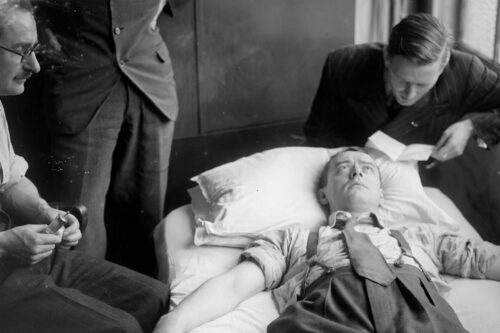
CIA ‘truth serum’ experiment. Photographer unknown.
In a world increasingly inundated with AI, with ChatbGPT and Grok (etc) and with pre-boxed platitudes and cliches (the use of cliches is increasingly horribly), and there is marketing which relies on manipulation — but eschews complexity, radical form of thought feels transcendental. There is something, aside from all else, rather therapeutic about reading Nietzsche. But this sense of complexity is found in Adorno, too, and in Wittgenstein, and the indeterminate fluidity of meaning, and the resistance to completing many works — that an ‘ending’ violated something of the meaning, that there cannot be completion in any meaningful sense and that TO complete, to define, violates deeper truths of the world around us. Quantum physics is a reflection or manifestation of this. The goal is rigour without anality. And here is the truth of dreams, as well. In dreams the dreamer does not worry about contradiction. I make my own small effort to this by way of digression, often. I have done it in theatre works, too. Never explain. Mystery invites one ‘in’. Solutions keep us out.
But then there are mysteries and there are mysteries. Secrets are often utterly without mystery.There are things hidden and there are things secret. Nietzsche insisted on a Christianity that sought the truth, and recognized the truth is always uncomfortable, and hence the need for stringent introspection. An asceticism.
“What is wrong with Christianity is that it has become massively implausible in the modern world. Or, to put it more exactly, it has destroyed itself; it is precisely those who are, in some sense, the most Christian who find themselves incapable of continuing to believe it. The reason for this, Nietzsche believes, lies in the true history of Christianity, the sources of its power and the origin of its constructs, which he has laid bare, most clearly perhaps in Genealogy of Morality. Its origins are in highly concentrated resentment; its continuing power lies in its ability to generate and focus hatred; and its characteristic habits and practices are expressions of a sadistic asceticism ( toward self and others) gone out of control. Christian introspection and truth- telling will, if pursued consistently, confirm this. And what is the (at this point former) Christian like Nietzsche then to do, when he inevitably comes to understand this? Simple continuation of the usual practices and beliefs, once they have been seen through as devastatingly as this, does not seem to be possible except perhaps for some few exceptional people who are absolute virtuosi of ascetic self- hatred and cognitive quick- footedness (say, Kierkegaard).”
Raymond Guess (Changing the Subject)

Jenny Morgan
And this is the last quality demanded, an embrace of the impossible. Guess adds ” Christianity is not primarily a sequence of propositions; rather it is a historically complex conjunction of habits, dispositions, beliefs, values, and practices which is directed at giving structure to human life and dealing with some of its less palatable aspects. So the question is less Is it true? than Does it work?”
This is an interesting proposition in today’s religious world. Pete Hegseth tells himself it works, but it most clearly does not. But then nobody would describe Pete as introspective or ascetic. The point here is one must try to make sense of this tipping point for western society. And since my concern tends to always return to art and culture, I suppose I am trying to pave both a tentative path toward ‘how’ to create in such a context, but also a path how to interpret culture today. I have asked before what would a great play look like today? What would a masterpiece look like? I don’t quite know. The second question has to do with Evil. With morality perhaps. And this is where Nietzsche is important, and Adorno. An acceptance that there is a struggle. Often between opposites. And this is our theatre. A theatre of struggle.
To donate to this blog use the paypal button at the top of the page. Donations also help support the Aesthetic Resisttance podcasts. https://aestheticresistance.substack.com/

Your point on mystery, side by side with Debord’s about the eternal present, and your previous remarks about entertainment, made me think about how difficult it is to criticize media to my peers today. Expressing criticism about a work, and most especially about a product of mass culture, is seen quite directly as a personality flaw, and this is widespread. “I go into a movie expecting to enjoy it and I usually do,” says my sister (sorry!). The implication (and often explication) is that disliking a piece of media that is “fun” or successfully “entertaining” can really only emerge from some innate sourness in the personality, or aggrandizement, that you “expected it to be a work of art.” If you have an unkind word for Spiderman 5 you were “asking too much of it,” expecting it to be good. It’s an ivory tower-fication of most any criticism, supported by a vague handwave at an innominate morass of commenters who “hate everything.” These comments support the insane belief that people in aggregate “hate everything now” or are “too critical,” when really, meaningful criticism is at an all-time low. We accept more than we ever have.
There’s also more identification with media than surely ever before. I think it happens when you are young by necessity, but as meaningful sources of adult identity shrink, people really confuse their collections of media Likes and Dislikes with their very selves. Very young people are priding themselves on consuming only uncanceled artists, unproblematic artists. And with that deep identification, criticism seems like an assault. What am I but the assemblage of my media consumption? And being that I have found such meaning in the music of Taylor Swift, you calling her an out-of-touch billionaire can be none other than a criticism of me, which can be none other than your shortcoming, of being a “hater”!
And that I think connects to this idea of mystery in art. Mystery in a work I would say is reviled, on average. Mysteries are presented only with a promise that they will be solved, on-screen, for the viewer’s satisfaction. The new Lizzie Borden dramatization on Netflix is not Ryan Murphy but his writing partner, and they may as well be the same. The first few seconds of the first episode are the axe coming down, blood spattering on our protagonist’s face, and then the other murder immediately after, presented in full glory. It’s not like anyone was in mystery over whether or not this would be depicted, but it is the ante of mass media at present. You must deliver within seconds, make good on your promise before you have even promised it. Viral media is going this way too (or rather, went that way first and the premise is being adopted by traditional media). It is popular now to put a fraction of the “money shot” as the first frame of the video, the Honda crashing into field from a crane in a Mr. Beast video or whatever. And then your viewer can tolerate the buildup, the tension, the car lifting above the earth, and so on. And that seems to me relevant to this pervasive sense of the eternal now, this need for immediacy. Mystery or ambiguity is replaced with immediacy and clarity, and your work’s “meaning” (if it is not narrated explicitly to the camera by a character) must be firm and readily available at first pass, or else you are pretentious, insulting the viewer with your ambiguity, trying to be intelligent by obfuscating your meaning.
“Here … Mr. Pivner stood, heir to that colossus of self-justification, Reason, one of whose first accomplishments was to effectively sever itself from the absurd, irrational, contaminating chaos of the past. … Reason supplied means, and eliminated ends.”
– Gaddis, The Recognitions
Excellent post, John. Another one.
I live so far away from you, in Portugal, and, keeping to the rhythm you have accustomed us to, here I am again, like someone opening the front door to see if the bread is there.
The kind of reflection that brings together historical knowledge, culture, an attentiveness to the world, and depth of thought has, for those who seek it today, an importance that seems to grow closer by the day to that of bread or water, both in its scarcity and in the vital nourishment it provides.
Some years ago, I stopped seeing in the news a once very common kind of report that would begin something like this: “So-and-so, aged however many years, son or father of such-and-such, has gone missing from his home. He suffered from mental health problems.”
Today, perhaps something along these lines would make more sense: “The home of so-and-so, aged however many years, son or father of such-and-such, has gone missing. He now suffers from mental health problems.”
Indeed, if there is one thing underlying the human drift — and, within it, the artistic drift — it is the longing for home. But your text made me think that, after Nietzsche associated his happiness with having no home, and Adorno linked contemporary morality to our inability to feel at home with ourselves, perhaps the next step in this dispossession will be precisely the theft of saudade [a Portuguese word].
For if there is no past in this eternal present, through the demolition of history and memory, then there is nothing left to long for; and saudade, as the last vestige of the very idea of home, also begins to fade away.
I hope you live and write for many years to come. On the day you no longer do, if I am still here, I will feel saudade for you.
Ah, Cointreau… that has been the working title of a novel I have been painstakingly piecing together for years …. about the very very quiet old money in Seattle, the people who couldn’t care less about Gates, Bezos, et al because they were billionaires before those 2 were born. Since most people only think of Seattle as new and tech some of these families couldn’t be more happy — of course they built the city in the 1800s and made massive fortunes in lumber, Alaska Gold Rush, shipping, mining, and then the savvy ones diversified in the 1900s and bought up all the real estate, brown fizz distribution, on and on … and they learned to be quiet. The reason for the title Cointreau goes back to a philanthropic party I attended 20 years ago at the home of one of the quietest of these families, and I accidentally got there early because I had the time wrong on my calendar, so I wind up having an unexpected impromptu conversation with the man of the house as he’s making his famous sangria for the party — staff and their chef are running around but he personally does the sangria and all the other old money families all talk about his legendary sangria. So he starts telling me about how many years and the trial and error it took to reach his pinnacle life achievement of the perfect sangria that gets talked about and he says that he knew he hit it right right when he added Cointreau. Then the recipe was sealed. Even though I was much more naive back then, I knew that when he emphasized the word Cointreau, he wasn’t talking about Cointreau or triple sec or sangria, or anything related even though the bottle of Cointreau was right there. There was something in his voice that only the initiated would pick up on. Obviously it stuck in my mind and when I mentioned this detail as a joke to a guy who was much more keen on these things at the time, my joke was that his talking up the Cointreau was his way of relating to the “average person” — see, I use a mid market triple sec just like the miserables — but this guy I told the story to said, well, you did notice the absolutely immaculate croquet lawn that is just beyond comparison, the most perfect thing you have ever seen… and what that signifies even if the upstart tech zillionaires would be lost on the symbolism if they were ever invited … it was that evening I started to learn the rules of the game, even in a quirky boom and bust town like Seattle.
first time Ive ever had Gaddis quoted to me. Few remember that book now. I should look at it again. I knew one friend who adored it and one who hated it. I never read it. Perhaps i will.
Ive been thinking on this…..great comment dre……we are but the assemblage of our media consumption. That’s quite exactly right. Identification yes but I suspect it goes even deeper. And current TV stuff is truly staggeringly stupid, and the ‘stupid’ has to be spelled out. And yes to the buzz kill accusation. The word ‘pretentious’ is bandied about quite a lot in those circles.-