


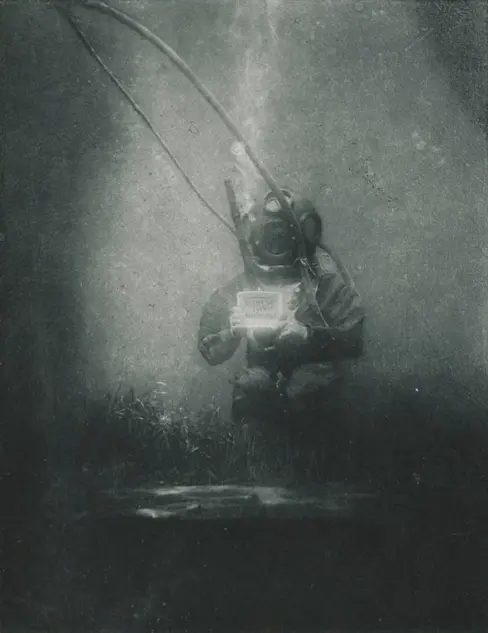
Louis Boutan, photography (underwater 1899)
“A history of the ‘world’, as distinct from a history of the unrepresented, must clearly be a history of phenomena; that is, of collective representations.”
Owen Barfield (Saving the Appearances)
“The covering over and occlusion of the discovery of the radical otherness of the unconscious and of sexuality in Freud’s thought, Laplanche suggests, trace out the movements of just such a covering over in the human subject itself.”
John Fletcher (Introduction to Laplanche’s Essays on Otherness)
“On my Right – who? The Death-Woman.
And you, on my Left, you?”
Paul Celan (On My Right)
I have been thinking a lot about pre-history, both in terms of the development and evolution of species on a planetary scale, and in our unconscious on an individual scale. These thoughts have been triggered by a sense of how people today, our contemporary culture, has lost touch with myth and with, for lack of a better word, spirituality. Perhaps my being interviewed for a documentary being made on my old friend and mentor Terry Ork (aka William Collins, Bill Terry, Noah Ford) which focuses mostly on his invention of CBGB’s and the punk scene in NYC and less on the erudite rare book collector, poet, and political/philosophical thinker I first knew. In any event I seem unable to not stop thinking about history in all forms, in even scale and dimension.
“The conflicting traditions of astronomical speculation in western thought were divided between a dominant between a dominant geocentric or earth-centered model of the universe (represented in the ‘great synthesis’ of Ptolemy in the second century A.D.) and a minority heliocentric or sun-centered one (from Aristarchus of Samos in the third century B.C. to Copernicus and Galileo at the beginning of the modern era, and beyond). At issue, as Laplanche suggests, was the question of ‘centering’: whether the stars and planets moved around a fixed point, the earth; or whether the earth moved around the sun, and the ‘fixed’ stars and constellations were at distances beyond the earth’s solar system, thus opening up the possibility of a quasiinfinite universe without a single center.”
John Fletcher (Ibid)
One another level, the Darwinian, and one that reaches back even much further…Victor Nell has a fascinating essay on Cruelty. And one what he posits as the three stages in the emergence of cruelty; predation, hunting, and power.
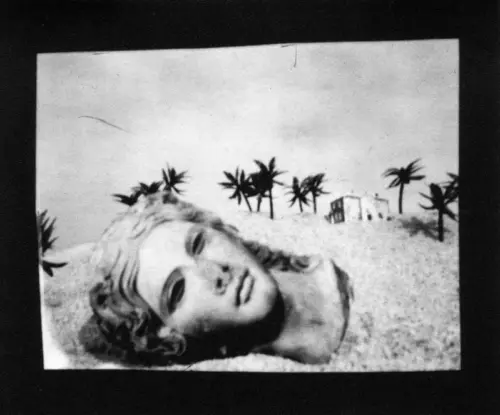
Ruth Thorne Thomsen, photography.
“The predatory adaptation derives from resource competition between and within species, which, in the Cambrian, becomes predation, the killing and con- sumption of one living creature by another. Predation is hard work: the evidence reviewed in section 3 shows that it is powerfully reinforced in mammalian carnivores and in the hunting apes by a set of linked conditioned stimuli that are carried over to the hunting adaptation in hominids. The stimuli driving predation and hunting are the pain-blood-death (PBD) complex: the prey’s terror and struggles to escape as it is brought down, the shedding of its blood, and its vocalisations as it is wounded and eaten, often while it is still alive. A range of anticipatory and consummatory reinforcers is triggered by the PBD complex, which is also active in intraspecific killing, and strikingly so in chimpanzees. “
Victor Nell (A Murky Portrait of Human Cruelty)
The vocalization reminds one of the sound sheeps make when sacrificed, a sound that gave way to the word ‘Tragedy’. (The word “tragedy” comes from the Ancient Greek word tragōidia, which literally means “goat song” –tragos, meaning “billy-goat,” and ōidē, meaning “song”). It is amusing (or something) to google-search origin of the word ‘Tragedy’. The west continues its obsession with sanitizing such material. Oh a goat was awarded as a prize at the annual festival in 5th century Athens. The goat wasn’t a prize, it was sacrificed. And the sound it made, in agony, was (in probably folkloric fashion for the time) duplicated with the Greek word ‘tragos’. The paradox of the West is that it is a culture obsessed and consumed with violence who must somehow pretend it would be offended by sacrifice practiced thousands of years ago.

Andy Warhol
“There are two facets to the Freudian revolution in the radical decentering it offers. The first is classical: the discovery of the unconscious, in so far as it is precisely not our center, as it is an ‘excentric’ center; the other facet, the seduction theory, is hidden but indispensable to the first for it maintains the unconscious in its alien-ness.”
Jean Laplanche (The Unfinished Copernican Revolution, from Essays on Otherness)
“What was the purpose of the will, which ultimately is one? The tragic idea, rescue from truth through beauty, absolute submission to the Olympians out of the most terrible knowledge, was now brought into the world. Thus the will gained a new possibility of being: the conscious volition of lif e in the individual, according to the idea of tragedy, of course not directly, but through art. That is why now a new art arrives: tragedy.”
Friedrich Nietzsche (Writings from the Early Notebooks)
So in Freud there was this tension that centered around what exactly the Unconscious is — and is the origin exogenous or internal (as it were). And then the contested, even by Freud himself, that everything conscious was once unconscious. But putting that aside a moment, it is useful here to make a few points about cruelty. If the beginnings of violence are found in the Cambrian, in the appearance of predation, the appearance of cruelty followed on the appearance of homosapiens (well, hominids).
“Because cruelty presupposes the intention to inflict pain and is therefore exclusively a hominid behaviour, it dates to no earlier than H. erectus, about 1.5 million years ago.”
Victor Nell (Ibid)

“Les Révélations Brutales”, illustration by Bertall (Charles Albert d’Arnoux) 1846
“…the chimpanzees’ visceral reaction to a hunt and kill is intense excitement. The forest comes alive with the barks and hoots and cries of the apes, and aroused newcomers race in from several directions. The monkey may be eaten alive, shrieking as it is torn apart. Dominant males try to seize the prey, leading to fights and charges and screams of rage. For one or two hours or more, the thrilled apes tear apart and devour the monkey. This is blood lust in its rawest form.”
Wrangham and Peterson (Demonic Males: Apes and the Origins of Human Violence)
At this point it is worth noting, too, that the unconscious is dependent on language. But these terms need clarification. And to point out that the unconscious is in no sense the analogue of consciousness. Consciousness is no mere translation of the unconscious. As Laplanche says, the unconscious is not a hermeneutic copy of conscious discourse.
“… this unconscious (memories, fragments of memories, fantasies—it matters little for the moment) consists of scenes or fragments of scenes, and above all that these scenes are essentially sexual. The significance of this is not merely contingent—why, after all, is sexuality accorded a primacy over, say, the alimentary or the need for security? Because the primacy of sexuality opens directly onto the question of the other, and in the case of the child, onto the adult other in his or her alien-ness.”
Jean Laplanche (Ibid)
“In certain diseases…thoughts emerge suddenly without one knowing where they come from.… These alien guests even seem to be more powerful than those that are at the ego’s command.… Or else impulses [Impulse] appear which seem like those of a stranger, so that the ego denies them;…the ego says to itself: ‘This is an illness, a foreign invasion’.”
Sigmund Freud (Standard Edition XVII)
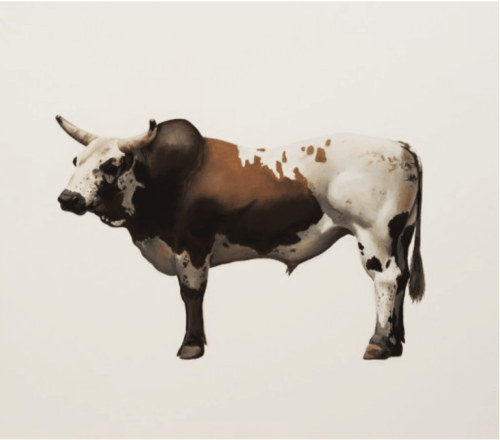
D. Beckman
In art, too, thoughts emerge suddenly without one knowing where they come from. And they are alien too. And in a sense, it is also a disease, or perhaps more accurately a symptom. And even in creative activity the backdrop is trauma. And here I want to just make note not to forget Tragedy.
“The Dionysian, including its most primitive and savage dimensions, is regarded as necessary for creative existence. It is an integral substratum of Apollonian consciousness at its most creative and not something to be denied its important place. We have
here the beginnings of Nietzsche’s interest in matters pertaining to sublimation: The Apollinian Greek…had to recognize [that]… despite all its beauty and moderation, his entire existence rested on a hidden substratum of suffering and of knowledge, revealed to him by the Dionysian…The ‘titanic’ and the ‘barbaric’ were in the last analysis as necessary as the Apollinian.”
Ronald Lehrer (Nietszche’s Presence in Freud’s Life and Thought)
The de-centering Laplanche discusses is also linked structurally to the appearance of predation in the Cambrian period. The absolute mystery of why , for example, stingers suddenly appeared on jelly fish is part of a grand myth of existence — our existence, but also not our existence. The existence of everything. The narrative of the cosmos was really what the Copernican revolution was about. Except that man cannot find a perspective outside of himself. It is, after all, ‘our’ consciousness.
“the point which I consider is the essence of the Copernican revolution begun by Freud; the decentering, in reality, is double: the other thing (das Andere) that is the unconscious is only maintained in its radical alterity by the other person (der Andere): in brief, by seduction”
Jean Laplanche (Ibid)

David Reed
Sigmund Freud (Interpretation of Dreams)
Now, there is also the Mother’s experience in this. And the memory trace of something sexual. How far back does this go? It seems unreasonable to assume just a few hours ago. It feels likely that ‘this’ is what evolution is actually about. And assuming Darwin is mostly correct (and I think he is) evolution — the mechanisms, the process, obviously goes back to beginnings. But ‘our’ present must still feel the connection on some level. But this is the mysterious aspect of the unconscious, for evolution resides in the unconscious. And yet the unconscious is language dependent. That is the accepted presumption. But I wonder if that is not too narrow an idea of language. Or rather, if Lacan is right, that the unconscious is structured like a language, that these dark infintetly long connections to our origins, are not structural connections. Those jelly fish in the Cambrian and the raging Gorillas and Bonobos viewed in the rain forests of Rwanda, are also tied into the narrative of the cosmos. In the same way that contemporary scientistic history sanitizes the Tragic goat slaughter in ancient Greece; it trivilizes the narratives of Copernicus and Ptolomy.
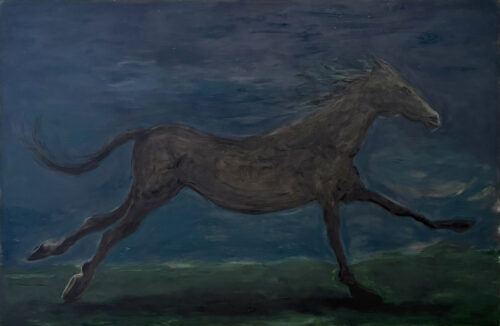
Tanya Merrill
“I have once again been discussing the archaic experience of breast-feeding; but what is called the ‘primal scene’ lends itself to analogous criticism. Whenever primal scenes are observed or discussed, two worlds without communication divide, so to speak: on one side, parental behaviour, the experience and content of which are by definition beyond the subject’s grasp; and on the other, the side of the child, a traumatic spectacle, more often glimpsed or guessed than seen, suggested by a mere allusion (animal coitus) which the child must then fill out, interpret, symbolize. My point is that between these two worlds something is missing: the supposition (which should have occurred to a psychoanalyst!) that showing sexual intercourse is never simply an objective fact, and that even the letting-see on the part of the parents is always in a sense a making-see, an exhibition. But Freud is never to suspect this idea—that the primal scene only has its impact because it bears a message, a giving-to-see or a giving-to-hear on the part of the parents. There is not only the reality of the other ‘in itself’, forever unattainable (the parents and their enjoyment) together with the other ‘for me’, existing only in my imagination; there is also—primordially—the other who addresses me, the other who ‘wants’ something of me, if only by not concealing intercourse. What is it this father wants of me in showing me, letting me see this primal scene, even if only by taking me to a field to witness animal coitus?”
Jean Laplanche (Ibid)
These topics stimulate reflections on art, from early cave painting to contemporary work.
“Predatory, quiet-biting aggression is mediated by the SEEKING system, a foraging, exploration, curiosity, and expectancy system “that leads organisms to eagerly pursue the fruits of their environment. . . . Energy is delight” (Panksepp 1998, pp. 145, 164), and SEEKING is its vehicle. Predatory aggres- sion is quiet, with methodical stalking and well-directed pouncing. ESB, in the ascending dopamine pathways from mid- brain nuclei through the extended lateral hypothalamic corridor from the ventral tegmental area to the nucleus accumbens, evokes the most highly energized exploratory and search behaviours of which the animal is capable (Panksepp 1998, p. 145). The emotional tone of affective attack is unpleasant (see sect. 3.4.2), but the hunt and kill are positive emotional experiences for the predator. { } Though SEEKING is dopaminergic, the pleasures of the consummatory processes (feeding, sex) diminish arousal in the SEEKING system (Panksepp 1998, p. 147) and are strongly linked to brain opioid systems which “may participate in every pleasure, serving as a general neurochemical signal that the body is returning to homeostasis” (Panksepp 1998, p. 184).”
Victor Nell (Ibid)

Jan Steen (Satyr and the Peasant. 1625)
In other words, the Death Instinct (or drive). Art from the earliest cave painting finds its way the Tragic vision in 5th century Athens. But how does that , or what is that, that reaches or is reaching back to the Cambrian ‘explosion’? Or before?
“ Because of its general interest, something must be said about earthquake prediction by catfish. This is so far the best documented case of animal responses prior to the major shock. The series of papers from Japan in the early 1930s that established a statistically significant behavior change some hours before an earthquake are reviewed by Kalmijn (1974). The Japanese authors gave some evidence that the adequate stimulus was electric potentials from Earth. Only later quantitative measurements of catfish sensitivity and of the magnitude of potentials anticipating the main quake (which are not universal accompaniments of earthquakes and are perhaps peculiar to certain regions) showed the signals to be well above threshold and the original observations therefore quite plausible.”
Theodore H. Bullock (Electroreception,” Annual Review of Neuroscience 5)
There are countless examples like catfish and their electrical whiskers cited above. It is also worth noting that in Japanese mythology the giant catfish Namazu is accused of *causing* earthquakes. And he and others like him live deep beneath Japan, in grottos and kept locked in by the thunder god Kashima (side bar, I have a Japanese style tattoo of Kashima on my upper arm).
“This has been the triumph of a materialist view of life—a view that permits no supernatural intrusions. It was also the triumph of a view that sees the physical world itself as unified in its basic constituents. Living activity is not explained in terms of a mysterious ingredient, but in terms of intricate structure on a tiny scale. That scale is almost inconceivable. To pick just one example, ribosomes are important parts of cells—the stations where protein molecules are assembled—with a rather complex structure of their own. But over 100 million ribosomes could fit on the period printed at the end of this sentence. Life, then, has fallen into place. In the case of the mind, much less is resolved.”
Peter Godfrey Smith (Metazoa)

Harriet Korman
The question of sentience is not really what this post is about (other post on this blog ARE about that question) but its related and really whenever this debate takes place there is a problem with nearly all the definitions involved.
“If panpsychism is also wrong and there is no hint of feeling in a grain of sand, why is that wrong? Might things be that way? There often seems to be a kind of arbitrariness in the situation. People can say whatever they like. If I were to guess where most people stand at the moment, when asked which living things around them have experiences, I would conjecture that a common answer is “yes”for mammals and birds, “perhaps” for fish and reptiles, and “no” for everything else. But if someone insists on pushing further out (to ants, plants, and paramecia) or pulling further in (mammals only), the discussion rapidly gets a bit untethered. How could we possibly work out who is right?”
Peter Godfrey-Smith (Ibid)
If there is no hint of feeling in a grain of sand then maybe its just that sand has OTHER kinds of feeling or awareness. An entire other vocabulary for feeling and/or awareness. Fish are complex, with if not complex then at least active brains. But as Godfrey Smith notes, that activity is going on in the dark, as it were. Maybe that grain of sand is in some kind of transit…maybe its sand from the past because ‘our’ subjective position always ends of centering discussions within ourselves.
“ The immense work of what I have called, ‘morality of custom’ , the actual work of man on himself during the longest period of the human race, his whole prehistoric work, finds its meaning, its great justification (in spite of all its innate hardness, despotism, stupidity, and idiocy) in this fact: man, with the help of the morality of customs and of social strait-waistcoats, was made genuinely calculable. If, however, we place ourselves at the end of this colossal process, at the point where the tree finally matures its fruits, when society and its morality of custom finally bring to light that to which it was only the means, then do we find as the ripest fruit on its tree the sovereign individual, that resembles only himself, that has got loose from the morality of custom, the autonomous ‘super-moral’ individual (for ‘autonomous’ and ‘moral’ are mutually exclusive terms.)”
Frederich Nietzsche (On the Genealogy of Morals)
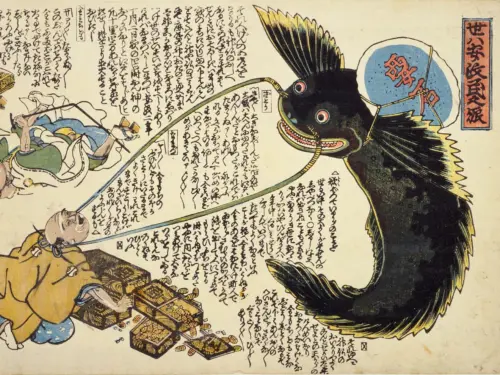
Illustrated page from Tales of the Catfish God (1855)
“The predatory cycle makes massive energy demands of the predator: among them, a sustained high level of autonomic arousal; the physical exertion of what may be a prolonged high-speed chase; the act of killing, during which the predator must overcome the last highly energised struggle of the prey and the close-in hazards of the kill; and scavenger threats. The aversive stimuli of physical exertion to the point of exhaustion are augmented by this final struggle. Yet the dopaminergic biochemistry of the predatory cycle and ESB evidence of its reward value indicate that far from being aversive, predation is a powerfully rewarding experience even before satiation occurs. One may thus hypothesise that a necessary condition for the success of the predatory and hunting adaptations is the conjunction of pain – the stress of exertion and the pain of injury – with a high level of pleasurable reward intermixed with sexual arousal, and that this is also true of fighting in its various forms, including single combat, assaults by individuals or groups on rivals, and war: though fighting is by definition not cruel, pain is inseparable from combat.”
Victor Nell (Ibid)
That predation seemed to appear rather quickly by evolutionary standards, and for reasons as yet not understood, the entire interface between community or tribe even, and society, and violence remains unclear. I have said before all stories are crime stories, all stories are about homesickness and all are about exile. There is much deeply buried material related to criminality. To say ‘buried’ suggests the obvious spatial metaphor regarding the unconscious. And, of course, it may be stored in quite an other fashion. But more, our ideas of stories intersect or are colored by what I want to call ‘deep crimes’.
“It is incomprehensible that the infliction of pain on the self is both pleasurable and also sexually arousing. This unlikely conjunction has long puzzled moral philosophers and psychologists. In a famous passage, Freud wrote that “the existence of a masochistic trend in the instinctual life of human beings may justly be described as mysterious from an economic point of view” (Freud 1924/1985, p. 413). Yet, using functional magnetic resonance imaging (fMRI), Becerra et al. (2001) report that a pain stimulus (a probe heated to 468C applied to the skin) activated the brain’s reward circuitry, following a pathway similar to that of the pleasure response: protein from the cfos gene shows “that many neurons in the amygdala that are aroused by aggressive encounters are also aroused by sexual activity” (Panksepp 1998, p. 199): the underlying motivation may be the seeking of safety.”
Victor Nell (Ibid)

Brad Holland
Remember narrative and deep crime at this point.
“ As the Greeks related stories of heroic ancestors and mythic history, and then adopted sacred writing, so they became a people of books, those of Homer and Hesiod, in particular. The significance of writing is remembered in an “people of books, those of Homer and Hesiod, in particular. The significance of writing is remembered in another way. They had an alphabet comprised of 22 nonpictographic, which is to say iconoclastic, letters: alpha and beta are its first two. Their sense of self empowered them, too. They developed the idea that gods were like humans, and that humans could be like gods. In time, that democratized when they recognized that it is not kings and warriors, at the top of the social hierarchy, who are closest to the heavens but otherwise inconsequential individuals. What mattered was the quality of a person’s soul, the radiance of their life. Hence, the cultivation of the individual became a key task. A person could aspire to know themselves and know the divine.”
Mark Vernon (A Secret History of Christianity: Jesus, The Last Inkling, And The Evolution Of Consciousness)
Certainly there are points in history that seem to function (if that’s the word) as nodal points, or fulcrum for forces accumulating over time before it. Fifth century Athens was such a point, as was Elizabethan England, or Fin de Siecle. Or periods we label the Industrial Revolution, or the Enlightenment, or the Reformation. If some have seen Copernacus and Darwin and then Freud as three wounds to self confidence in man, then they function in a related manner. The 20th century was the century of technical advancement (sic) but also of mass violence. Enzo Traverso has written of the first World War as a benchmark for anonymous mass industrialized death.

George Tooker
But Attic Greek society still retains a special lasting influence today, in spite of popular liberal culture seeming determined to find anti-woke aspects the better to trivialize it. The seeming impossibility of Tragedy today is worth more thought. Today there continues a rabid irrational fear of communism, because it threatens bourgeois consciousness. The ‘tragic’ sensibility threatens the bourgeoisie, too. And my sense, my intuition, really, is that today’s growth of scientism, the continuing parade of instrumental logic that cuts across all contemporary life, is linked to this. The West today fears history itself. Technology as a whole is anti-historical. It doubles down on an imaginary ‘present’. The culture of ‘Now’.
In Greek art, the period between 700 and 500 BCE is called ‘the great awakening’. Mostly it began in 600, but artists began to use foreshortening perspective. Suddenly a new naturalism was appearing on pottery painting and in sculpture.
“The Greek aristocracy tended to regard artists as inferiors, even when they showed such remarkable innovation. Perhaps it disturbed them, sensing that the move to what we call classical art was subtly disturbing the status quo. It was. Athenian democracy arose at the same time, presumably as part of the individualizing shift of mindset. It began to afford artists of genius public recognition and a few started to be remembered by name.”
Mark Vernon (Ibid)
Artists were depicting inner life. And in theatre, there was suddenly the invention of character. But more than character, the rituals of theatre during the Athenian festival(s) each year inaugurated something that exists in the history of the unconscious in a sense. The audience knew these stories but each author gave their own perspective — and created a theatrical space that mimicked the scene of the primal crime –meaning a primary experience of self, but also of trauma — remember the goat — and the Oracle at Delphi, still active but the tragic stage was replacing Pythia. All three main tragic authors mention the Oracle. The Temple of Apollo that was home to the Oracle was once dedicated to Poseidon, the God of earthquakes and the sea, but that two hundred years earlier. The tragic marked a migration of belief from Pythia to the stage at Athens. To other stages as well.
“How that developed can be tracked across the works of the best tragedians of the time, the first being Aeschylus. { } Those who are caught up in this flow of violence have little choice but to participate in it. They are not so much individuals as noble or ignoble pawns, their virtue assessed by the manner in which they embrace their destiny. The gods are experienced as an irresistible fate, directing every part of the individual, even their hands and feet. Similarly, the gods appear alongside the mortal characters, as if the divine and the human seamlessly mingle. Deities speak in the climatic moments of the drama to determine the outcome of lives. This is presumably how it felt and part of the thrill of Aeschylus’s work when seen today comes from entering this, to us, alien environment. You feel its difference when the chorus offers warnings and laments in a single, unison voice. Pride and blood can’t be questioned or resisted. The overall experience is emotionally intense as events sweep over the actors like a tsunami, caused by powers outside and above.”
Mark Vernon (Ibid)

Hermes and the Infant Dionysos, 4th century BCE
Vernon is interesting, as a former Anglican cleric, he is not a conventional academic. He is also a practising psychoanalyst. He does have a PhD in philosophy from Oxford, so he seems to straddle a few things. His privileging of Aeschylus is something I agree with. Sophocles was the beginning of something else. Euripides was yet another stage of writing work that reflected the everyday in some sense. Euripides was the Arthur Miller of Greek tragedians, and Aeschylus was the Beckett. But there also arose a class of philosopher who began to interrogate the natural world, but from a new subjectivity. And this eventually led to problems (it is remarkable to see this repeated today in rather similar fashion across the west).
“The tension came to a head in about the year 432 BCE, when the Athenian state acted against what it regarded as the philosophers’ sacrilegious, anarchic teaching. They were lumped together as “atheists,” a word that at the time meant believing in the gods in the wrong way, rather than not believing in gods at all. The Sun should not be downgraded to gold, as Anaxagoras had speculated. The received wisdom about deities should not be doubted, as another of their number, Protagoras, had wondered. “The next thirty-odd years witnessed a series of heresy trials which is unique in Athenian history,” reports E.R. Dodds. Alongside Anaxagoras and Protagoras, others including Euripides and Socrates were prosecuted. They were accused of treason which, under original participation, is indistinguishable from idolatry and faithlessness because gods were the life of the people. Philosophers were banished, others fled, a handful died. It’s possible that books were publicly burned. Plato later remarked that the life of a philosopher exposes them to ill-will and conspiracy “so that most of them find it necessary to work undercover.” They were not unlike the prophets in this regard.”
Mark Vernon (Ibid)
What Vernon leaves out is the role of sacrifice, the secret learning and hidden mysteries. And in Heraclitus, perhaps, much of the earlier thought found a synthesis. Or found its mystical core. Or, found ‘philosophy’.

Blackboard illustration by Rudolf Steiner. 1924.
“if you learn to direct your attention aright, you’ll see that sacred places and divine objects transmit a source of life that transcends them. It is a perception that was to have a long history, as any reader of the opening verse of John’s gospel will realize: “In the beginning was the Word,” or Logos. For Heraclitus, this was not yet experienced as the sustaining aspect of a monotheistic God, as Christians were to conclude. Nonetheless, he articulated a clear sense that whilst divinity can be experienced immanently in nature, the divine itself must originate in a realm that is outside of nature.”
Mark Vernon (Ibid)
Silent reading to oneself was a massive shift in both individual and societal consciousness. The authorities (The Church) wanted to stop it, for it was spreading too fast. Today it is the same tension. Media tech is there to erase private space (and time) and contemplation. It’s all a part of erasing history. The threat is not from surveillance because firstly the tech doesn’t work and secondly the authorities just lie anyway. No, the threat is allowing you time to think. Western society is now a culture of lies. People anticipate lying, and they practice lying. Governments barely pretend to market new technologies as there to make life easier, or to save time. In fact the tech stopped doing that fifty years ago. In a certain sense the new digital tech is there to massage the lies.
“Even if the usual way of recording what, in the absence of man, was going on in the unrepresented must be criticised as a dubious extrapolation, the descriptions may still, as I have suggested, be valuable, not as actual descriptions, but as notional ‘models’. What is important is, to remember that that is all they are. (Especially will this be the case, if we should ever have to assess the merits ofthis approach against those ofany other possible way of acquiring knowledge of the pre-historic past.) For their nature is that of artificial imagery. And when the nature and limitations ofartificial images are forgotten, they become idols. Francis Bacon declared that the medieval approach to reality was under the spell of four different sorts of idols, which he called ‘idols ofthe cave’, ‘idols of the tribe’ and so forth. In the same way, these images of what was going on in the unrepresented in the prehistoric past may be called ‘idols of the study’. “
Owen Barfield (Ibid)
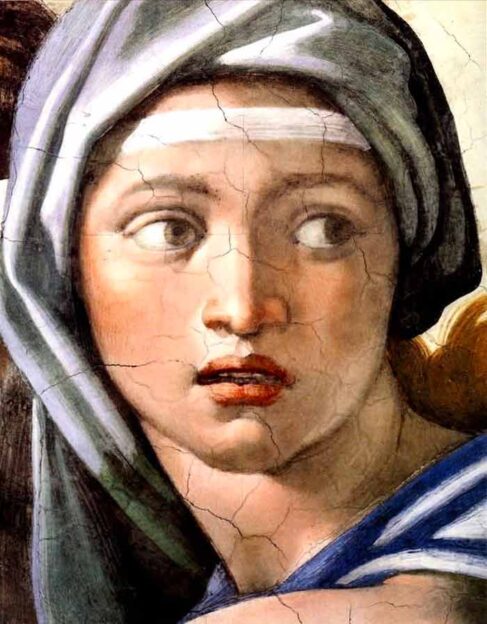
Michelangelo (The Delphic Sybyl, Sistine Chapel, detail)
“Regional polities, whether as chiefdoms of several thousand people or the empires that emerged in Egypt, China, and India in the third millennium BC, brought “not only dazzling advances in civilisation, but also the enormously powerful instrument of state power as a new moving force in history” (Heilbroner 1992, p. 907) { } Gladiatorial shows in the amphitheatre were “the most prominent and most popular spectacle of all,” writes Tertullian (197 AD/1958, 12:1). One could not attend the arena spectacles, he continues, “without his mind being aroused and his soul being stirred by some unspoken agitation. No-one ever approaches a pleasure such as this without passion [and] violent agitation of the soul” (15:2– 6). Even sober citizens demanded that “the man who has been slain be dragged back to feast [their] eyes on him, taking delight in scrutinising [his death] close at hand” (21:1–5). The allusion is to a platform in the middle of the arena to which wounded victims were dragged, “thus enabling the spectators to observe more closely their death struggle” (Tertullian 197 AD/1958, p. 94, note 3). In his Confessions, St. Augustine tells of his young friend Alypius, a Christian who had come to Rome to study law. Augustine’s account captures the delirious contagion that swept over the arena audience: “some man fell; there was a great roar from the whole mass of spectators. . . . [Alypius] saw the blood and he gulped savagery…he was drunk with the lust of blood.”
Victor Nell (Ibid)
The desire in the U.S. today to televise execution is a recreation of medieval death carnivals. The video truck recording the firing squad is the 21st century executioners cart. The audience today no longer runs alongside and behind such carts but sip soft drinks or lite beer at home on their sofa. For two centuries such executions were hidden behind prison walls in an administered expression of power, and now the televising of the Ft.Hood mass shooter has been amended. No more public viewing. Which itself is interesting. Real death is increasingly routinized — the soldier falling from a rappelling rope and dying in front of a football crowd did not even suspend the playing of the game. That there was no delerious contagion sweeping the crowd suggests not a decrease of cruelty but an increasingly sensitized sense of shame.- But a shame that itself is ersatz. And there is no oracle to consult about such matters. The King is not really a King. The Prime Minister or President is not really a sovereign.

Benedictine Monestary of Holy Trinity of Las Condes, outside Santiago, Chile.
Perhaps all Oracles are there to report on the unrepresented. On a version of pre-history. The tragic drama was there to mark out the boundaries of the interior life.
“To make a world out of himself the dreamer must not only split with the world, but also split himself into both self and world, self and environment…”
Norman O. Brown (Love’s Body)
Tragic drama employed masks. Today the mask is unnecessary. The mask has been subsumed. The mask IS the face, the face is the mask. And Mar-a-Lago face is the allegorical expression of this subsumption. Such masks cannot be removed. And the voice coming from out of such masks is not ancestral. It is demonic. It is the voice not of ancestors but of ‘now’.
“The masquerade or carnival is a danse macabre, a visit of ancestral spirits, represented by the authorized bearers of their persons. The life of the clan consists in the perpetual reincarnation of ancestors—a reincarnation achieved by magic, by imitation (identification), by dramatic representation.”
Norman O. Brown (Ibid)
I think the unconscious is eternal. It isn’t ours, or rather it is everyone’s — how bespoke it is I don’t know. If it is structured like a language (per Lacan) then nature is a language, too. Reality is a grammar.
Iris Murdoch said that the greatest art is “impersonal,” in the sense that it transcends the individual person. A very common experience for writers is to wake in the morning and re-read what was written the night before and feel surprise, to not really remember writing it.
To donate to this blog and the Aesthetic Resistance podcast, use the paypal button at the top.
Speak Your Mind