


Patssi Valdez, photography.
“…an analysis of the simple surface manifestations of an epoch can contribute more to determining its place in the historical process than judgments of the epoch about itself.”
Sigfried Krakaur (The Mass Ornament)
“The owner of labor-power is mortal.”
Karl Marx (Capital)
“The new concern with self involved a new experience of self. The new form of the experience of the self is to be seen in the first and second century when introspection becomes more and more detailed. A relation developed between writing and vigilance.”
Michel Foucault (Technologies of the Self)
I have been thinking lately about ‘intelligence’. About what that word means. If you asked me the most ‘intelligent’ people I ever knew I would probably say my old friend Terry Ork, and my old friend in Bangkok, Bob Halliday. Both now have died. Both were in very different ways just these enormous minds — minds of exceptional breadth and depth. And, in somewhat similar ways both were maladapted to the society in which they were born. Both found it difficult, for a variety of reasons, to function in a way conventional society would describe as productive. And yet both were hugely important to many people. Deeply important. And that’s the thing, there was something that can only be described as ‘deep’ about both, again, in different ways. Both had flaws, certainly. Both failed to take care of themselves. Both had self destructive aspects. Both had blind spots, too. And that observation would lead us into a discussion of character. But this post is not about Ork or Bob. I miss them both even if both were flawed. I am probably far more flawed, to be honest. Its interesting to me that neither had children. Nor did either evidence much interest in children. They were both homosexual, but their sexual desires manifested in very different ways.
Now, do I have a point to all these thoughts? Well, I hope so. But in a sense I am writing this because I have also been struck this last week with how deeply deformed western society has become, and how the glaring ignorance of public life is coming to feel suffocating. One aspect of this is alienation. The growing isolation of most people’s daily lives. A good part of this is the transformation of the service industry. From robotic phone asnwering systems, to Q codes instead of people, to the endless coercion to use screens for nearly every obligatory chore one is given. The cumulative aspect is one that furthers the erasure of feelings of community. The most ordinary exchanges with counter people or gas station attendants, or telephone operators (quaint to think about now) are hugely missed on a fundamental emotional level. There are reasons for those conversational conventions — remarks on the weather or sports or news. There are historical antecedents for these conventions. Losing them means losing our history.
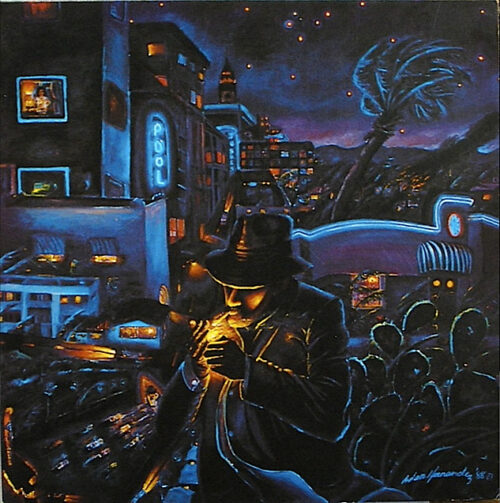
Adán Hernández
A recent op ed in the NY Times discusses the current (in a long stream) of ‘panics’ about technological or consumer moral vices – from comic books to video games to social media. And currently the potential or probable effects of screen habituation.
“The panic over brain rot assumes that the brain-rot content itself is the problem. That Gen Z-ers’ engagement with absurd, low-quality videos, because they are young and impressionable, necessarily leads to cognitive decay. Our participants described the inverse: The mental state comes first. After scrolling algorithmically curated feeds long enough, they experience a “brain-rot feeling” — a fogged-out, low-selectivity state in which they simply consume whatever appears.”
Maxi Heitmayer (The Truth About Brain Rot, NY Times 2026)
This is very interesting. Most people are aware of living in an algorithmically mediated world. They anticipate manipulation and marketing and they expect the attention economy. And there is a degree of self awareness about already being caught up in this system of psychic exploitation.
“What struck us in our interviews, however, was how clearly Gen Z understood this dynamic. (The interviews are anonymous, following social science conventions.) One participant told us: “You’ll watch something anyway, so why not brain rot? It’s actually better than an ad because it doesn’t demand anything from you.” Another argued: “If everything is content now, then brain rot is anti-content. It’s the only way to be free online, which is to do something so stupid it can’t be monetized.” When we spoke to Gen Z-ers about brain rot, we heard sophisticated — if uncomfortable — statements outlining a generation’s response to the cultural conditions and the overbearing information environment it inherited. Like every generation before them, they are making something out of the conditions they were given. In this case, they are participating in deliberate nonsense.”
Maxi Heitmayer (Ibid)
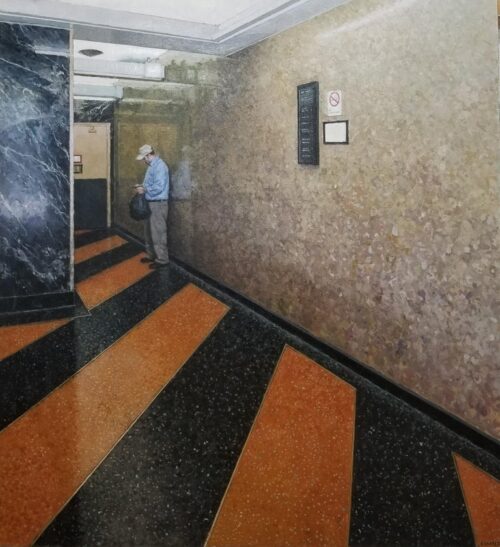
Richard Combs
Tik Tok and Youutube and Instagram are purveyors of what Heitmayer calls anti gratification. The popularity of this stuff attests to the deeper mental fatigue than so called educational or intentionally ‘funny’ or ‘serious’ content provides.
“Brain rot breaks the mold of social media through its absurdity, its deliberate refusal of narrative, purpose or message. “
Maxi Heitmayer (Ibid)
The content is there, its not content free, nothing is. But much of what I have seen is expressing something about ‘feeling’. The youtuber Nathan Milner, the creator of Unspeakable — a series of videos he and his friends make out of Houston, Texas, is a useful example. My kids loved it and so I watched. And I rather liked it. And I liked it because Milner exudes a kind of non snarky decency. He never makes fun or anyone except himself, and he is unfailingly kind and generous to his friends on these videos. And watching it I realized how unusual this quality has become. In the videos he and his friends create stupid projects like filling a giant inflatable swimming pool with jello. Or fill an old school bus with water and then try to drive it. There is never ever any point, there is never ever any lesson to be gleaned. Its just some good natured and purposely immature guys (who should be having more serious professions at their age. Milner is 29, though he began in middle school) doing dumb stuff. Now I watched a number of imitators of Milner’s channel and realized I was right about his good natured treatment of his friends. Almost all the other content was snarky and self aggrandizing. It was narcissistic. But one liked spending empty time with the Unspeakabl crew. They were guys who had fun together. That’s all.
Its staggering to realize how rare that quality has become. I would argue music, certainly popular music (whatever that is) has gone from Patsy Cline to Beyonce or Taylor Swift, or, worse in a sense, to a dozen or so ‘other’ singers (in this case female vocalists) viewed as ‘indie’ and you see the lack of ‘selling’ in Patsy. The pain was in her voice. Or I should maybe say the ‘truth’. It wasnt in how she sang, in ‘her’ interpretation of the song. She simply sang. But the message was in her voice. There was no hiding it. Hank Williams was much the same, I think. Sam Cooke, too. Maybe most of all in Mississippi John Hurt (and as an incidental observation, women seem particularly moved by Mississipi John). My point is that there is nothing manipulative in Patsy Cline.

Beverly Buchanan
“A century ago, artists responded to the horrors of World War I by creating deliberately irrational, anti-aesthetic work. Dada rejected the cultural logic that had led to industrialized killing.In its own meme-driven way, brain rot refuses to participate in the attention economy on that economy’s terms. The joke is that there is no joke. The meaning is that there is no meaning. And for a generation that grew up with its every digital interaction tracked, measured and monetized, that refusal is experienced as a form of honesty in a dishonest system.”
Maxi Heitmayer (Ibid)
It is worth noting that most (nearly all) this stuff comes out of white suburbia. And white suburbia is itself without meaning or purpose. These are white platforms, mostly, though this is changing. But the creators of the jillion other streams of Lego figure animation or stop action toys, or Huggy Wuggy home-made vids, or whatever, all of it is white. Just like most serial killers.
It is worth a footnote observation on the Iranian group that makes Lego animated videos of Trump and his posse as a means of trolling the US government is an outlier.
“The expression “free time,” incidentally of recent origin—formerly one said “leisure” [Muße], and it was a privilege of an unconstrained life and hence surely also something qualitatively different, more auspicious—refers to a specific difference, that of unfree time, time occupied by labor and, one should add, time that is determined heteronomously. Free time is shackled to its contrary. This opposition, the relationship within which free time appears, even shapes some of its essential characteristics. Moreover, and far more importantly, free time depends on the totality of societal conditions. That totality now as much as ever holds people under a spell. In reality, neither in their work nor in their consciousness are people freely in charge of themselves.”
Theodor Adorno (Free Time, Critical Models)

Nathan Milner (Unspeakable)
People have known for fifty years that ‘leisure’ is a profitable market, especially for Americans. And there has evolved a kind of sadistic and very aggressive aspect to hobbies and leisure. In the US much of the desert has been damaged by ‘hobbyists’ and campers. By extreme sports and various motor races. On a corporate scale you have stuff LeMans 24. Or the Indy 500. Or take marathon running by what can only be described as hobbyists. I know all the reasons for this, most of which are utterly understandable. I am always seduced by professional sports, (at least some of them) but that appeal is waning. Even the small bit of pro league sports I know (NFL, NBA, MLB etc) are a shadow of what they once were. Pro golf is perhaps the most dada-esque of all. It is also certainly most encrusted with class markers and codes.
“Even the superfluous and senseless activity undertaken in free time is integrated into society. Once more a societal need plays a part. Certain forms of service, especially of domestic service, are dying out, demand is disproportionate to supply. In America only the truly wealthy can maintain domestics, and Europe is following closely behind. This causes many people to practice subaltern activities that formerly were delegated to others. The slogan “Do it yourself”* [tue es selbst] takes this up as practical advice, though it also takes up the weary exasperation people feel toward mechanization, which unburdens them—and this fact cannot be disputed, rather only its usual interpretation—without their knowing how to utilize their newly acquired time.Thus, once again in the interests of specialized industries, people are encouraged to do themselves what others could do better and more effectively for them and what, for this reason, they must in turn despise deep down. { } More than thirty years ago, I described such behavior as ‘pseudo-activity.’11 Since then pseudoactivity has expanded to an alarming degree, even, and especially, among those people who believe that they are protesting against society. In general one may suppose that this pseudo-activity corresponds to a pent-up need to transform the petrified relations of society. Pseudo-activity is misguided spontaneity. Misguided, but not by chance; rather people dimly sense how difficult it would be for them to change the burden that weighs upon them. They prefer to let themselves be distracted by spurious, illusory activities, by institutionalized vicarious satisfactions rather than to face the realization of just how much the possibilities for change are blocked today. The pseudo-activities are fictions and parodies of the productivity society on the one hand incessantly demands and on the other hand confines and in fact does not really desire in individuals at all. “
Theodor Adorno (Ibid)

Judith Godwin
Now I think there are profound implications to the above paragraph. Pseudo-activity implies a kind of pseudo emotional life. Pseudo feelings. Pseudo sex, etc etc etc. And those unable to find a socially proscribed ‘hobby’ are found to be outside some sort of accepted and unspoken definition of ‘useful’. One must make one’s hobby motorcycle work in the same way one must make one’s life work. And for some (I think of Ork and Halliday here) it is just not possible to make anything work. They were brilliant and understood what ‘working’ meant, and in rarified classifications, they did make shit work. But overall they could not make their lives work. And this suggests that the pseudo activity requires a certain ‘brain rot’ quotient.
“This ambivalence communicates the emotional register of people living inside a system they cannot escape. They see the manipulation, understand what the algorithms are doing. But they keep scrolling anyway, because they cannot imagine a life outside this system; most of them never lived one.”
Maxi Heitmayer (Ibid)
And here enters a discussion of art (and entertainment). Entertainment is a kind of pseudo art. And for many this is perfectly acceptable. The problem is that because of how integrated these pseudo activities are, and how conditioned many in the West have become to screen activities, the role of demanding artworks has been shrunk. But in a sense, this in itself is not a problem. The poems of Keats or the fiction of Joyce or Melville were never meant to be wildly popular. The problem, the real problem is twofold; the elevation of junk (Kitsch) and an increasing inability to do ‘real’ art. And I can already hear the complaints about this. So, yes, I’m an elitist. I grant you that. Still, the sheer numbers of bad prestige film and TV, the sheer number of bad artworks in various Bienalles or museums IS a cause for concern. And perhaps just as troubling is the loss of coherent art criticism. I’ve harped on this before so I don’t have to go into it all again, but the Trump assault on the Smithsonian is a useful example. Trump wants white nationalism (its his red meat for MAGA followers) and wants to erase black and brown history from the venerable institution. So much pressure was exerted by Trump and his minions that Lonnie Bunch, longtime secretary of the Smithsonian has retired. The furor was around Amy Sherald’s planned show, now cancelled. And specifically the black drag queen Statue of Liberty. I don’t much like Sherald’s work but I also don’t hate it and this show was fine for what it was. But I’d not normally find myself defending this stuff but I mention it because of the commentary surrounding the cancelled show. Identity politics just doesn’t make great art and because of the context this work is being canonized and fawned over.
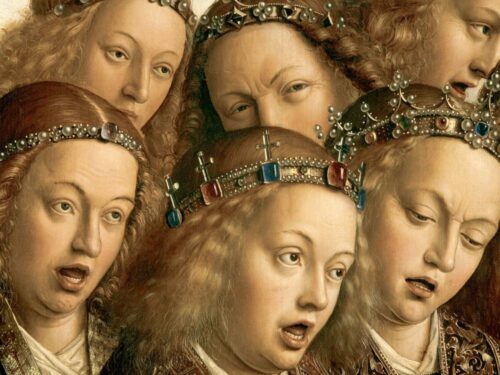
Jan Van Eyck (Ghent alterpiece, detail. 1432)
I point this out because it is another sort of culture distraction. Most culture war stuff is. While much more radical and profound work exists out there. At the top of this post is a photograph by Patssi Valdez. Now Valdez was born in East LA (same year as me, 1951) and worked on the outskirts of mainstream art. She painted and photographed the chicana world of So Cal, but more, she created uncanny and quietly radical images that I find haunting. She is now being presented in terms of her sociological importance and in a sense that’s a shame really because she is really much more than that. Ok, I digress.
But back to intelligence. This is of course a pointless question. There can be no real definition of intelligence. I think my point was that conventional ideas about intelligence tend toward examples from the world of science. Particle physicists and the like. And that is certainly valid enough but it also betrays something about this view of ‘fitting in’. Of finding a pre-fabricated *role* in society. And there is a problem today with how deeply personal branding infests all cultural affairs. In the broadest sense of the term ‘culture’.
“Free time does not, however, stand in opposition only to labor. In a system where full employment in itself has become the ideal, free time is the unmediated continuation of labor as its shadow.”
Theodor Adorno (Ibid)
And here is an excerpt from the concluding paragraph of this essay:
“Thus, if my conclusions are not premature, whatever the culture industry sets before people in their free time is indeed consumed and accepted but with a kind of reservation, similar to how even ingenuous people do not simply take events in theater or cinema to be real. Perhaps even more: such things are not completely believed. Apparently the integration of consciousness and free time has not yet wholly succeeded. The real interests of individuals are still strong enough to resist, up to a point, their total appropriation. This would accord with the societal prognosis that a society whose fundamental contradictions persist undiminished also cannot be totally integrated into consciousness. It doesn’t happen smoothly, especially not in free time, which surely appropriates people but, according to its own concept, cannot do so completely without overwhelming them.”
Theodor Adorno (Ibid)
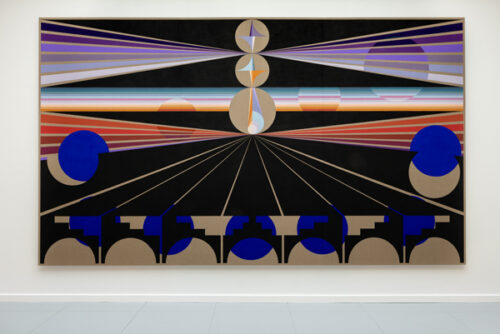
Eamon Ore Giron
Now apply this to social media today. Adorno was specifically referencing the TV coverage of the marriage of Princess Beatrix of Holland and the German diplomat, Claus von Amsberg. I think the same thing applies to Princess Diana and any number of other pseudo events. Now today, as in so many other areas during the Trump epoch, we are approaching complete disconnect from reality. But its too early to really tell if Trump et al is an outlier in a sense, or the logical conclusion of societal and political forces preceding it. Certainly in strictly political terms the U.S. foreign policy remains imperialist and militaristic. But in areas of culture things are far murkier. And the ‘resisting’ Adorno notes is very like what the NYTimes article seems to indicate. People are aware of the manipulation, aware of the algorithms (up to a point) and consume this stuff in a curiously jaundiced and cynical way.
“Brain rot is the collective recognition of a shared cognitive state; we have all been through the same algorithmic meat grinder. “The humor is deeply tied to feeling like you are part of an inside joke,” as one participant put it. “Brain rot gives you the sense that you’re in on something.” Repetitive catchphrases from brain-rot videos migrate out of digital spaces and into offline conversation, becoming part of everyday speech, without anyone’s “even understanding what those terms really mean.”
Maxi Heitmayer (Ibid)
But this is, I suspect, very consciously built into the platforms. They know we know they know etc. And yet, there IS a kind of unconscious resistance going on, too. Young people are absolutely aware of the ‘system’ and deeply distrust it and are in no way fooled. The influence of this junk cannot be dismissed but it also shouldnt be overstated. What is more disturbing is the entire bourgeois frame in which all of this unfolds. Even very serious art. The sense that nobody escapes is the actual shadow.
There was much discussion during the Weimar period about critique of ideology that resisted academic restraints. Adorno particularly admired Walter Benjamin’s work in this regard. (much of Benjamin’s anecdotal aphorisms remain untranslated, remarkably).
“Benjamin’s technique in Einbahnstraße is related to that of the Gambler. . . . Thought renounces all semblance of the security of intellectual organization, renounces deduction, induction, and conclusion, and delivers itself over to luck and the risk of betting on experience and striking something essential. . . . The numbers Benjamin bets on often come up,”
Theodor Adorno (On Benjamin’s Einbahnstrasse)
Nicola Florimbi
And I think this is appropriate to contemporary analysis. The University is now so sclerotic and paralysed by pressures of funding and carerrism that not much in the way of serious study comes out of it. So, per the current discussion, sometimes its best to just take the surface of the system at its word. Nathan Milner’s Unspeakable franchise is an eighty million dollar a year empire now. All achieved by not trying to do more than goof off. But this sort of raises another issue. And it is perhaps partially illuminated by the rise of self help books. Paul Stephens and Robert Hardwick Weston have a paper that digs into some of this.
” Like many contemporary self-help books — The Seven Habits of Highly Effective People is probably paradigmatic in t his respect — the primary aim of The Life Audit is to teach readers how to manage their time effectively. Everything is offered to every citizen of every class — just so long as one is able to allocate one’s mortal energy properly.There is something fatalistically reassuring about these books. They tend to assume that happiness is normative and universal, and that technology and the fast pace of modern life are the primary obstacles to personal fulfillment. The terms, like “personal fulfillment,” are innocuously vague. Religion is politely kept out of the conversation. Overwork is generally kept out of the conversation as well. The homogenous reader is assumed to be apolitical.”
Stephens & Watson (Free Time)
I only reference this because, well, firstly the extraordinary popularity of self help books, but also the assumptions the authors note: normative and universal ideas of happiness. We all know there are huge dangers associated with technology (more on that below) but the question of self help — of what is wrong that one needs help with — is worth exploring. As are ideas of what constitute happiness, and more , what happiness actually means.

Teiko Shotani, photography (Matsue, 1926)
“The allocation of time, not surprisingly, uses as its model the alloca-tion of capital. Our metaphors for the passing of time — “buying,” “spend-ing,” “saving” — are inescapably chrematistic. But what is more interesting in the context of time-management self-help books is that the management of time becomes almost soteriological. The best way for the contemporary middle-class reader to achieve his or her life goals is to maximize the scarce time at his or her disposal. Balancing one’s obligations and one’s needs is the key to success.”
Stephens & Watson (Ibid)
The best example of what took place in the second half of the 20th century is what happened to psychoanalysis. The transformation from the search for truth, the search for the deepest layers of our psyches, of ourselves, to a discipline of adjustment. An adjustment to the status quo. Make your life ‘work’.
“Most worrisome about the official chronotistic approach to what the late Foucault calls technologies of the self is not the reductiveness of its metaphors, but its reduction of the horizons of human possibility. Micromanaging everyday life might function to make time intellectually, politically, and creatively fulfilling. Instead, the micromanagement of time Social TextPublished by Overwork as an Ontological Condition functions almost entirely as a means by which the secular middle class is made to renounce a world beyond the pseudo-personal maximization of productivity — a productivity whose terms are dictated primarily by employers and by a culture industry that continually demands what Marx famously called the xth hour of every working day.”
Stephens & Watson (Ibid)

Patsii Valdez (Virgin of Guadalupe)
Technological mediation in 21st century life seems to neglect ‘listening’. Except for music (more on that in a moment). Or rather listening is less exact. My experience is that people don’t listen well in western societies. They might be visually acute and fluent and even knowledgable, but they seem to experience listening impatiently. And this is partly connected to the loss of meaning in culture. The loss of meaning of words. And this in turn connects to ‘intelligence’. Listening to speech, as in oration or sermon feels long dead, and listening in a face to face conversation feels under duress somehow. It is also obviously the quality of the speech we hear. Modern urban dwellers hear a lot of background voices. This is an entire other topic but its related — the schizophrenic backdrop of our aural landscape. The 21st century city resident hears enormous amount of ‘noise’. We listen a lot to recorded voices, some actual and some digital. This society listens to a huge amount of music, but mostly recordings of music. That is debated though as there is, in fact, massive attendance for live music (sic). Still, there has been a gradual inexorable increase in urban noise — transportation, traffic, construction, and general signals and mechanical activity.
“The loudest areas in cities are related to transportation, such as highways and train stations. People who live by these places often suffer from health problems such as a lack of sleep, high blood pressure, and even poor concentration. This can even have an impact on how long you live. Often, construction projects and new developments are imposed onto low-income communities because they do not have the resources or power to resist them. For example, urban planners throughout the country have often designed minority areas through a lens of white supremacy.”
Nandi Ndoro (Inequities of Noise Pollution)
A hundred some years ago the term ‘personality’ was pejorative. Personalities were vain and interested in their own image and, as Adorno wrote: ” Personalities were people who lived in anticipation of what would be said about them at their gravesides, and they fostered the impression of doing great things. “ From A Gloss on Personality. But this connects to ‘selling’ as well. As in ‘selling a song’. The personality does the selling. Personalities are salespeople. There is in this society of ‘making your life work’ a persistent inclination toward personality, rather than person. And there is a psychoanalytical underpinning to this. The narcissist is a personality. And of course the dialectic of narcissism (and personalities) is ambivalence. And I wrote on some of this last time, and the time before. The reduction in prolonged reading means an increasing inability to experience anticipatory narratives — there are no fairy tales and no Tragedy. There is only the self interrogation of the mediated self. An interrogation about which the subject knows he is unworthy. The salesperson is the voice of Gen Z. And more the voice, one less given to speaking aloud, of Generation Alpha.

Arvid Boeker
There is an aesthetics of privilege today that I am not sure has existed before this moment. And noise and sound are one of the markers. The rich are quiet. In Hollywood film the home of the affluent and rich are homes of quiet and calm. Eighty years ago the homes of the rich in much of film noir were quiet but the way mausoleums are quiet. The way mortuaries are quiet. The rich were already dead, emotionally. The rich were spiritually dead. Today the aspirational homes of Hollywood prestige product are more like libraries. Or, interestingly, the world of surveillance, or of luxury spas. In the noir films of the forties the voices were often whispers. Characters spoke confidentially, in hushed tones of doctors in consultation, or code breakers or priests at confession. I mentioned golf above; and compare the TV coverage of golf to that of football, say. In the latter the announcers often almost scream. In golf they whisper. The small dramas of privilege; owners of major sports franchises are always addressed as ‘mister’, never by a first name.
So, *happiness* Are the very intelligent ‘happy’? Mostly no I would say, and yet the culture, in fact most all of western culture going back to the Greeks has valued intelligence. The ‘stupid’ are ridiculed. The stupid are often happy (and often not). But one key marker for *smart* is an inability to ‘fit in’ or to make ‘one’s life work’. I often hear the definition of intelligence is adaptability. And in certain contexts that seems correct. But adaptable in the way sea coral is adaptable. In a frame that has a million years perspective. I am actually not sure what adaptability means in daily life.-
“Person and personality are not identical. Yet that respect and esteem personalities later arrogated to themselves was by no means intended for those people who are either really or supposedly prominent in the depraved sense of the term but for the general principle embodied in real existing persons. Kant faithfully respects the grammatical form of the word “personality.” The suffix “ity” indicates an abstraction, an idea, not particular individuals.3 “Yet, because this universality, moral freedom, indeed belongs to the intelligible, spiritual world and not to the sensible world of empirical individuals though manifesting itself only in them, this Kantian concept of personality declined with the rise of bourgeois individualism and attached itself to individual persons who, according to Kant’s own distinction, define themselves more by their price than by their dignity. Gradually the individual, in the interest of some arbitrary external and internal qualities, was to become directly what in Kant’s theory he was only indirectly by virtue of the principle of humanity within him. The honor accorded by Kant to the principle of humanity is smugly recuperated by the individual. Instead of having personality in Kant’s sense, one is a personality; instead of the intelligible character—the better potential in each person—the empirical person, just as he happens to be, is posited and transformed into a fetish.”
Theodor Adorno (Gloss on Personality)

Richard Serra
Adorno says the criterion of personality is power. The rule over people; in some fashion, and through different means. This quality of strength is now fused with sales, with commerce, with commodity, much more than eighty years ago. The implication then and now is that strength is moral (one could and maybe should do an entire essay on this fact).
“Because it is insinuated that strength is something ethical, language use and collective consciousness capitulate to the bourgeois religion of success. “
Theodor Adorno (Ibid)
Personalities are advertisements for themselves. And this is reflected, increasingly I would say, in the cultural and arts spheres. And even in the work produced. Much contemporary pop music is ‘personality’ music. Those who resist conformity are no longer considered to be the more capable persons (per Adorno). This impinges on this idea of happiness again. Conformity is promoted as the road to happiness. But we are critiquing these qualities within a bourgeois frame that has become more solidified since Adorno, and it was pretty solidified even then. The bourgeois frame hinders radicalism in all senses and meanings of the word. And its absolute solidity renders it invisible. Far far more than a hundred years ago. The rabid anti-communism of popular culture today is a product of this, too. The half educated prattle of a Bill Maher, for example, is part pf this cult of personality. The not-quite-becomingness of personhood is now accepted as a goal (self help books aspire to this). Making your life work means making sure you cannot become a real person.
To donate to this blog use the paypal button at the top of the page. Donations also support the Aestheteic Resistance podcasts.

I came across this Kurt Vonnegut quote from 2004:
“I told my wife I was going to buy an envelope. She says, ‘You’re not a poor man. Why don’t you go online and buy a hundred envelopes and put them in the closet?’ So I pretend not to hear her and go out to get an envelope because I’m going to have a hell of a good time in the process of buying one envelope. I meet a lot of people and see some great-looking babes. A fire engine goes by, and I give them the thumbs up. I ask a woman what kind of dog that is. Of course, the computers will do us out of that. And what the computer people don’t realize—or they don’t care—is we’re dancing animals. You know, we love to move around. And we’re not supposed to dance at all anymore.”
And yeah, in the arts on the one hand the Trumpian Smithsonian cancelling, on the other hand the arts funding gatekeepers who only give money to people involved in “social justice” or “community” endeavors. mostly identity-related. But never actually class-related. So that’s a fake opposition set-up, where people think they’re fighting “for social justice” (or fighting “Trump” or the idea of him), by doing the worst, pandering kind of art as long as they’ve got a “community” focus. Whatever that is. I don’t see much real community anywhere in this country. Anyway. Most people I know who have “made their life work” are doing so under either delusion or duress, these days. Not to be debby downer. haha. But I am.