



Sir Joshua Reynolds ( portrait of Catherine, Lady Chambers. 1756)
“300 of the dead in Boot Hill died violently 200 by guns, over 50 by knives some were pushed under trains—a popular and overlooked form of murder in the west. Some from brain haemorrhages resulting from bar fights at least 10 killed in barbed wire.
In Boot Hill there are only 2 graves that belong to women and they are the only known suicides in that graveyard.”
Michael Ondaatje (The Collected Works of Billy the Kid)
“When I was a child, a peculiar question occurred to me: how do we picture the world as it existed before consciousness evolved? There was such a world, of course, but how do you picture it – the world as it was before picturing things became possible?”
Mark Solms (The Hidden Spring)
“Then thou scarest me with dreams, and terrifiest me through visions:”
Job 7:14
There are wider aesthetics at work in contemporary society that often, if not usually, pass without comment. More than ever politics is run on ‘optics’, and beyond that the ‘optics’ have extra-aesthetic aspects. Cutting across this is ‘entertainment’ — as an idea more than a reality. But largely in the West, politics (and aesthetics) means entertainment. Look at Vladimir Zelensky, at Trump, and Javier Milei — all three were comedians or entertainers in their earlier lives. Entertainment is now the perfect training ground for world leaders. (I’m waiting for Jon Stewart to run for office, or even Colbert).
And as was noted on a recent Aesthetic Resistance podcast, and in recent blog posts, there is a dearth of critical writing on culture. There is a lot of reviewing, and a lot of lists (which is its own fetish) but not much serious analysis of art and culture. Non entertainment is increasingly a niche activity.
And its interesting when I hear a review of a new TV series that includes in the description.. ‘a unique show about male friendship’ (as an example) — I know right there I don’t want to see it. This is a big problem with Hollywood executives. A kind of elemental superficiality. These terms or descriptions…’coming of age story’ is another one of them, that I recoil from. And the reason is both these descriptions guarantee sentimentality. But this is the bourgeois consciousness and its projection of a world in which the status quo doesn’t change. There is no place called ‘adulthood’. Now I understand it is unavoidable to use such shorthand in conversation, and maybe even at times in written criticism. But these kinds of shorthands have become codes. And codes without any definite meaning. They signal a certain climate or generalized atmosphere of ‘meaning’ — and comfort.
Catcher in the Rye is the most famous American ‘coming of age story’. Probably To Kill a Mockingbird is second. But if you were to Google search ‘best coming of age stories’ I would guess 85% are grossly sentimental. It has become the refuge of kitsch narratives. It is also true that nearly any narrative can be described as a coming of age story… or, ok, almost any.

Ed Ruscha (1965)
My point is that sentimentality is so common in ‘entertainment’ as to be almost invisible. I can’t think of a popular entertainment that is not sentimental. The three seasons of the Aussie series Mister In-Between is one, however. It managed to be remarkably free of sentimentality and remarkably singular. And this in spite of plot points that normally lead to the sentimental (estranged or divorced father with teenage daughter or son for example).
So how is it that contemporary late stage capitalism relies so completely on the sentimental? One answer is the loss of literacy. A general decline in cultural sophistication. Sentimentality can be reached with very few brush strokes. And here I want to segue to yet another article at The Atlantic. This from Scott Stossel, What if Freud was Right?. Well, first it would validate something I have said for decades now. Of course he was right. As a general statement this is absolutely true. And here I would recommend a couple of books by Russell Jacoby (Social Amnesia and The Repression of Psychoanalysis).
“Neurology itself had to evolve, from a mechanical science that thought in terms of fixed “functions” and “centers,” a sort of successor to phrenology, through much more sophisticated clinical approaches and deeper understandings, to a more dynamic analysis of neurological difficulties in terms of functional systems, often distributed widely through the brain and in continual interaction with each other. Such an approach was pioneered by A. R. Luria in the Soviet Union. ”
Oliver Sachs (introduction to The Brain and the Inner World by Mark Solms)
What is funny about the Scott Stossel article (The Atlantic) is how grudgingly he admits that, largely, Freud was right. In Sachs intro to the Solms book (the topic of the Stossel article) the ubiquitous V.S. Ramachandran appears. Of course he does. And now the man who openly used to make fun of psychoanalysis — is suddenly sounding like he knew all along it was deeply significant.

Johnson Wax headquarters. Racine Wisconsin. (Frank Lloyd Wright, architect) 1951
“There are some neurological or neuropsychological syndromes that seem easily compatible with psychoanalytic or metapsychological concepts—thus, large frontal-lobe lesions (such as that which affected Phineas Gage, after a tamping iron was thrust through his brain) can give rise to an impulsive, thoughtless, conscienceless state, sometimes called a psychopathy or pseudo-psychopathy—and in such patients it is very much as if their superego functions have been extinguished (though not just these).The driven, violently appetitive states seen with some hypothalamic and periventricular lesions (or the absence of basic drives if there is massive destruction in these areas) suggest that it is in these primitive areas of central gray matter that much of the basis of the id resides.{ } There are almost incredible states that may go with massive right-hemisphere lesions, where half the body may be neglected, disowned, or attributed preposterously to someone else—and such syndromes (it has seemed to neuro-scientists like V. S. Ramachandran as well as to Solms) may involve a form of repression, and not just neural disconnection.”
Oliver Sachs (Ibid)
The problem here, of course, is that it is still ‘science’ that is the ultimate arbiter for truth. What happens if we think, ah, Freud is being reinforced by the once wrong headed disciplines of neuroscience. See, I knew there were some useful bits in psychopharmacology and neuroscience. That biological studies would catch up with psychoanalysis. The point is not to dismiss brain science, it is recognise its shortcomings. Its limits. Stossel’s article is actually full of problematic liberal bromides (such as its NOT TRUE that anti depressants are addictive). Well, I’d say depending on how one defines addictive, they are certainly habituating in a very acute sense. And he has to stress he doesn’t actually believe in things like the Oedipal complex or death drive.
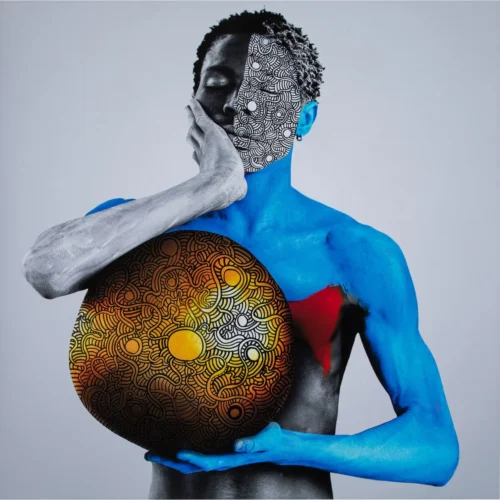
Aïda Muluneh
“The nature of consciousness may be the most difficult topic in science. It matters because you are your consciousness, but it is controversial because of two puzzles that have bedevilled thinkers for centuries. The first is the question of how the mind relates to the body – or, for those of a materialist bent (which is almost all neuroscientists), how the brain gives rise to the mind. This is called ‘the mind/body problem’. How does the physical brain produce your phenomenal experience? Equally confoundingly, how does the non-physical stuff called consciousness control the physical body?”
Mark Solms (The Hidden Spring)
This is the most fundamental question in all science but also the most basic question in philosophy, too, and it bleeds into everything else, too. It is a question with religious implications, too, because the other question which is its partner, is what happens to this consciousness when we die?
“The question of what we can know about minds from the outside – how we can even tell when they are present, for that matter – is the second puzzle. It is called ‘the problem of other minds’. Simply put: if minds are subjective, then you can only observe your own. How, then, can we know whether other people (or creatures, or machines) have one at all, let alone discern any objective laws governing how minds in general work?”
Mark Solms (Ibid)
The mind/body problem, together with the ‘other minds’ problem (and death) remain completely opaque. Given these questions it has often occurred to me that human beings should, logically, being spending most of our lives exploring these problems. If one thinks they are a problem. But death certainly looms as something like a problem I would posit. These issues have been talked and thought about since the dawn of humanity — the ‘why is there something and not nothing’? Instead humans invest most of their energy in distracting themselves from these questions.

Beverly Fishman
Now Oliver Sachs became famous as an author of books about extreme psychological problems and brain functions. Often quite bizarre problems. Solms notes that Sachs colleagues often derided him for his literary career. This primarily because of the deep seated bias against Freudian notions of the mind. The neuroscientist was interested in sleep and wakefulness, because the quantity of each could be measured, but shied away from examining the contents of sleep, for example. Measurement was an end in itself, and this is true of much scientific research today. Blame Karl Popper for a lot of this, who made falsifiability the core of this thinking (sic).
“Those who did take the subjective perspective into account were not taken seriously by proper neuroscientists. I am not sure how many people know that Sacks’s publications were widely derided by his colleagues. One commentator went so far as to call him ‘The man who mistook his patients for a literary career’. This caused him a good deal of distress. How can you describe the inner life of human beings without telling their stories?”
Mark Solms (Ibid)
And this is something I have written about a good deal. In one sense everything is a story. In fact (as noted in my last blog post in fact) there seems to be a narrative at the very earliest consciousness of infants. Solms recounts his road from strict neuroscience to psychoanalysis (without abandoning neuroscience) and how a workshop led by a professor of comparative literature (Pierre de la Porte) afforded him a breakthrough regards Freud. Without going into the details the point was that around 1895 to 1900 Freud shifted his position on neurological studies, determining that the science of the time was not advanced enough to solve the riddles of consciousness. He turned to psychological study. Or more fully turned to psychology.
“Freud’s change of heart brought ample compensation, though. It forced him to look more closely at psychological phenomena in their own right, and to elucidate the functional mechanisms that underpinned them. This gave rise to the psychological mode of investigation that he went on to call ‘psychoanalysis’. Its fundamental assumption was that manifest (nowadays called ‘explicit’ or ‘declarative’) subjective phenomena have latent (nowadays called ‘implicit’ or ‘non-declarative’) causes. That is, Freud argued that the erratic train of our conscious thoughts can be explained only if we assume implicit intervening links of which we are unaware. This gave rise to the notion of latent mental functions and, in turn, to Freud’s famous conjecture of ‘unconscious’ intentionality.”
Mark Solms (Ibid)

David von Schlegell
Freud saw through his clinical work that patients were not indifferent to their inferred unconscious intentions — they repressed or resisted the causes of these intentions. They did this to avoid the emotional distress these intentions caused.
“These findings (obvious today) showed Freud that some of the major motivating forces in mental life are entirely subjective but also unconscious. Systematic investigation of those forces led him to his third fundamental claim. He concluded that what ultimately underpinned feelings were bodily needs; that human mental life, no less than that of animals, was driven by the biological imperatives to survive and reproduce. These imperatives, for Freud, provided the link between the feeling mind and the physical body.”
Mark Solms (Ibid)
And at this point it should become obvious that the derision of psychoanalysis by Popperesque scientists was itself a form of resistance. That emotions, feelings, are deeply embedded in psychological processes. I have said before that those most hostile to psychoanalysis are the ones often most in need of it.
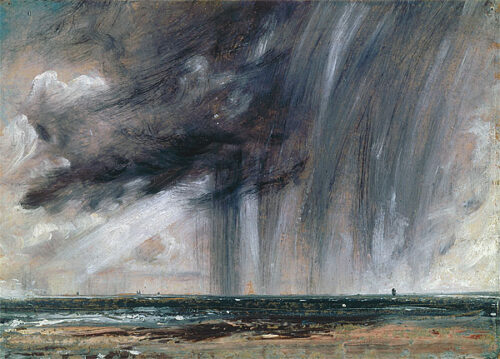
John Constable (1828)
Now Solms makes really critically important points around the idea of brain science today. He describes how brain imaging shows certain areas in the brain become highly active during sleep — areas associated with wishing and seeking. And also recounts a patient who had a tumour removed from just beneath his frontal lobes but suffered a haemorrhage during the procedure. He suffered damage to areas in his forebrain associated with memory retrieval.
“For example, Mr S thought he was in Johannesburg (his home town) but he had in fact just travelled to London to consult me. He had no memory of the journey. When I corrected him on that score, he insisted that he could not possibly be in London. I therefore asked him to look out of the window, since it was snowing, which never happens in Johannesburg. Initially he looked shocked, but then he composed himself and retorted: ‘No, I know I’m in Jo’burg; just because you’re eating pizza, it doesn’t mean you’re in Italy.”
Mark Solms (Ibid)
The questions lurking around the edges of all of this is what we mean by “I”. Because finally this is the core philosophical question of being human. What is “I” and why does it die, and what does all that mean? The only reason death is frightening is because we fear we will lose this “I”. And that’s all we have. And what is meant by wishful, for example. In dreams the wishful part of the brain is activated, stimulated. But what is a wish? A desire for something we do not have. But this is hardly a precise definition. The Cambridge dictionary’s first entry is “used with the past simple to express that you feel sorry or sad about a state or situation that exists at the moment:”. The second entry is: “used with the past perfect to express that you feel sorry or sad about a particular action in the past:.” These things are very different. And there are several other ways that word is used. Here we need a phone call to Wittgenstein.

David Seymour, photography (Spain 1937)
To circle back to culture in all this, I think it is easy to see how repression and resistance play a huge role in how culture is created and consumed, both.
“The id, cut off from the external world, has a world of perception of its own. It detects with extraordinary acuteness certain changes in its interior, especially oscillations in the tension of its drive needs, and these changes become conscious as feelings in the pleasure–unpleasure series. It is hard to say, to be sure, by what means and with the help of what sensory terminal organs these perceptions come about. But it is an established fact that self-perceptions – coenaesthetic feelings and feelings of pleasure–unpleasure – govern the passage of events in the id with despotic force. The id obeys the inexorable pleasure principle.”
Sigmund Freud (An Outline of Psychoanalysis)
There is much debate about where certain functions are located in the brain. Is the ego in the brain stem or the cortex? Etc etc etc. But Mr.S., the man who ‘knew’ he was in Jo’burg and not London, is a fascinating subject because his confabulations are deeper versions or more acute versions of what we see in Donald Trump today. And that is no exaggeration. But for art and culture, the creative aspect is a part of system of feeling, and of intuition. Something that feels uncanny most of the time. And I was thinking, to digress a moment, how contemporary surrealism seems, finally, to fail often — for me, exactly because it is the opposite of what it claims. Its far too NOT uncanny. It is a calculated surreality. I watched Giorgos Lanthimos’ film Poor Things(2023) the other night. Now Lanthimos is very interesting and I love Killing the Sacred Deer (2017), which is unsettling exactly because the reality created in that film is embedded in the form. And the acting is unsettling and sincere. But ‘Poor Things‘ works much less effectively. And it is the more overtly surreal. And part of the problem is that it feels doubly removed from the audience ; it is both a period piece AND full of fantastic images (flying machines in Victorian/Belle Epoch Lisbon, etc) and narrative devices. It is like a presentation of ‘surreal’. (what I once called the David Lynch ‘weird effect’). Its also found in a director like Alejandro Jodorowsky — who certainly has his virtues (and is still with us at age 97) — but is finally creating this calculated kind of ‘surrealism’ disconnected from the world. Or I should say disconnected from the creator. Now I get Poor Things is a gloss on Mary Shelley and Robert Louis Stevenson and I can even sort of respond to that. And probably that needed to be more overt. In fact I’m pretty sure it should have been. But finally it feels very modern and performed in a way that ‘indicates’ the surreal without being the surreal. Killing the Sacred Deer (and even his first feature, Dogtooth) are anchored in a reality I share. And also echo their hiistorical antecedents . Poor Things should have explored why we still read Frankenstein and Dr Jekyll and Mister Hyde. One aspect of the uncanny is its familiarity. And there is a paradox in that. Hollywood TV and film is the wrong kind of familiar. Basil Rozlaban’s review touches on another problem…
“Maybe that’s because Bella and the vast majority of the other characters come from upper-class backgrounds. Bella’s detour in Alexandria seems to be her first inkling of her privileged class position. She encounters poverty for the first time and pities the “poor things” she sees there. She is briefly animated to help them, which she does by naively donating a ton of money via a middleman who promptly steals it. Then, seemingly, she forgets about the whole thing. Are we supposed to see this as a satire of liberal charity initiatives or is it meant earnestly?”
Basil Rozlaban (Left Voice)
I was reminded, as I read through the reviews of this film, how much attention everyone gives to the set design and that in turn reminded me of Frank Lloyd Wright’s neglected masterpiece, the Johnson Wax building in Wisconsin. A visionary structure, impractical perhaps, but truly ahead of its time. Also more fantastical.
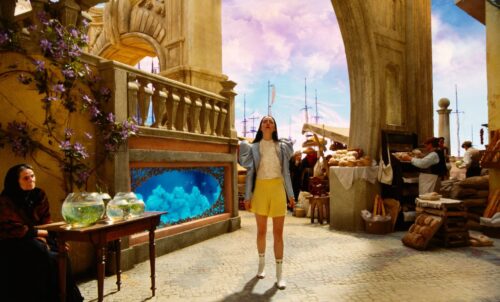
Emma Stone in Poor Things (dr. Giorgos Lanthimos)
Like a lot of today’s culture, the lead characters and the backdrop is upper class. The recent Jon Hamm vehicle Friends and Neighbors is a perfect example. Meant to skewer the haute bourgeoisie, what it really ends up doing is being a travelogue to ruling class commodity indulgences. And I think a lot of the writing for Friends and Neighbors to be far above average for Hollywood. But again, this makes Mr In-between a unique case.
But I digress. My point with the Solms book (which is just outstanding it should be added. He is a very good writer for one thing) is that Freud and psychoanalysis remain the best starting place for most discussions of contemporary society. And then the best of our entire philosophical tradition. And that’s a sort of loaded remark I realize.
Anyway, the issue that Solms tackles is really what do humans do with ‘needs’ and from whence arises consciousness. And maybe its my age but this feels increasingly like the most pressing question to answer. Aside from the political nightmare we are all in, I feel increasingly driven (sic) to look for illumination on the subject of consciousness. There is a giant civilizational edifice out there and yet rarely do people talk about consciousness and death. And I suppose the political overlaps — the kitsch political theatre of Milei is proof of that. One cannot ponder purely philosophical questions as if Trump or Zionism didn’t exist.
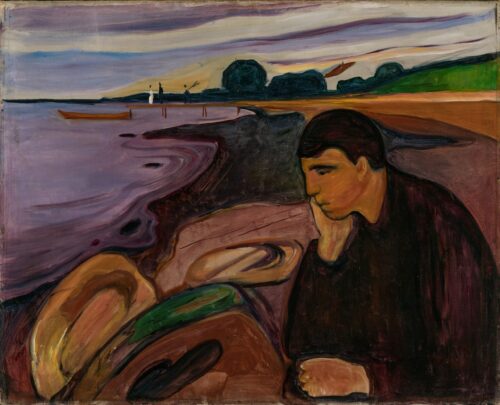
Edvard Munch (1894)
Solms notes that we are complex organisms with complex needs which require often competing means of satisfaction. Our interior lives are also largely still invisible to us. For all the advances in brain neuroscience, our lives on a day to day basis remain not hugely different than they were 3000 years ago. And this is a basic problem for science. And in this case, brain science. Or the study of consciousness. Once (and Solms does this, too) one starts using equations one is leaving the world of actual theory — which is perilous enough — and entering a world of laboratories. I have written about this vis a vis quantum theory. If you need a Hadron Collider to figure out a problem, then I’m wondering the relevance of that problem. A universe of unseen particles is valid and important — I think anyway but I’m not certain — because since Einstein’s special relativity paper things have not advanced much. Is that because this world is just so cut off from everyday life? Higher math is beautiful and full of insights, but at what point do those insights reach a cul de sac of meaning?
Specialization is a strange double edged principle. In what way does particle physics relate to the study of our unconscious? I think it must in really profound ways but my science is not good enough to tackle it. But in what sense is our brain like the galaxies of space? The people of arrival (the earliest homo sapiens) …per John Berger … were only a tiny tiny tiny blip of time on a galactic scale.
T.J. Clark has a beautiful essay in the London Review of Books just now, on the cave paintings at Chauvet.
“Having stressed how little we can be sure of 37,000 years ago, I now offer a series of hypotheses concerning speech and depiction in the Aurignacian world. They are an outsider’s speculations, meant to bring a set of questions into focus – to propose that these may be the questions, and that so far they’ve hardly been put. The questions are about language and visual depiction as coexisting forms of life. By that I mean two specific and different ways of being, two ‘views’ of what human being consists in, two kinds of encouragement to act, manipulate, assess, stand back from, investigate, see as a whole, think-of-oneself-in-relation-to. These two forms of life, linguistic and pictorial, were no doubt by the time of Chauvet deeply enmeshed. But enmeshing doesn’t equal peaceful coexistence. Any more than, say, the sacred and the secular over the millennia to follow. (Was anything sacred to the Aurignacians? Hard to say.) { } This is an art of high abstraction, but in the service of a shameless ‘reality effect’. ‘Disappearance from the scene’ equals entry on stage, in front of the torches, here where we are. I want, to repeat, to think of the depictions on the cave walls as an answer to language, and of the line of escaping bison as a demonstration of depiction’s ability to twist and reframe the illusion at will, and in doing so reveal its machinery – its syntax, if you like. Here’s what depiction is! The force of that demonstration derives in great part, I’m convinced, from its implied negative: Here’s what language is not. To justify that conviction I have to say more about what these image-makers – these users of language 37,000 years ago – may have thought and felt language was. What was using language like for them? { } Dreaming, to repeat, or something like it, may well have preceded language itself, perhaps as a means for the mind to stay partly awake in sleep and stay on terms with its percepts and concepts. Perhaps sequences of images in sleep prepared the way for sequences of sound, propositions. But dreaming is a constant travesty of ‘how things are’. Language, when it came, may have seemed almost like dream’s instrumentation, its invasion of the waking day. { } As a good modernist I warm to much of this. Likenesses can be trivial and deceptive. But so can speech acts. Supposing we ask again: why do certain likenesses, or traditions of likeness-making (the Upper Palaeolithic, the Tang and Song, the sixth-century Greek, the line from Giotto), come to matter so much, and then be subjected to centuries of imitation and variation? My answer would be: because the question of what the world is occurs naturally as an aspect of human affairs – especially in the early stages of human society – and likeness is an obvious starting point for inquiry.”
T. J. Clark (Night Visitors, LRB 2026)
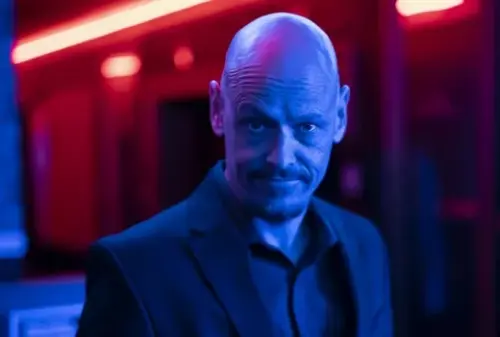
“Mr. In-Between “(with Scott Ryan) 2026
Clark calls the cave paintings an ‘anti-cinema’ a bit later.
The question of what the ‘world’ is seems essential. Clark thinks dreaming came before most everything else. Our brain stem lighting up at night long before there were instruments to measure it. Was the word for ‘dream’ one of the first words? I suspect it was.
I have said before that cave painting was theatre. It was also an alphabet. It was the primal scene enacted. Someone got up one night (always at night) and painted as he danced or spoke. The first stage. This was the ur-play. And it was about our unconscious.
Solms states that feelings evolved. And no doubt they did, but I wonder how much exactly? I think its’ wrong to imagine early Homo sapiends having in some way primitive feelings. Whatever is meant by that. If one feels angry, say, there is a story to access about this. Did cave dwelling early humans get angry? Sure, but was it less complex? I don’t think so. I might get mad about a mistake in my bank statement or my in-laws or Zionist genocide. But I’m not sure that is different than cave dwellers anger at not killing the prey and being hungry. The internal narrative is shorter perhaps, but not the feeling. The feelings, the emotions are likely the same. But what do I mean by emotions? This sort of thing, almost a game, can be played about anything. But its still valid. I know where in my brain neural activity increases when I am angry. Or hungry. I know where in my brain the neural activity lights up when I desire. But there are a million qualities of desire. Did cave-dwellers desire the same way we do? (well, most of us). I doubt it. But maybe I should say did they tell themselves the same narratives about desire? Absolutely not. But what is it I feel when I desire something or someone? I ‘feel’ intensely but an undifferentiated intensely — I then find the words and grammar of my desire. Or anger for that matter. My interior narrative is conditioned by history, as I understand it, and by my place in society. Did the cave painters at Chauvet narrate their desire? I feel strongly that they did. Their narration was different certainly. Their vocabulary was limited (we assume) but I think their gestural grammar was probably bigger than ours and possibly even more complex.

R. H. Quaytman
This does start to feel very Wittgenstein’ like. I have always felt Wittgenstein was deeply interested in metaphysics but searched, endlessly, for an approach to it. Remember Wittgenstein came out of that cauldron of intellectual ferment that was Vienna at the end of the 19th century (born in 1897). And part of what is never understood about the revolution in thinking that was given birth in Fin de Siècle is that most all of was it was colored by metaphysics. By ideas of the spiritual. In comparison with today, it was an era of great religious and transcendental thinking — a search that informed most of the artworks from that era. Fin de Siècle means ‘end of the century’. And while much beyond spiritualism took place in the arts, certainly, I would argue the spiritual informed everything, and anxiety. The age of spiritual anxiety, then. But those who so heavily critisized the spiritual (Nietzsche, Kierkegaard, and a tad earlier Schopenhauer) were also themselves spiritualists. Nietzsche hated Christianity so much he became the world’s greatest Christian.
World War one marked the end of this spiritual search. Perhaps the arrest of Oscar Wilde was foreshadowing (1896). And in France there was a decline in optimism that began before 1905.
“Nothing is really beautiful unless it is useless; everything useful is ugly, for it expresses a need, and the needs of man are ignoble and disgusting, like his weak infirm nature.”
Théophile Gautier ( Jordan Kistler, Arthur O’Shaughnessy, A Pre-Raphaelite Poet in the British Museum, 2016)
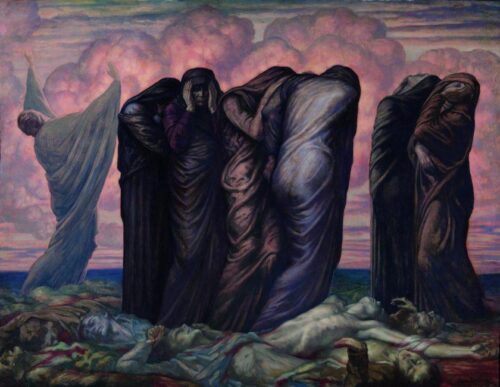
Jean Deville (Les Meres, 1919)
The point is that Victorian ideas of culture as moral instruction were upset in the late 1800s. The last twenty five years, probably. But then WW1 stamped the horror of global war on man’s consciousness. A stamp that has lasted over a hundred years. And one followed by the rise of Fascism in Europe.
But the waning of the Fin de Siècle movements brought revanchist moralism, too. This was the foundation of the acute anxiety of the age.
“The Victorian public’s obsession with degeneracy, criminality, and moral decay proved fruitful for many Gothic writers. { } Fin de siècle Gothic authors tended to set their tales in the heart of London and, in keeping with the Urban Gothic tradition, depicted it as a labyrinthine space designed to conceal criminal deeds. The malevolent cityscape was the perfect home for iconic criminals and monsters. We see in Wilde’s The Picture of Dorian Gray and Robert Louis Stevenson’s Strange Case of Dr. Jekyll and Mr. Hyde (1886).”
Sophie Rain (What was the Fin de Siecle)
This is mostly right, although there were plenty of non London tales of Gothic horror. But London did take on a kind of psychic geography of moral threat. Whitechapel and Jack the Ripper becoming a kind of epicentre. And it is worth noting the colonial backdrop to so much of this. The European powers plundered and raped and enslaved the global south. The Gothic tales and preoccupation with the supernatural were projections of colonial guilt and repressed shame. And the legatees of this three hundred year nightmare include today the richest man in the world. Forgive the side bar but Elon Musk is the richest man in history (or close to it) and also visibly the most miserable. From hair plugs to his constant yapping on social media, increasingly making few bones about his toxic racism, and as one commentator jokingly put it, ‘Musk vows to keep having children until one of them likes him’. My point is that Freud (alongside the inventions and discoveries of the age, including many optical devices like the microscope) turned human vision inward to what was previously unseen. Or at least it did it in new ways. But Vienna and middle europe, London and Paris, all became colonial monsters, too. The *uncanny* was found in a dialectic between morbidity and religious dreams. The idea of an unbearable reality forced to express itself in nightmares and neurotic symptoms reached peak acuity at this time. At least for white Europe.

Marc Riboud, photography. (London 1954)
I will leave here with a quote found in the Solms book…
“It is undeniable that some organisms are subjects of experience. But the question of how it is that these systems are subjects of experience is perplexing. Why is it that when our cognitive systems engage in visual and auditory information processing, we have visual or auditory experience: the quality of deep blue, the sensation of middle C? How can we explain why there is something it is like to entertain a mental image, or to experience an emotion? It is widely agreed that experience arises from a physical basis, but we have no good explanation of why and how it so arises. Why should physical processing give rise to a rich inner life at all? It seems objectively unreasonable that it should, and yet it does.”
David Chalmers (Journal of Consciousness Studies)
The problem with this question is, again, an appeal to science. He asks how it is these systems (organisms) are subjects of experience. Or why when cognitive systems engage with visual stimulus there is an information processing. And the answer is why not? The universe, our ‘self’ is not a laboratory. We live within magic — humans have found magic in saying something aloud or scratching colors on walls for thirty seven thousand years. The real question is why we wake up screaming still?
To donate to this blog use the paypal button at the top of the page. Donations also support the Aesthetic Resistance podcasts https://aestheticresistance.substack.com/
Nothing done here is montezied. But we accept donations !

Excellent. The mentions of Freud and surrealism in film make me wonder what your thoughts would be on The Boy and the Heron… the first genuinely intelligent surrealist film I’ve seen in ages.
You’re so sophisticated. Sohpisticated heart. Brigite Bardot has your respect. Was she sohpisticated? I try to understand your mind, your heart. So sophisticated. Sophisticated family. Literate, moral, just. I’ll read more. You say you get it right, always. Never seen you get it wrong, nor anyone. That’s because you read. Freud. Lacan.
“for those of a materialist bent (which is almost all neuroscientists), how the brain gives rise to the mind”
Perhaps the whole body is the thing which gives rise to the mind, or even the body and its immediate surroundings (’embodied mind’)
Ive not seen it, but I will make a point to find it.
that is, in fact, a topic. And i hope to write more on this. Thanks.
Johnny Conspiranoid – have you ever thought consciousness gives rise to the body?
I do wonder about penal reform. Many people are proud to work in penal reform, but if people make moral mistakes i’m nor sure we should help them. Many of them are so so sociopaths and perhaps if we encourage enough moral rigor and puritanism in society we can encourage more of that Japanese/Korean shaming and the outcomes result from that.then there wouldn’t have tears, nor prisons. No pain, just goodness. No need for compassion, it’s such a limited exhaustove resource, juggling the allocation is tiring.
The piloting of consciousness through these bodies is a strange thing.
@Sarah
I’m not sure who of us can lay claim to floating above these “moral mistakes”…but even granting that, I’d protest that the adjudicating of morality is far from the purpose, stated or effectual, of a penal system….
@drdre
What is that purpose of a penal system then? As it stands, and (humor me if you like, i’m listening) how one might like to imagine it? For me, I think abolish the whole thing. But, I think humans will always have bloodlust and the group will always outcast someone for their deviance and sins. For this, there is suicide.
@Sarah
I’ve never been accused of excessive brevity, so I will try not to digress too much.
Perhaps on some level we agree. There is a case right now that I keep seeing, Gerhardt Konig. An anesthesiologist took his wife hiking in Hawaii, trying and failing at the peak to cast her down over the edge. She had, six months previous, been found to be flirtatiously texting a coworker, the whole thing rated PG at worst. Never a held hand between them. This was enough however to have his punishment reduced from attempted murder to attempted manslaughter, and his team is in the process of trying to have even that overturned.
On some affective level it bothers me. Imagining being at the hands of an ego so wounded, I feel retributive. In reducing his charge, I feel that his moral failure has not been punished enough. A moral laxness in him, a violent misogyny, coddled by society, and so on.
This is all to your initial point. A penal system that does and should in some fashion adjudicate morality. My belief in that on some level is proven by my affective response to Gerhardt Konig: he got away with it.
And yet I believe that affective response of mine in large part is informed by media-driven narratives which we of course cannot disentangle cleanly. Taking the penal system in broad, the vast majority of it litigates traffic violations and non-violent drug offenses. Murders, assaults, gun crime, much lower proportionally.
Nancy Grace and CNN and other such spectacle machines take up such mind-space for the average citizen that most would probably estimate some 50% of cases that go through the courts are clear-cut moral parables, with an aggrieved victim, but most often the defense is the state itself, the abstract sense of order.
What is the purpose of a penal system, then? In the United States, I believe its material function is an amoral preservation of order. Great blossoms of spectacle make it feel as though the issue at hand is morality, and perhaps above all the viewers’ own safety, and the safety of their property. Its material function is the preservation of order, and in no small part the preservation of the existing order of capital.
Then, back to the original point of penal reformers. I don’t mean to excessive lionize the profession one bit. I’m not even so familiar with it or its pedagogies or what have you. And if we’re being terrifically blunt, most similar professions are loaded with ineffective liberals. My only concern is to properly name the beast. Implying that it in any way successfully adjudicates morality seems too credulous: most of the nation’s most immoral sociopaths hold office and will never have to face it.
Dre, I think you’re getting close to something here. May i offer another piece of this puzzle? I read a substack article posted recently about the anomalies in those Idaho student murders in late 2022. I think the author titled it Liedaho murders or something similar. The point is that the absence of any pretense toward a fair trial doesn’t necessitate a grand conspiracy. It occurs because all the power players’ interests are served by the outcome. Chilling.