


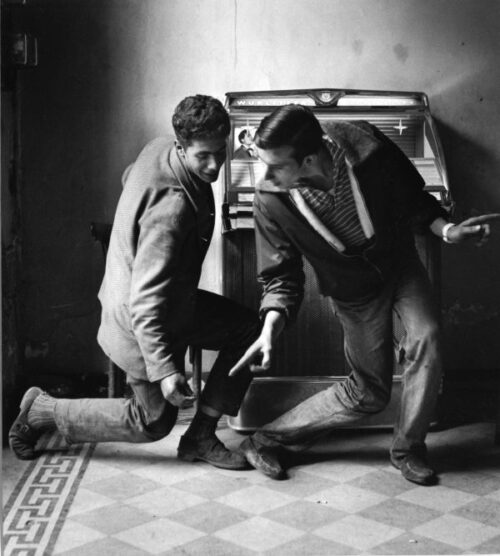
Mario Cattaneo, photography. (Naples 1956)
“The sun has never seen any shadow.”
Leonardo Da Vinci (Notebooks)
“…history cannot be more certain than when he who creates the things also narrates them.”
Vico (The New Science)
“History begins with bestial giants.”
Vico (The New Science)
“Though the things of Nature are given in common, man (by being master of himself and proprietor of his own person, and the actions or labour of it) had still in himself the great foundation of property.”
John Locke (Two Treatises of Civil Government)
There are several seemingly disparate points I want to connect here. For some reason I feel they have emerged into the zeitgeist, as it were, together over the last few months. One has to do with falling birth rates across the western world (and the symptoms I see now that are perhaps a causal factor, too) and I feel these points ‘are’ connected. The second is paranoia — and the police, and government. And third is a new infatuation with ideas of reading, of the classics, and how that prediction (from The Atlantic article on the decrease in literacy) about reading becoming a niche ‘hobby’ (like orchard growing or collecting buggywhips) is already true. And of course Nolan’s pedestrian (and superficial) film of The Odyssey, has been a trigger mechanism. The paranoia of which I speak began I believe in the 60s. Or just before. Pynchon and Kesey and Burroughs.
But this has also led me to ponder how entertainment, the entertainment industry, views storytelling. How we in the 21st century, nearly a century after Edward Bernays and fifty years after marketing became an industry, view the idea of narrative. In Hollywood today the idea of starting a story at the start is viewed as horribly old fashioned. And yet, even the most convoluted storytelling in cinema today feels as if it must always have a ‘big’ beginning. And the paradox is that Greek tragedy and Shakespeare do not. Or maybe I should say, Shakespeare’s ‘beginnings’ are never what they seem.
“Homer is where European literature begins for us, so we can’t know whether there was heroic precedent for the in medias res start of the Iliad, though obviously if poets are working on different parts of an epic cycle not all of them can start from the egg. What can be studied is the effect Homer’s device had on later writers, and how they modified it. Nuttall makes much of the point that whereas Homer begins by calling on the Muse to sing, Virgil at once says, Arma virumque cano: that is, he is going to do the singing himself. Here is a postural shift into what used to be called ‘secondary epic’; there will be a formal invocation of the Muse but she has to wait a while, and the song will now come from within. Nuttall identifies this as a shift into psychologism or a new kind of egotism, presumably the sublime variety.”
Frank Kermode (Making a Start, LRB)
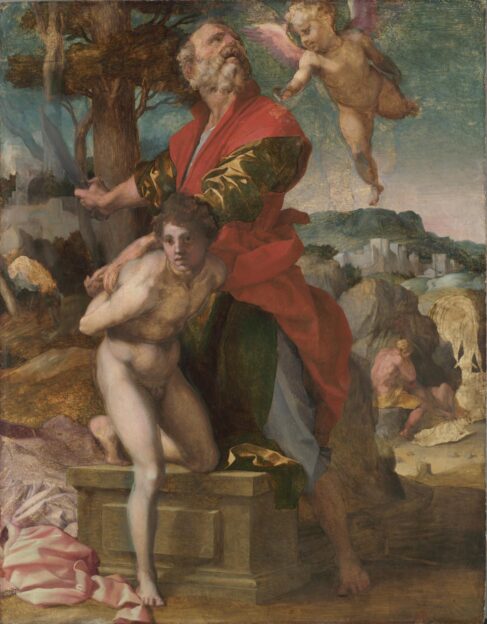
Andrea del Sarto (The Sacrifice of Isaac, 1527)
This is from a London Review of Books piece by Frank Kermode — primarily a review of A.D. Nuttall’s book on Homer and epic poetry. We will get into Nuttall more below. But Tony Nuttall was one of the last of the truly erudite classics scholars who came out of the Cambridge/Oxford universe. I will add he was especially elegant and penetrating on the topic of Shakespeare. But I digress. What is so painfully missing in contemporary criticism (of both literature and film, and even architecture and the fine arts) is the contemplation of the moral. Nuttall viewed literature philosophically. If we stick with Homer for a moment, Nuttall makes a very salient observation about the consciousness (and unconsciousness) of the poet — and it goes back to Plato, but also unavoidably to Aristotle.
“Sidney transformed mimesis, quietly shifting it from the poet to the excited reader, who emulates and copies the great figures of ideal art. But we cannot leave the matter there. Sidney also revived Platonist theory in such a way as to cancel a modification carefully introduced by Aristotle. It is a restoration which involves a considerable irony.I have said that Sidney changed the nature of the poet, turned Aristotle’s copyist of probabilities back into a freeranging creator or maker. I use the designedly brutal word copyist’ in order to acknowledge the element of mere imitation which really is involved. But as soon as we say `of probabilities’ we are requiring the exercise of intelligent imagination. That is why Aristotle thought poetry was `more philosophical’ than a mere chronicle of events. Now this account of Sidney’s poet as moralist creator holds good as long as we take reality to be constituted by the available world. But Plato, as everyone knows, believed this world to be a tissue of inadequacy, while true reality lay beyond, in an ideal realm.”
Anthony D. Nuttall (Why Does Tragedy Give Pleasure?)

Clara Peeters, 1615.
This calling upon the Muse to bring forth the poem (the beginning of The Odyssey is interesting because if you were to do no more than eliminate the reference to the muse or goddess you would go a long way in making the text feel modern and sort of existential– by which I mean questioning of self, finally. In a line with the King James Bible and Kafka).
“Milton reverted to Homer and so, it is alleged, ‘brought back the Muse from the dead’. The great 16-line sentence that begins Paradise Lost opens with a proposition, ‘Of man’s first disobedience …’, but it is the Muse who is required to sing of that subject, and she is invoked – it is the first of the four invocations in the poem – in the first main verb, which occurs in the sixth line (‘Sing, heavenly Muse’). Thereafter this Muse, unlike Homer’s, is seemingly identified with the Logos…”
Frank Kermode (Ibid)
Why is this important? Because a film like Nolan’s Odyssey is without choice. Is unaware of choice. And I think that is a bit of a problem. And even if one goes back to the golden age of Hollywood (mostly the 1940s) and picks any quality ‘noir’ (see maybe Out of the Past or Criss Cross, 1947 and 1949 respectively, and arguably the two greatest noirs of all time) one sees two different but philosophically similar narrations. Both these films (and Sunset Boulevard, obviously) have voices that come from beyond the grave. Not literally in Criss Cross, but emotionally.
“ I was careful to say earlier that even one-to-one mimesis of the actual involves the formal independence-the `non-reality’ -of the signifier, and to add that Aristotle’s conception is in any case not of a one-to-one `mirror-mimesis’, but proposes the interposition of a further space, making mimesis hypothetical. One wonders what Aristotle would have said about portrait painting: perhaps that our pleasure becomes truly aesthetic only when it is rendered hypothetical by the death of the subject. It is striking that our inability to check the photographic accuracy of Rembrandt’s selfportraits does not begin to impair, it would seem, our ability to respond to them as great art. But-Aristotle would swiftly add-we crucially need nevertheless to know what faces can be like in order to understand how humanity can glisten in the thickening of the paint. Because we inhabit a causal continuum we can speak of real probabilities, and that is why it is possible for an art which treats no actual existent to deal nevertheless with the world we all inhabit. Drama is something simultaneously real and unreal, real at the level of probability, unreal at the level of “actuality (the medieval scholastic terms would be `act’ and `potency’).”
Anthony D. Nuttall (Ibid)
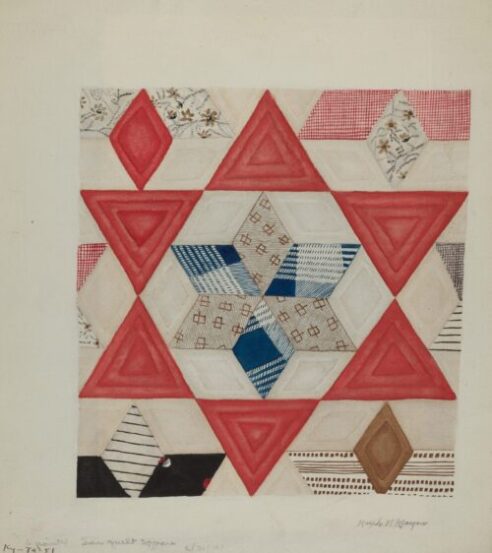
Shaker quilt pattern, Ralph Morgan, 1941.
This is why, or is a part of why much contemporary ‘fantasy’ is so tedious. I mentioned some of this in regard to Lanthimos Poor Things but its also true of David Lynch and Robert Wilson. And I will digress a moment here to reference a NY Times review of Wilson’s final production, an adaptation (sic) of Moby Dick. Helen Shaw reviews it. A quick note on Shaw. She attended Harvard, and an MFA in dramaturgy from ART/MXAT. She got a MacDowell Fellowship (so did I, to be honest but I never went to the residency). And she wrote for TimeOut and the Voice , Art in America, The Guardian, and Vulture.
Now, here is an aside, a quote: “1982. Antoine Vitez is enraged against the very notion of a ‘dramaturge’. This is one of his most constant themes: ‘As long as I am alive, he declares, there will be no dramaturge here, except in the sense of the one who writes plays.’ The German tradition of the dramaturge in his eyes is that of a policeman of the text who forbids the theatre artist ‘on the spot’ to seize hold of the scenic situation. The dramaturge introduces a legitimist politics into the theatre, with the director as his technical bag holder. What exasperates Vitez is this separation put in place between the textual exegesis, which produces meaning, and the actual theatrical gesture. This is because, for him, theatre is a form of thought, and there is no thought prior to it except the being of the text, which has no need of anyone, since it is the objective filter of the theatrical intervention.”
Alain Badiou (Rhapsody for Theatre)
Anyway, back to Shaw. Or more acurately back to Wilson. I really do loathe Wilson I have to say. Or loathed him. Painting people’s faces white does make a play ‘important’. It began about 150 years ago I think. It is now an avatar or signifier (more accurately) for ‘prestige’. Ooooh, soooo expressionistic. Yes, well.
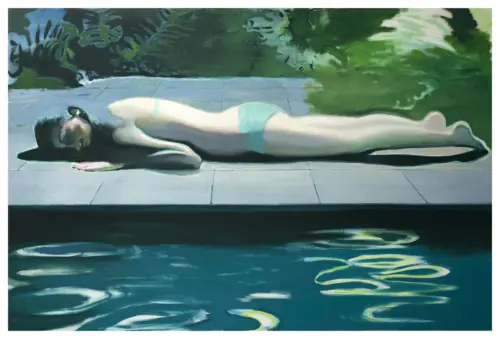
Jonathan Wateridge
“The adapter Robert Koall has stripped Melville’s story to its best-known elements. The rootless Ishmael (Raphael Gehrmann, endearingly naïve) yearns toward the sea; he grows fond of his tattooed ship- (and bed-) mate Queequeg (Yaroslav Ros, wearing glam-rock slashes of black paint); their whaling ship, the Pequod, is wrecked by the deranged Captain Ahab (Rosa Enskat) and his pursuit of the white leviathan Moby Dick. It’s no period production. Characters, typically for a Wilson show, look like German expressionist film stars: Faces painted white; hair in pompadours or flame-shaped quiffs; movements sudden and angular; mouths frozen in shocked, rictus O’s.”
Helen Shaw (NY Times review of Wilson’s Moby Dick, April 2026)
Well, is Ishmael ‘rootless’? That isn’t quite correct. Of course queer theory today sees Gueequeg and Ishamel as queer but I’d posit a more homosocial bonding as was common at the time. That itself, of course, contains homosexual aspects but glam rock pacific Islanders feels out of the spirit of the character. Queequeg is more Father than lover. Or elder brother. A female Ahab. Of course. Why not simply undermine the entire psychological underpinning of the novel as well as huge chunk of American literary history — a history which explains the American psyche better than almost anything else I can think of. It is also deeply reactionary. Interesting I was reading Treasure Island to my boys the last couple months and was struck with how Long John Silver is very much in the Ahab, Judge Holden, Ethan (The Searchers) and Thomas Sutpen tradition. The list is quite long. Puritan patriarchy runs like a red hot coil through American culture. And such figures are always destructive but also they are educators. The Icarus metaphor is in play. How close to the sun do you fly? And it goes back of course to Lear and Abraham (well, to Isaac and Jakob, as well). But, now back to Wilson, and to Shaw…
” The Romantic sight of Ahab, standing lonely against one such ocean projection, hair blown permanently sideways, might be my favorite of the show’s many beautiful images, although I’ve changed my mind twice since seeing it. Wilson’s vision was of another world. He knew about some alternate place, a pocket universe into which he could move an entire theater, audience and all. You would imagine that he would have created a galaxy of imitators, but somehow no one else has figured out how to do what he does.”
Helen Shaw (Ibid)
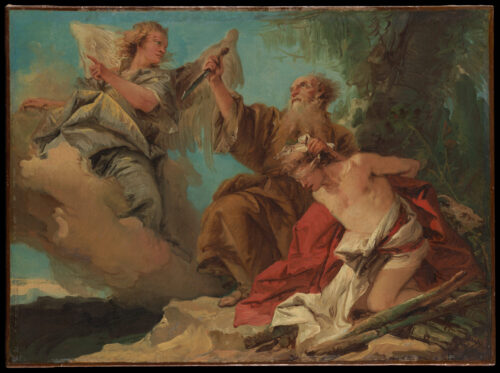
Tiepolo (Sacrifice of Isaac, 1750)
The question is, first, is the creation of another world a virtue? Second, another world is always this world. And therein lies the real problem. Another world is never, finally, *other*. And I return to Nuttall at this point.
“If the world with its griefs and terrors were not represented the emotions would not be activated-and they must be activated before they are discharged. Aristotle allows a separable, prior pleasure in the mere reading of a mimetic representation, the simple process of the learning what is here being represented. But, equally, the representation must not fuse with actuality or our tragic pity would lead to our rushing on to the stage to comfort the protagonist, our tragic fear to flight from the theatre. I was careful to say earlier that even one-to-one mimesis of the actual involves the formal independence-the `non-reality’ -of the signifier, and to add that Aristotle’s conception is in any case not of a one-to-one `mirror-mimesis’, but proposes the interposition of a further space, making mimesis hypothetical. One wonders what Aristotle would have said about portrait painting: perhaps that our pleasure becomes truly aesthetic only when it is rendered hypothetical by the death of the subject. It is striking that our inability to check the photographic accuracy of Rembrandt’s selfportraits does not begin to impair, it would seem, our ability to respond to them as great art.”
Anthony. D. Nuttall (Ibid)
As Nuttall notes, we can appreciate Rembrandt’s portraits (or Reynolds or even Warhols) because we live in causal continuum, as he puts it. Theatre is both real and not real. But it is always a ‘real not real’. A real unreality. The uncanny is only uncanny because it is familiar.
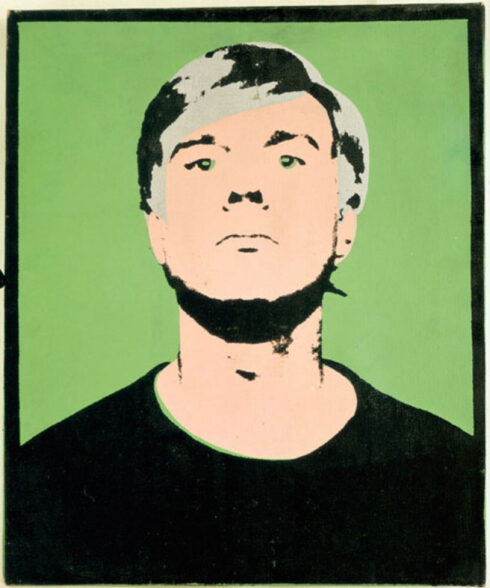
Andy Warhol (self portrait, 1964)
Now people will complain that Wilson is doing something different — that I am criticizing him for not doing what I want. And on one level, or in one sense, this is true. But its not true in the larger sense of culture as moral and philosophical — that causal continuum has meaning, it is operative in a dialectic with language itself. One cannot write like Shakespeare today because the codes and evolution of words has changed as well as how the meanings of words are established or dis-established. Why do ‘this’ as if it had anything to do with Moby Dick? Why reference Melville at all? One could easily create a Wilsonian seafaring play that employs an Ahab figure, as well as Lear or Abraham — but without the weight of Moby Dick‘s shadow — and sure I guess some will see that shadow as the point. And I can accept that. But while accepting it I am compelled to explore how that shadow is misread. Moby Dick is not a novel about hairstyles.
“(C.S.)Lewis knew about the second thesis of psychoanalysis in which the mechanisms of repression are emphasized. We are not only libidinal beings, we are also comprehensively repressed beings (indeed, if we were not repressed, there would be no such thing as the Unconscious). Therefore we are not allowed to enjoy the libidinal material directly; all sorts of alarm bells are jangling, the mind’s police are being mobilized. It is at this point that Lewis becomes clever. `Fine,’ he says, in effect, ‘I understand that.’ But if we’re not allowed to enjoy the libidinal material directly and are obliged to get our pleasure indirectly by way of muffling images, what is one to make of the medieval poem, Guillaume de Lorris’s Le Roman de la Rose? In this poem the plucking of the rose means exactly what Freud would have it mean, but the poet has sign-posted everything, made this meaning explicitly clear. The imagery, therefore, cannot be there to provide an essential disguise. It really looks very much as if the poet and his audience were interested in both sex and gardens-and in the rich imaginative commerce between the two.”
Anthony Nuttall (Ibid)
My answer to Lewis would be ‘yes’. But Nuttall’s book is about Tragedy, or more precisely, why Tragedy can be or is meant to be ‘pleasurable’. And this relates to ‘entertainment’.
“Not so very long ago a royal wedding or a great public celebration would have been incomplete without executions, tortures and autos da fe – a noble household without some person whose office it was to serve as a butt for everyone’s malice or cruel teasing … To behold suffering gives pleasure, but to cause another to suffer affords an even greater pleasure !”
Nietzsche (Genealogy of Morals)
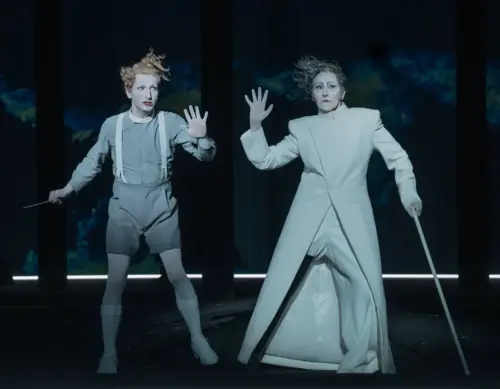
Robert Wilson’s Moby Dick (Brooklyn Academy of Music)
The problem with questions of morality has to do with the ambiguity of society overall. Today there is a massive social media outpouring of condemnation for sexual offences. The Epstein files triggered this although it has never been too far below the surface in a Puritan society. Gradually the definition of these offences has stretched. And once the age gets up to the legal limit and beyond the new gatekeepers of morality turn to ‘grooming’. A highly inflated definition. But it is also true that that child trafficking is rife throughout the developed (sic) world (if not beyond). And I cannot help but ponder the connections between plummeting birth rates, falling sperm levels, and economic hardship that is now reaching classes who never before had to worry about buying food — and with surveillance and the development and research surrounding stuff like Flock cameras (and Axon, et al).
There are daily reports of police using Flock cameras to track ex girlfriends or ex wives. It is an epidemic of cyber stalking. And all these things feel connected. On the one hand you have the lynch mob that sees pedophilia everywhere, and yet sees nothing worth discussing in sexual advertising (or haute couture) using young teen girls scantily clad. How much of this is their wishing they had gotten an invite to Epstein island? I suspect that schadenfreude is dramatically on the rise. Envy and projection. (and I also suspect a rise — already noted by many — in borderline personality diagnosis). If society coerces various repressions of aggressive impulses or drives, then compensatory mechanisms will be in demand. Schadenfreude allows us to experience pleasure in the fall of others without feeling guilty. Feeling better about yourself in comparison with the lowering of others — and also on a group identification level the exclusion of others from your own peer group. And there is an addictive quality to it since it is viewed as linked to the reward system in the brain. You get a dopamine hit from Schadenfreude.
“The human race has found a way, if not to abolish, then to defer and diminish the Darwinian treadmill of death. We send our hypotheses ahead, an expendable army, and watch them fall. It is easy to see how the human imagination might begin to exhibit a need, in art, for a death-game, a game in which the muscles of psychic response, fear and pity, are exercised and made ready, through a facing of the worst, which is not yet the real worst.”
Anthony Nuttall (Ibid)
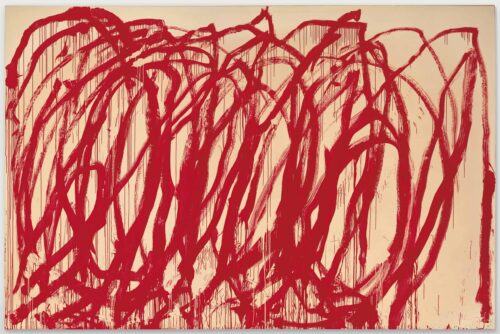
Cy Twombly
The flock camera abuses feel somehow significant. Resentment is everywhere in this culture. Trump is the walking (sort of) avatar for resentment. That he soils himself and is accompanied by a FOX-News blond diaper girl/acolyte, simply overflows (sic) with symbolism. And infantilism. It cannot be a historical accident that Trump and his posse; Hegseth, Rubio, Miller, are all childish sociopaths. And they have unleashed the worst impulses in an already fertile ground of psychopathy — the police and ICE agents. The administrations of control. There are shootings every single day and apparently the cyber stalking of ex wives and girlfriends is massive. That this surveillance technology has taken the form that it has is also not an accident. And then Zionism. There are no limits to the sadism of Israeli society. Literally none. Netanyahu got 26 standing ovations when he spoke to congress. The worlds most despised war criminal got TWENTY SIX standing ovations. This cannot be ignored. So in what way does culture today reflect this? Well, the obvious answer is that cop shows and violence on screen is hugely popular. But that is too simple. Often the most rancid cultural product is to be found in the stuff intended as a corrective to this mock violence. And here enters sentimentality as a topic. But more than just sentimentality, there is now a kind of cultural autism at work. And I can’t help but note the late Robert Wilson again. But this is true of all prestige product today (or mostly all). Sometimes it is overt and often it is subterranean; a buried secondary loss of affect, an adumbrated and stunted language. I often have the feeling that art today is the product directly of low sperm counts and physical infertility.
Dolly Parton died this week and media is awash in fawning tributes. Which is fine, Dolly was a gifted singer. She also had eleven siblings. Her mother married at fourteen or fifteen. And started having children immediately. This was rural Tennessee. But in an age of Epstein and grooming this is a topic best ignored.
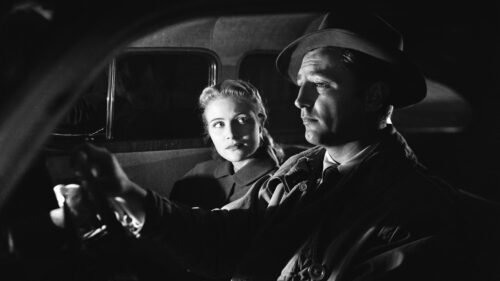
Out of the Past (Jacques Touneur,dr.) 1947
Trumps incontinence is the burlesque of Martin Luther and his toilet.
“Civilization began with water. It was by becoming imbued with this cleanliness of body and this fear of gods and of fathers that the giants dimin- ished to our normal stature. It was perhaps for this reason that from politeia, which in Greek means civil government, was derived the Latin politus, meaning clean or neat. “
Vico (The New Science)
William Empson noted in his essay on Hamlet that critic Clifford Leech was of the opinion that at the time Shakespeare wrote Hamlet there was a shift in audience’s expectations. A complex shift and an expression of this ambiguity (if that’s what it was, and it was, mostly I think) was the play within the play idea. Kyd had done it already and Shakespeare and his company were acutely aware of the competition.
“Clifford Leech (Shakespeare’s Tragedies) has pointed out that the “induction” was revived in four plays around the turn of the century, and argues that it marks a new kind of self-consciousness about the situation of being in a theatre; one which led to greater realism but rather began by excusing the absence of it (Antonio and Mellida, The Malcontent, Every Man Out of his Humour and Cynthia’s Revels{ } have been seen wailing on your stage here”. Shakespeare himself had hardly written a tragedy before. To have written or had a hand in Titus Andronicus, ten years before, only brings him closer to his current audience; his own earlier tastes, as well as theirs, were to be re-examined. Romeo does not suggest an Aristotelian “tragic flaw”. { } But he must have seemed an unlikely person just then to start on a great Tragic Period, and he never wrote a Revenge Play afterwards; we can reasonably suppose that he first thought of Hamlet as a pretty specialised assignment, a matter, indeed, of trying to satisfy audiences who demanded a Revenge Play and then laughed when it was provided. I think he did not see how to solve this problem at the committee meeting, when the agile Bard was voted to carry the weight, but already did see how when walking home. It was a bold decision, and probably decided his subsequent career, but it was a purely technical one. He thought: “The only way to shut this hole is to make it big. I shall make Hamlet walk up to the audience and tell them, again and again, T don’t know why I’m delaying any more than you do; the motivation of this play is just as blank to me as it is to you; but I can’t help it.’ What is more, I shall make it impossible for them to blame him. And then they daren’t laugh.” It turned out, of course, that this method, instead of reducing the old play to farce, made it thrillingly life-like and profound.”
William Empson (Essays on Shakespeare)
I find this a very credible theory. Beckett’s Waiting for Godot was the 20th century return to Hamlet. I cant go on. I’ll go on.
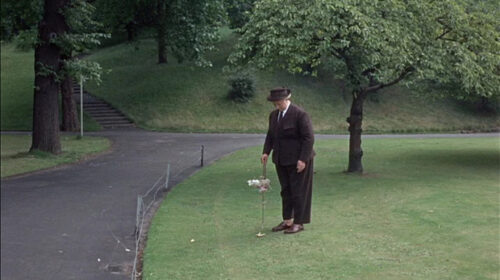
Blow Up (Antonioni dr. 1966)
Waiting and waiting and thinking about it, and in a sense Pinter was acutely aware of this, too. Following on from Beckett his early short plays– The Dumb Waiter and The Caretaker in particular — were doing much the same thing. For the shift initiated around the time of Hamlet gradually reknit its social cohesion and compromised in the person of Chekov. Society though has lost the ability to provide roles for many people. Inaction is really a sort of psychic paralysis.
Perhaps also under the influence of the 20th century novels but certainly under the influence of film, or at least film noir and a handful of European auteurs like Antonioni and Fassbinder. Antonioni’s early career was marked by the inability to act (sic). And then in Blow Up (1966) he created the logical endgame for this sort of existential crisis.
That Hamlet is tragic and Blow Up is not (nor is Godot, finally) has to do with the way film and the culture industry have interceded in how audiences see themselves as they sit in a theatre. Now Nuttall references Yeat’s poem on the Irish airman, and why he risked death — not for duty or patriotism but for something more elusive and closer to artistic experience (‘a lonely impulse of delight’). What Nuttall views as a Darwinian death game (via Freud). Today extreme sports, or cliff diving or whatever suggest something both more and less. It is perhaps a substitute tragic catharsis. But bungee jumping does not really provide anything cathartic. It is another ersatz experience.
It has always seemed misguided to juxtapose real life tragedies (school bus crashes into river killing fifty schoolchildren) with theatrical tragedy. This is just a confusion of category to begin with. Tragedy causes a very specific sort of experience. The problem (Nuttall’s problem, and others) is using the word ‘pleasure’. Art is not pleasurable in the same way as a cheeseburger or having sex. They are related perhaps, but barely. Tragedy is awakening but not ever truly pleasurable.
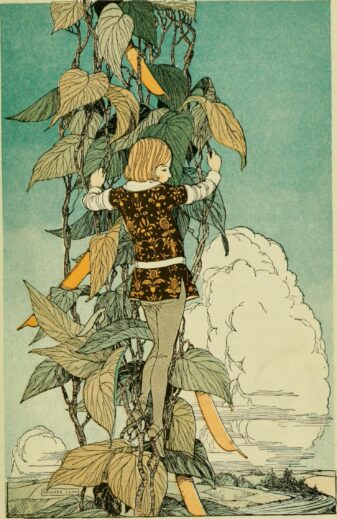
Mildred Lyon (illustration for Jack and the Beanstalk, 1922)

Luigi Ghirri
The hunter, perhaps alone, standing before the red bison on a cave wall, perhaps drawn a thousand years before he faced it, in what is now France, the mountains of France, is, must be, stunningly lonely. His hunter/gatherer group is probably very tightly knit, but it is small. How many? Estimates vary. twenty, twenty five, maybe forty or fifty. Later those groups grew into the hundreds. Later they built walls and tended gardens of a sort. They organized the curing of skins and hides. (skeletal dental records suggest a majority of their waking lives was spent pulling hides with their teeth to straighten and stretch them. But before that, in the first small groups, Neanderthal partners among the homo sapiens, the figure of the hunter in the cave is compelling and haunting. How much is lonliness learned? Was he alone often? Who did the painting on the walls? Was it done privately or in celebratory groups? As much as it makes a certain sense that these paintings were group affairs, celebratory or part of something like a festival, I also feel some were solitary and individual works. Were they always done in the fall? In the spring? It is hard for me to imagine at least some of these drawings were not done by a single artist. The contemplative quality is too great. And for me, they feel personal. But there are much older paintings than Lascaux. In Indonesia, at Sulawesi, in a remote and hard to reach cave there are drawings of pigs that date at 44 to 50 thousand years ago. And archeologists feel pretty certain areas of the Congo and central Africa there are yet to be discovered cave drawings. But Lascaux is the Sistine Chapel of cave art. It is simply hard to grasp just how monumentally awe inspiring this work is.
If I have a thesis here, in all this, it is that something was lost over the last thirty years or so. Maybe last fifty. And the loss began with the Industrial Revolution and the Enlightenment. The rise of science and what Adorno called ‘instrumental thinking’. The loss took the form of (gradually increasing) of an inability to experience grandeur and the metaphysical.

Cave art at Lascaux, France. (20, 000 years old, apprx.)
And there is an accompanying loss of the moral. I realized that I find careerism (at least as I get older though I always felt a revulsion in the presence of it) is the great disease of capitalism. And that the tension of winner or loser has made life unbearable in the capitalist West today.
“Freud’s myth of the rebellion of the sons against the father in the primal, prehistoric horde is not a historical explanation of origins, but a supra-historical archetype; eternally recurrent; a myth; an old, old story.”
Norman O. Brown (Love’s Body)

Sulawesi, Indonesia. (Cave art 44 to 50 thousand years old)
Norman O. Brown (Ibid)
Brown observes something significant, even profound here…that Locke kills Filmer’s fatherhood. Even if one might argue the history in this, it is the structural interpretation that matters. THIS is the truth of Freud. It is also the truth of art, and one might see this reproduced in Shakespeare’s King Lear. It is not an indentical re-telling, but rather an improvisational riff on the story.
“But the equality of brotherhood is a leveling in the presence of a father; it is a way of dividing what belongs to a father—”the father’s equal love.” Locke’s equality in the state of nature belongs to men as sons of God. Liberty means sonship. To make all men free and equal in the state of nature, Locke allows no man the status of father, and makes all men sons of the Heavenly Father. The phantom of fatherhood is banished from the earth, and elevated to the skies.”
Norman O. Brown (Ibid)
This is how cultural criticism should work.
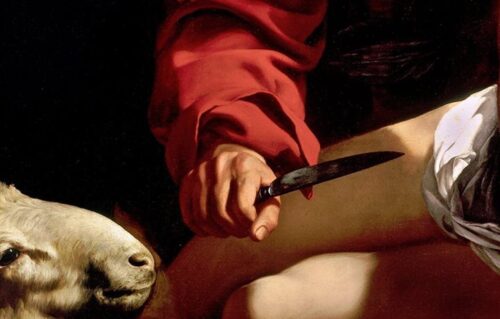
Caravaggio (Sacrifice of Isaac, detail) 1601
Shakespeare wrote Hamlet in 1601. (perhaps a year before, or even two). Caravaggio painted Sacrifice of Isaac in 1601 (perhaps a year earlier)
“Fraternal organization in the body politic corresponds to ego-organization in the body physical. As fraternal organization covertly assumes a father, ego-organization covertly assumes a super-ego.”
Norman O. Brown (Ibid)
The dispute between fathers and sons is over property. Sons are slaves, except sons are ‘free’. Enter Karl Marx, stage left.
“Besides the natural union of the sexes in the family of which Aristotle speaks, there is also unconscious hostility between the sexes; “an archaic reaction of enmity”; taboos which prescribe sexual separation, mutual avoidance; the castration complex.
Without an understanding of the seamy side of sexuality there is no understanding of politics.”
Norman O. Brown (Ibid)
To donate to this blog (and to the Aesthetic Resistance podcasts) use the paypal button at the top of the page.
Much to think about, as usual.
It’s dangerous to start thinking of social media use as ethnography, but I do, a bit, when I use TikTok. I know it’s a bad habit, but I invoke generational immunity.
“BookTok” is what they call the niche that reads books and makes videos about them. I have panned for and isolated a few observations about it which came to mind while reading this. The first thing I notice is precisely what you mention, a pre-occupation with the optics of reading classics, “racking up” classics, which represent Points for your self-image of being “disgustingly well-read” (a meme phrase which cropped up in the space and annoys me deeply). A particularly funny one I saw was someone challenging themselves to read every Pulitzer Prize winner for fiction. It’s common to track the number of books you have read in a month, number of pages, an obsession with the epiphenomenal “data” you generate while reading (which almost instantaneously becomes the end in itself). This whole micro-community venerates the classics while simultaneously making curios of them, trading cards to collect, whatever you got from them left to imagination and assumption (must be a lot–he’s read every Pulitzer Prize winner for fiction!)
On the same app: a middle-aged musician exposed for wanton texts to teenaged fans (fans of the music he made when he was 20, that is) pressuring them to BDSM engagements and so on. Nothing atypical, but the punchline, he was one of the most aggressive, grandstanding maker-of-statements on his peers caught for the same thing. “I’ve been faithfully married for 10 years–your heroes are texting high school girls.” Not a year later, divorce, the selfsame texts. Bitter about missing the Epstein invite as you say!
Also on the same app: groups of young men catfishing as underage women, persuading people to meet in public and then freely assaulting them, because they are, of course, predators. It is a Chinese finger trap (outdated I know) where you cannot even speak of it plainly without being accused of standing up for the rights of predators. The marks are, by design, pathetic, isolated, no-doubt porn-addicted men foolish enough to fall for terribly unsubtle catfishing and meet in a park. The men running the scheme are broccoli-headed and brainless fascists, complete tundras where you would normally find a soul, all too delighted to be body slamming strangers onto the sidewalk, because they have navigated the social media spectacle in such a way to find where this is not just okay but celebrated.
There is some common thread between these three that may be something like Schadenfreude. For the optics-obsessed readers, the broadcasted status and good-taste positions you above your peers and of course to a whole sea of non-readers. In addition, the instrumental thinking is present: by just consuming enough classics, the revelation can be expected to occur automatically, without a struggle. At the end of every Pulitzer Prize winner, salvation. The crucified musician exemplifies the demand to do this with morals as well, to have a flawless assemblage of “takes” which preclude you from criticism, as long as you attack the wrong takes with the appropriate viciousness. And then the pred catchers, of course, occupy sort of a spandrel, a blank space which the network of perfect projected morality cannot seem to account for, and, somehow, there’s no applicable rule against it. Unless that is, you’re a predator yourself?
“The rise of science and what Adorno called ‘instrumental thinking’. The loss took the form of (gradually increasing) of an inability to experience grandeur and the metaphysical.” I think about it all the time. I was born in 1993. Perhaps around when this wave started in earnest. Sometimes I feel like my dandelion has already been poisoned by its concrete. Or some metaphor less tortured.