



Ron Mueck
“In 1985, Postman, a friend and disciple of McLuhan’s, published Amusing Ourselves to Death. He argued that television had hijacked Americans’ attention and turned politics into cheap entertainment. “The problem is not that television presents us with entertaining subject matter but that all subject matter is presented as entertaining,” Postman wrote. “Television is our culture’s principal mode of knowing about itself.” At the time, the average American household watched more than seven hours of television every day, a number that would rise to nearly nine hours by 2010.”
Rose Horowitch (The End of Reading is Here, The Atlantic 2026)
“Evil denies the reality of death and all human limitations. It makes an insatiable, limitless quest the substitute for legitimate expansion of the individual self.”
Robert L. Moore (Facing the Dragon: Confronting Personal and Spiritual Grandiosity)
“…anthropologists had been interested in the underlying organization of experience among nonliterate people-why some peoples, such as the Talensee studied by Meyer Fortes in the 1930s, had no time-bound crisis definitions. Things happened when they were ‘ready.'”
Jerome Bruner (Acts of Meaning)
“‘Oh, granny, your teeth are tremendous in size!’ ‘They’re to eat you!’—and he ate her.”
Brothers Grimm (Little Red Riding Hood, 1865)
I was thinking this week about the concept of ‘entertainment’. I have before, of course, but it feels as if the culture today has absorbed the idea in perhaps new and disturbing ways. Maybe it was the World Cup debacle. Millions upon million of viewers watched the premier sporting event on the planet subjected to something more resembling WWF. Sports-tainment. Now there was great football hidden in there, but between Trump’s phone calls, and the Zionist partnership with FIFA and Argentina, and the naked racism of the U.S. in its treatment of all the black African teams, it made for distasteful viewing. And really even the Arab and largely Muslim teams were treated unfairly. A new shrieking was heard from both North America and Europe about too many ‘blacks’ on traditionally white European teams. A revanchist racism emerging. An interesting side bar was that Italy, a traditional elite team did not even qualify. The reason is that they are not finding new youth talent and in fact lack enough young players for their football academies. The low birth rate is now felt in unconventional ways.
The U.S. made glaringly racist provocations for all African sides, through VISA problems, and even turned away the Somalian referee Omar Artan, who had been chosen to referee the opening game. The amazingly popular fan ‘Lumumba Vea'(Lumumba lives) of the DRK was not allowed into the U.S. for the Congo’s last game. This is the Trump drum beat. Throw red meat to the MAGA white men who are the noisiest of his followers, and embolden them even more. The most acute expression of this racism is ICE and their growing trigger happy violence and profiling — only its not even that, now. ICE agents simply lack any impulse control and at any given moment will shoot people through the windshield. And their new detention centers are replete with stories of regular rape, and underage detainees becoming pregnant. Others left sick without medical attention (at least fifty have died in custody over the last two years). ICE is addicted to this cosplay violence more than to their racism. The shooter in Maine of a young father (with a three year old next to him in the car) was a man with a long and well documented history of mental illness and violence (just ask his ex wives). Homeland Security (or just ‘Homeland’ as new head Markwayne Mullin likes to refer to it) now has ousted Kristi Noem and her cross dressing husband for the aforementioned Mullin, a guy who’s only qualification (sic) was that he ran a plumbing company. The Gestapo, honestly, pales in comparison.
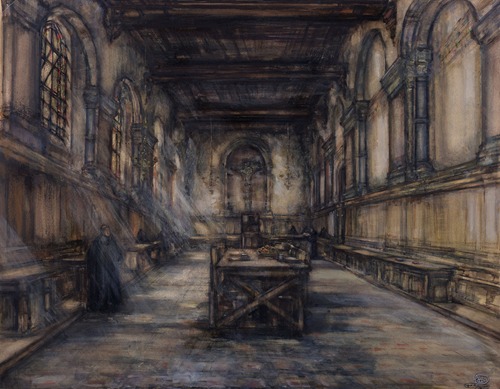
Alfred Delaunois
But this is entertainment today. And how it overlaps with culture is my point here. Remember last post I commented on how ‘art’ was talked and written about, and how a certain kind of ad-copy or gallery copy had embraced a certain style of sheer emptiness. Here is a description of the irritating Dutch performance ‘artist’ Florentina Holzinger, headliner at the Venice Biennale.
“Working with her own body or predominantly female-identifying casts, Holzinger experiments with corporeal endurance and transgression to make power legible at the level of the body. The Austrian artist describes her multifaceted practice as creating experiences ‘always in relation to the body’, which she considers her starting point, her primary material and a means of radical agency: a conception rooted in her choreographic and performance work. In her compositions of image, sound and action, the body is the touchstone against which all objects and perceptions are measured.”
This was from the gallery representing her (Thaddaeus Ropec). Most recently she sat underwater in a large tank at the Venice Biennale, with scuba mask and little else. The water in the tank was actually filtered urine from the porta potties at the Biennale. Wow. radical. I remember when Kirby Dick made a the memorable documentary (“Sick“) on Bob Flanagan, self described ‘supermasochist’. This was mid nineties. So almost thirty years ago. Interesting to compare with Holzinger. First, Flanagan was smart (and funny) and his schtick of driving a nail through his penis on stage had a certain je ne sais quoi. The documentary is outstanding (I know Kirby it should be noted for the record) and my point is that most of this sensationalist exhibitionism is in and of itself is really pretty tedious at this point. Bob Flanagan (and more, Kirby Dick) were making a film about death. This was not about attention. Bob was dying during the creation of the film. Holzinger is not. She is, however making money. But like Marina Abramovic and her schtick(s), performers like Holzinger seem to have found or created a niche market. And this also is about ‘entertainment’ and also my point.
Holzinger is ‘creating experiences always in relation to the body’. Not, you know, in relation to a Lemon cupcake.

Rene Magritte
” Employment at newspapers has fallen by 75 percent in the past two decades. Job openings for academics in the humanities are likewise in decline, and fewer and fewer of the remaining positions are tenure-track. In 2024, only 8 percent of college graduates earned a bachelor’s degree in a humanities discipline. That year, both English and history departments awarded 40 percent fewer degrees than they did in 2012. There’s a fear among historians, whispered during panels and conferences, that they will be the final generation to systematically examine the past.”
Rose Horowitch (Ibid)
There was another statistic in the Horowitch essay worth noting.
“Just 20 percent of adults accounted for more than 80 percent of all books read last year. “It’s becoming a kind of niche hobby, like stamp collecting or growing orchids,” Leah Price, a historian of reading at Rutgers University, told me.”
Rose Horowitch (Ibid)
What happens when the idea of ‘truth’ dissolves?
“AI produces crisp, professional prose. Presented with human- and AI-produced text side by side, even M.F.A. candidates have been shown to prefer the work of the machines. If AI writing is pleasing and convincing, however, it is also unoriginal, often inaccurate, or both.”
Rose Horowitch (Ibid)
Innacurate is no longer an issue. Evidence is no longer a certainty. I was thinking this week if the Epstein files are released those named in the files can just say the videos were faked. The names were disinformation. It was all from Iranian hackers. Chinese intelligence agents. The files are not real. This is almost becoming a viable defense for anything. And the world cup was a kind of precursor for this, too. The video assistant referee (VAR), a hugely expensive video replay system to determine if calls were correct, is really just a way for the institution to decide certain games. FIFA is asking you believe its replay system and not your own eyes.
“The Party told you to reject the evidence of your eyes and ears. It was their final, most essential command.”
George Orwell (1984)
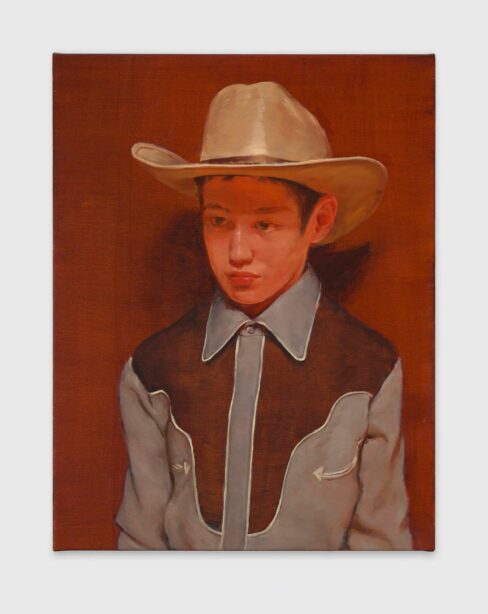
Michaël Borremans
I wrote a couple postings back on the idea and aesthetic of ‘liminality’. And I started to realize that, really, the liminal — in addition to being the site of an acute uncanniness (and all that that brings) and its marked sense of purposelessness, there is a feeling of mourning found in it. The liminal is about death. Or not so much our own death as the death of ‘others’. Maybe even more narrowly the death of someone close to us. Now the rise in popularity of liminal aesthetics probably is part of a dialectic that includes an ever more lonely and isolated populace. We have fewer close friends to mourn. Small families. And family members live further away and are seen less.
“Aldine elaborated in the excerpt from The Ritual Process, that ‘as such, their ambiguous and indeterminate attributes are expressed by a rich variety of symbols in the many societies that ritualize social and cultural transitions.’ Thus, liminality in anthropology terms is often related ‘to death, to being in the womb, to invisibility, to darkness, to bisexuality, to the wilderness, and to an eclipse of the sun or moon.'(Aldine, 1969)”
Veronica Ng & Jia Pey Lim (Tracing Liminality: A Multidisciplinary Spatial Construct)
It is about an experience of symbols of death. It is about how we interpret others dealing with loss or death. Societies need to ‘mourn’. Even about relatively small things. Architectural sites, businesses we once knew, the micro pilgrimages of childhood even. The hyper rational computational sensibility discourages rituals. Nothing that can’t be measured is worth preserving. But a culture pays a heavy price for forgetting its rituals.
Ng and Lim quote Winnicott on liminality: “a meeting-ground of potentiality and authenticity, located neither within the self nor in the world of political and economic affairs. In this space, one finds the most authentic and creative aspects of our personal and communal existence, including artistic, scientific, and religious expression.”
D.W. Winnicott ( Playing and Reality (1971))
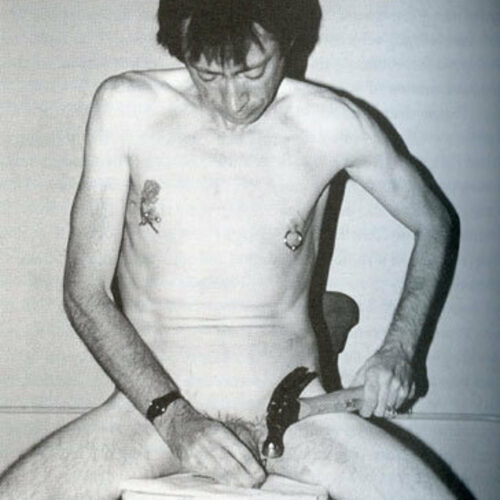
Bob Flanagan
I don’t want to digress too far into liminality again, but there is something important lurking at the edges of its popularity. It is perhaps a new detour to ideas of authenticity and even self. Not to yet again mention that Gramsci quote, but if correct then morbid symptoms appear in moments of transition. These are liminal times. But not only morbid symptoms. The desperate growing violence of billionaire oligarchs is built into capitalism — the transference of wealth to the top 1% has unintended consequences, even for that 1%. That billionaires are building absurdly expensive bunkers for when, I guess, the zombie apocalypse occurs, suggests this is how acute anxiety is expressed when money is no object. And yet, one has the distinct sense that these billionaires (a hundred times over) have not really thought through what happens if they might have to actually use these refuges. There is anxiety obviously expressed in Musk’s fantasy of colonizing Mars. Peter Thiel is creating a new zone of refuge for himself in Argentina (of course).One wonders what he thinks this will actually look like.A neo-Zionist colony of fanatic pseudo religious authoritarianism ? Or just a sort of vague not fully thought out tech state, a 21st century digital Technocracy. But the liminal feels like an aesthetically worked uncanny.
But one of the things that has happened with the loss of reading is a loss of anticipatory intelligence. Or anticipatory knowledge.
“Jerome Bruner identified two forms of human intelligence (Acts). On the one hand, he identified a “logico-scientific cognition” that enables rational intelligence powered by conceptual logic and a reflective, abstract memory of the lawful properties of objects. This is a knowledge of static, timeless facts and hard truths. But there is another form of human cognition that is lived and embodied, that extends through time and is directly experienced in the flow of life. This is what he named a “narrative cognition” of the way a human life experiences itself in the world, and the myriad possibilities for action, interaction, and growth set within a temporal and sequential order (Fantasia and Delafield-Butt). Narrative intelligence is akin to what child psychologist Margaret Donaldson named the “line mode” of cognition, extending experience in time to both generate and appropriate experience. This allows one to know what has come before and, therefore, what is likely to come in the future. Knowing “what is likely to come in the future” has an anticipatory function for action and engagement. For this reason, we call this “anticipatory knowledge.”
Phillip Tonner (Fairy Tales as Anticipatory Narratives)
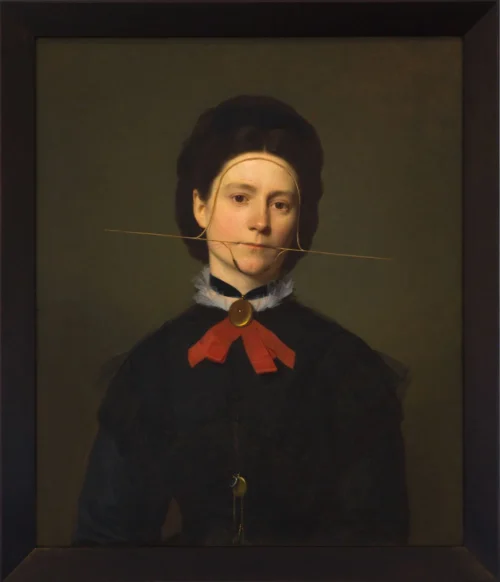
Markus Shinwald
Bruner (who is not uninteresting and a bit neglected) saw the cognitive revolution (as he put it) taken off track by the computational notion of learning. Bruner wrote….
“I argued in favor of a renewal and refreshment of the original revolution, a revolution inspired by the conviction that the central concept of a human psychology is meaning and the processes and transactions involved in the construction of meanings. This conviction is based upon two connected arguments. The first is that to understand man you must understand how his experiences and his acts are shaped by his intentional states, and the second is that the form of these intentional states is realized only through participation in the symbolic systems of the culture. Indeed, the very shape of our lives-the rough and perpetually changing draft of our autobiography that we carry in our minds-is understandable to ourselves and to others only by virtue of those cultural systems of interpretation. “
Jerome Bruner (Acts of Meaning)
There is a sort of faux metaphor here regards a review of David Hockney’s final iPad ‘paintings’ (sic). Olivia McEwan reviews them in the current Hyperallergic issue.
“No amount of such curatorial reverse-engineering, or insistence that the iPad creations were made en plein air through the changing seasons, counters the sense that these digital doodles represent the very antithesis of the traditional methods and inspirations they are supposedly honoring.{ } The iPad, however, is a fascistic form of mark-making. Tablet “painting” is dictated by software designed by a corporation. Its “marks” are strictly delineated, as is its palette. “
Olivia McEwan (Hyperallergic 2026)
You can’t fake the funk. And researchers Delafield-Butt and Trevarthen wrote that narrative building exists even in early infancy. A pre-linguistic phase. And I would accept this. And the reason I keep returning to fairy tales this past year is that I think such narratives are a rear guard action against the computational.

Rodrigo Moya, photography (Mexico City 1955)
“Contemporary cognitive neuroscience, intending to explain knowledge of facts, reasons, and symbolic language, often forgets that the cerebral cortex sits on top of a more ancient neural structure that nonetheless mediates fundamental psychological functions for thought and intelligence. The brainstem may be anatomically sub-cortical, but is functionally super-cortical in the structuring of thought, experience, and learning. It serves to organize and inform a higher-order, rational intelligence (Merker 2007). In development and through a life of learning, it recruits the activity of the cortex in projects of movement-with-feeling organized through time. ”
Colwyn Trevarthen, Delafield-Butt, Aline-Wendy Dunlop (The Child’s Curriculum)
Here I only wish to point out that what is being said in contemporary neuroscience on the brain is that the ancient brainstem seems to carry a part of intelligence that is tied to narrative, but more specifically to ‘movement through time’ (see Heidegger at this point). Our reptile brain. We do not exist without narrative. And with the loss of reading comes something less human. More critically put, we lose an ancient part of ourselves.
“…with analysis of intentionality in movement recorded by four-dimension ultrasound movies, shows that this basic self-consciousness is developing at 14–16 weeks’ gestational.”
Colwyn Trevarthen, Jonathan Delafield-Butt, Aline-Wendy Dunlop (Ibid)
At 14 to 16 weeks the cerebral cortex is not yet functioning. So this is a very primitive layer of our brain — which implies a number of things. And among those implications is the superficiality of scientism. Of computational analysis and the instrumental thinking Adorno and Horkheimer wrote about — and the valorizing of this superficiality is what we see in culture today. Self without this deeper layer being activated ´becomes tik tok videos. Tragic drama, say, or Rembrandt or Melville, is the deep brain stem reptile/amphibian core of existential awareness.
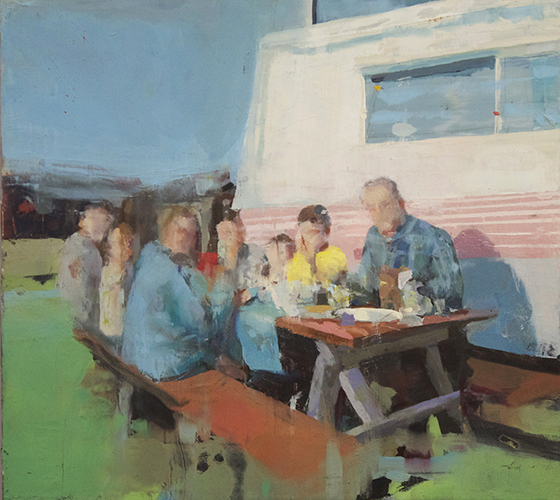
Justin Duffus
Entertainment is the superficial layer of art and culture. Entertainment is the anti-Tragic.
“The participatory act of reading, as with attentive listening or watching,creates what has been called a “flow state” of mental activity powerful for human well-being(Nakamura and Csikszentmihalyi).Reading, listening, and watching are active methods of participation in a story that integrate sit with the whole person – mind and body – in a present, situated moment, and broadens withouteffort an agent’s knowledge of their ability to cope with trials and tribulations. Such experiences can generate imaginative narrative journeys for readers and listeners where the aspects of the stories encountered serve as the ingredients for the genesis of new and possible understandings of self and world, its people, and its objects.”
Phillip Tonner and Jonathan Delafield-Butt (Fairy Tales as Anticipatory Narratives)
But this is not really what is significant in fairy tales.
“Fairy tales are the purest and simplest expression of collective unconscious psychic processes. { } In terms of Jung’s concept, every archetype is in its essence an unknown psychic factor and therefore there is no possibility of translating its content into intellectual terms. The best we can do is to circumscribe it on the basis of our own psychological experience and from comparative studies, bringing up into light, as it were, the whole net of associations in which the archetypal images are enmeshed. The fairy tale itself is its own best explanation; that is, its meaning is contained in the totality of its motifs connected by the thread of the story. “
Marie Louise Von Franz (Introduction to the Interpretation of Fairy Tales)
All art is, finally, its own best explanation. Per se. For Von Franz the fairy tale, or all fairy tales, have one meaning. The self. A complex never to be fully understood fact. The fairy tale actually helps describe how reality cannot ever be fully understood. It is purely counter rational.
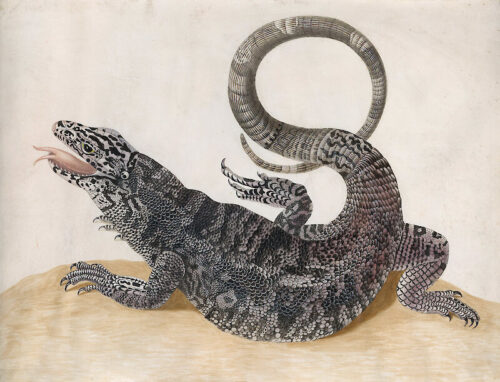
Maria Sibylla Merian
“As you know, modern physics does accept the fact that the observer and the theoretical hypothesis he has in his mind, on account of which he builds up the experimental set-up, does play a role in the result of his investigation. What is not yet accepted is that the emotional factor in the observer may play a role. But physicists will have to re-think that-for, as W. Pauli has pointed out, we have no a priori reason to reject it. Most certainly we can say that in psychology we have to take it into consideration. That is why so many academic scientists call Jungian psychology unscientific, because it takes into consideration a factor which has hitherto been habitually and intentionally excluded from the scientific outlook. But our critics do not see that this is not just a whim of ours, or because we are still so childish that we cannot repress our personal feeling reactions to the material. We know from conscious scientific insight that these feelings are necessary and belong in the method of psychology, if you want to get at the phenomenon in the right way.”
Marie Louise Von Franz (Ibid)
With the loss of reading the issue is now less that society represses its feelings, but more that it simply has fewer feelings. The instrumental culture of today produces no fairy tales.
“After reading that I came across a story from a 19th century family chronicle, published in a Swiss paper on folklore. (Schweiz. Zeitschrift fiir Volkskunde, 1937) The family still lives in Chur, the capital of Graubiinden. The great-grandfather of the people who are still living had had a mill in some lonely village in the Alps and one evening he had gone out to shoot a fox. When he took aim the animal lifted its paw and said: *Don’t shoot me!’, then disappeared. The miller went home, rather shaken because speaking foxes were not part of his everyday experience. There he found the mill-water racing autonomously around the wheel. He shouted, asking who had put the mill into motion. Nobody had done it. Two days later he died. In spiritualistic or para-psychological records this is a typical story. All over the world such things sometimes happen before someone dies: instruments behave as if alive, clocks stop as if they are part of the dying owner, and various queer things occur. Now the man who read this story in the chronicles of this family, went to the village and asked the people there about the mill. The mill itself is in ruins. A few people said: ‘Yes, there was a mill up there and there was something uncanny about it. There was a spook there’. So one sees how the story had degenerated. They all knew that it had something to do with death and a para- psychological event, but they did not remember anything special. { } … then this same investigator found other old people who said: *0h, yes, we I remember the story. The miller went out to shoot the fox, and the fox said, Miller, don’t shoot me. You remember how I ground the corn at Aunt Jette’s.’ And then at the funeral party a wineglass was broken and Aunt Jette, the miller’s aunt, went quite white, and everybody knew that she was the fox and that it was she who had killed the miller.’ There is a general belief in witches taking the form of foxes. Witches are said to go out at night as fox-souls, do much mischief in this form and then return to their bodies, which have lain as dead on their beds meanwhile. “
Marie Louise Von Franz (Ibid)
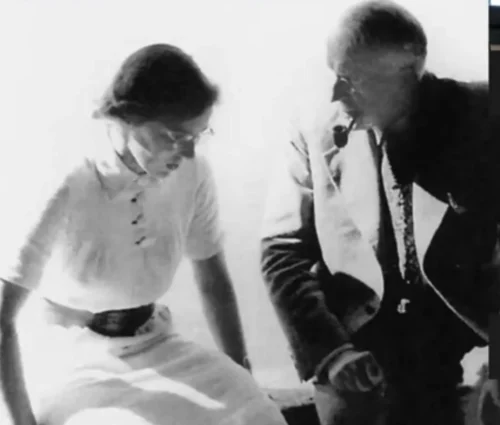
Marie Louise Von Franz and Carl Jung
Fairy tales must have a community of experience to be fairy tales. The phenomenon of ‘liminality’ is, in a sense, a stand-in for fairy tales today. But with no community the liminal image is empty of people. That is part of the lesson. Waiting for community. Waiting for the return of community. And this also explains the foregrounding of the uncanny. We remember community, and its loss doesn’t dull the familiar feeling. The liminal like the fairy tale is about anticipatory knowledge.
“If one lived quite alone, it would be practically impossible to see one’s shadow, because there would be no one to say how you looked from the outside. There needs to be an onlooker.{ } We must have a shadow which we have not yet realized, of which we are unconscious; and the collective shadow is particularly bad because people support each other in their blindness—it is only in wars, or in hate for other nations, that the collective shadow reveals itself.”
Marie-Louise von Franz (Shadow and Evil in Fairy Tales)
Whenever I employ Jungian ideas I become slightly uncomfortable. Jung poses a conundrum for many — Ernst Bloch called him a ‘raving fascist’ — for example. He was the non Jew in the first circles of Psychoanalysis and therefor garnered a good deal of suspicion anyway. But Freud loved him, until he didn’t. Jung’s opportunistic flirting with National Socialism always gives one pause. But, he was also Freud’s most brilliant student (along with Wilhelm Reich, and Fenichel). And Freud was clearly difficult (given later breaks with Adler, Reich and Stekel, and finally Rank). But this was an extraordinary period in history — and the political implications of psychoanalysis were present from the start. But then everything had political implications at that point.
“The Vienna Circle lived not just through ‘demented times’ (Sigmund 2017), but also through turbulent ones. This turbulence was not only observable in politics and culture, given that science also had its fair share of tempestuous discourses. By subsuming new phenomena of the world, science experienced radical changes in its structure (including its institutional make-up and publication arrangements), its ontological commitments, and its types of legitimate (non-mechanical) explanation, with the boundaries and edges of consensually accepted doctrines often becoming blurred.”
Adam Tamas Tuboly (Between Science and Fringe: The Vienna Circle on pseudoscience)
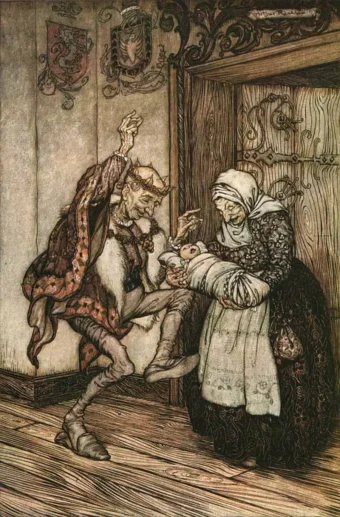
Arthur Rackham, illustration for Grimm’s Fairy Tales 1917
“Today the careful clinical and theoretical works of an Otto Fenichel or an Edith Jacobson or an Annie Reich appear to exemplify the best of main-line psychoanalysis. Yet this perception is incomplete to the point of falsehood; in fact, the misperception is mute proof of the repression and self-repression of psychoanalysis. An entire dimension of the lives of these analysts has fallen into obscurity. They were not only sterling examples of establishment psychoanalysis; they were also political and analytic rebels.”
Russell Jacoby (The Repression of Psychoanalysis)
The radical culture of Vienna at the time Freud formed his group, more or less informally, was something both the original group and the later second generation had to leave behind. Most U.S. psychoanalysts know little of the bohemian spiritual and political climate of the original Freudians. And also that this was much less medical and more philosophical than most realize today. Freud, Jung, and Adler even, were excavating the human psyche more than just treating neurosis.
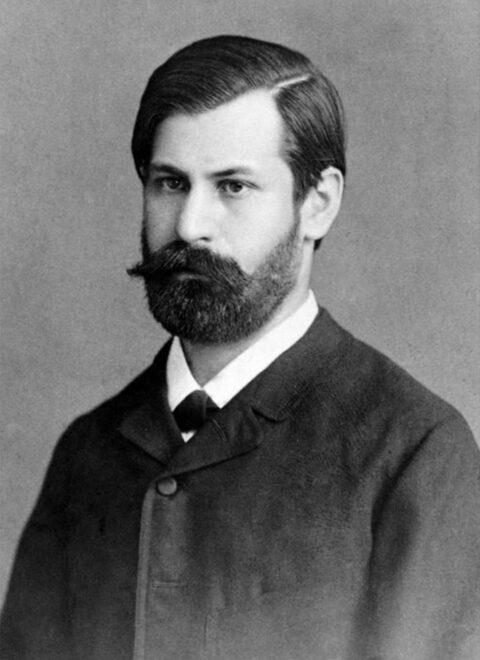
Freud 1885
Worth noting, too, that Freud was a brilliant prose stylist. (He was awarded the Goethe prize even). And Jacoby makes the point that part of his enduring importance is grounded in literary aesthetics.
“Marxism and socialism remained culturally marginal in the United States, if not suspect—especially among conservative doctors. The immigrant analysts therefore tabled their political beliefs and nonconformist opinions in order to ease their integration into
American life. In Berlin, Ernst Simmel had been president of the Berlin Psychoanalytic Institute; he had also presided over the Association of Socialist Physicians. In the United States his connection to socialist groups ceased. Fenichel believed his own political past slowed his naturalization. For those who did not get the message postwar McCarthyism made it clear.”
Russell Jacoby (Ibid)
The numbing effect of life in the United States was felt by all the emigres. Although perhaps most acutely Fenichel. Reich of course is his own stunning story and he became a scapegoat and the FBIs object lesson on not to get too uppity. It is breathtaking actually to see Marco Rubio today, ushering in a new McCarthyism. New witch hunts and a renewed policing of thought.
“The discipline and dedication of Fenichel’s generation are almost obsolete; they valued their own cultural education with unsurpassed seriousness. For instance, during the course of his life, Fenichel kept a list of every cultural production he attended. He would enter the details—name, author, date, place —in a regular Viennese artifact, a “Concert and Theater Book,” advertised as essential for all those who take “seriously” art and “Geist.”His parents kept track of his early cultural experiences, and he transcribed and maintained the list throughout his wanderings. The productions ran from Frau Flolle, Max and Moritz and Hansel and Gretel when Fenichel was four, five, and six years of age to the 392nd entry, Oklahomaseen in New York in June 1945.”
Russell Jacoby (Ibid)

Gideon Gechtman
But I digress. My point was that the radical nature of the early Freudians is utterly forgotten today. And Jung was a part of that. His split with Freud occured in 1913 (and this has all been written about exhaustively) and centered around Jung’s first book The Theory of the Unconscious. The short version was Jung’s notion of a collective unconscious. For Freud, the Unconscious was individual, and there was no apriori. Except Freud hedged that more than a little over the years. It would be hard not to, but probably not in the way it was posited by Jung.
And while I feel affinity with Jung in many respects, he was a much less lucid writer and also simply not as ruthless a thinker as Freud. But…but…I suspect for all the flaws in Jung’s work, taken in total, there are crucially important insights. James Oppenheim, a poet, wrote a now famous article in 1925 on the break between the two thinkers.
“The human body is the product of millions of years of evolution, and in it is written the history of life. It is not a sudden creation. If this is true of the body, how can it be anything but true of the mind, which is a function of the body? The mind, too, is a product of millions of years of evolution, and just as the history of life is written in the flesh, so too the history of man’s spirit, his adventure, is summed up in the mind. In other words, the new born babe does not present a mind like a blank sheet of paper on which his personal experience will begin to write; he is born with the great inheritance of the race, the collective unconscious, in which is stored the wisdom of the ages as well as the great instincts, and what Jung calls “the residues of our animal ancestry.”
James Oppenheim (The Break Between Freud and Jung, 1925)
Hence for the Jungian the fairy tale is vehicle for reproducing these collective narratives. Now, another early book of Jung and an important one is Psychological Types.

Louis Carlos Bernal, photography.
“Jung first differentiated two attitudinal types: the extrovert and the introvert. In the extrovert, the conscious libido habitually flows towards the object, but there is an unconscious secret counteraction back towards the subject. In the case of the introvert, the opposite occurs: he feels as if an overwhelming object wants constantly to affect him, from which he has continually to retire; everything is falling upon him, he is constantly overwhelmed by impressions, but he is unaware that he is secretly borrowing psychic energy from and lending it to the object through his unconscious extroversion.”
Marie Louise Von Franz and James Hillman (Typologies)
These two expanded to four but what is interesting is that one finds entire cultures and societies (sometimes) tend toward one or the other. The Finnish are famously introverted. And I can tell you this is true. (there is a joke about it: did you hear about the Finnish extrovert? He stares at the top of your shoes when speaking to you, and not the tops of his own shoes.) Communities can be found with great uniformity of type. Jung noted, too, that often in marriage people will marry their opposite type. A man finds a woman to do all the talking and socializing for him. It provides great relief.
Its not just that reading has declined so dramatically, its the domination of culture by screens that is causing psychological pathologies today.
“Something went suddenly and horribly wrong for adolescents in the early 2010s. By now you’ve likely seen the statistics: Rates of depression and anxiety in the United States—fairly stable in the 2000s—rose by more than 50 percent in many studies from 2010 to 2019. The suicide rate rose 48 percent for adolescents ages 10 to 19. For girls ages 10 to 14, it rose 131 percent. { } As the oldest members of Gen Z reach their late 20s, their troubles are carrying over into adulthood. Young adults are dating less, having less sex, and showing less interest in ever having children than prior generations. They are more likely to live with their parents. They were less likely to get jobs as teens, and managers say they are harder to work with. Many of these trends began with earlier generations, but most of them accelerated with Gen Z. Surveys show that members of Gen Z are shyer and more risk averse than previous generations, too, and risk aversion may make them less ambitious. { } But before we can evaluate the evidence on any one potential avenue of harm, we need to step back and ask a broader question: What is childhood––including adolescence––and how did it change when smartphones moved to the center of it? If we take a more holistic view of what childhood is and what young children, tweens, and teens need to do to mature into competent adults, the picture becomes much clearer. Smartphone-based life, it turns out, alters or interferes with a great number of developmental processes.”
Jonathan Haidt (End Phone Based Childhood Now)
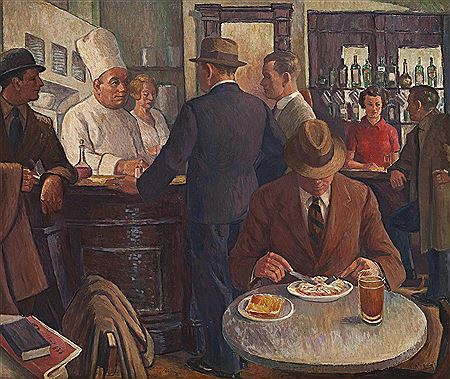
Meyer R. Wolfe
Community was already decimated by the time of the smartphone. But the smartphone accelerated the problem. And a little discussed problem, in terms of the ‘smart phone childhood’ is the effect on narratives. In some perverse sense the smart phone/internet technology has cut off people’s connection with their primitive brain. This almost sounds counter intuitive, but I don’t think it is wrong. Its clear that with children the use of smart phones before bed disrupts sleep. My guess is it deforms dreaming in, probably, complex ways. But dreams are also Nature — they are deeply entangled with the unconscious, and likely with something of (assuming we agree we have one) collective unconscious. There is a famous story recounted by Adolf Guggenbühl-Craig:
“An international criminal who had already murdered ten or twelve people, a kind of pathological creature who committed pathological cold-blooded murder without the slightest reaction of conscience, killed an unknown old man in the street in Zurich, took his money, and got caught. Adolf Guggenbühl-Craig had to give the court the psychiatric expert’s opinion and ascertain whether or not the man was responsible for his deeds. Dr. Guggenbühl had the intelligent idea of investigating the dreams of this man, and he told Dr. Franz Riklin and me a dream without telling us the whole story. He simply asked us what we thought of a man of forty who had such a dream. { } “ The dream in question was very simple. It was one which was repeated frequently and in which the murderer went to an amusement park where there were big swings. He was on such a swing, swinging up and down, higher and higher, when suddenly the swing went too high and he fell into empty space. That was the end of the dream. I thought, “My God, swinging between the opposites and taking it as a pleasure with no reaction toward it, taking it as fun!” And the lysis in the end sentence of the dream was “falling into empty space,” without even the reaction of “I woke up with a cry.” There was no emotional reaction. I could only say that this was a lost soul. I felt, to put it into pictorial language, as if God had written off this soul. In the dream there is no attempt by nature to save the man by giving him a shock. We assume that dreams come from the unconscious instinct, that is, nature. His unconscious tells him, just as cold-bloodedly as he murders, that he is lost!”
Marie Louise Von Franz (Shadow and Evil in Fairy Tales)
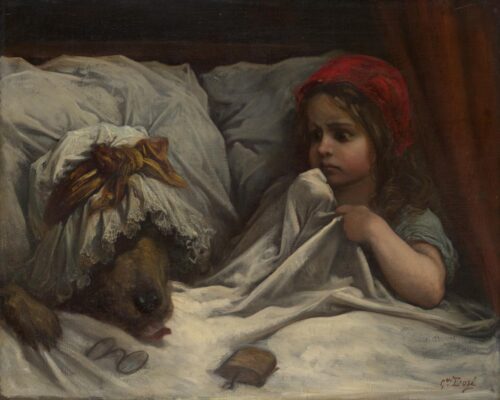
Gustav Dore (Little Red Riding Hood, oil on canvas 1862)
If we lose touch with our primitive reptile brain (what I like to call the reptile brain, though its not my invention), with our Nature in a sense, then ‘fall into empty space’ — liminal space even — without a moral response, and without really even an instinctual one, there is a disconnect that is pathological. The dream above was the dream of one disconnected to all community. But also to memory of, or history of community. Often tribal societies place huge importance on ancestors. There are complex rituals in place to consciously honour the ancestor (Mongolian nomadic tribes, living in portable yurts, will not step directly on the plank that forms the underside of the doorway. This is seen as an insult to those who stepped before, and it is viewed as the neck of the spirit of the home). The dream of the murderer is without affect. Swinging higher and higher was fun, but then for an unstated reason the dreamer fell — and the looming question is did he let go? Did a force push him or did the swing simply give way?
If we don’t dream with active purpose, in a sense, we are always ‘lost’ — the alternative to the journey is to fall into empty space. Narratives come out of the primitive layer of the brain. The earliest experience humans have is of something like a narrative. Fairy tales exist in a timeless place that usually entails abandonment, poverty, orphanhood or displacement somehow. Ideas (most the legacy of the Enlightenment/capitalism) like progress and efficiency, and risk management do not exist in fairy tales. Another reason the ‘moon hoax’ conspiracy idea has such durability is that I think the Apollo missions removed too much of the mystery of the Moon for people. Or at least seemed to remove. The wrong kind of nothing was found up there.
“A simple way to understand the differences between Gen Z and previous generations is that people born in and after 1996 have internal thermostats that were shifted toward defend mode. This is why life on college campuses changed so suddenly when Gen Z arrived, beginning around 2014. Students began requesting “safe spaces” and trigger warnings. They were highly sensitive to “microaggressions” and sometimes claimed that words were “violence.” These trends mystified those of us in older generations at the time, but in hindsight, it all makes sense. Gen Z students found words, ideas, and ambiguous social encounters more threatening than had previous generations of students because we had fundamentally altered their psychological development.”
Jonathan Haidt (Ibid)
The most fascinating find in Haidt’s essay on smart phones and the young was that most high school and even university students WANTED smart phones turned off. They knew they were addicted. They were simply afraid to be the only ones who unplugged. The shadow needs an onlooker. If we forget our own shadow we become sick. We fall into empty space.
To Donate to this blog use the paypal button at the top of the page. Donations help keep Aesthetic Resistance podcasts afloat, too.
https://aestheticresistance.substack.com/
Nothing is monetized. We depend on donations.
Speak Your Mind