


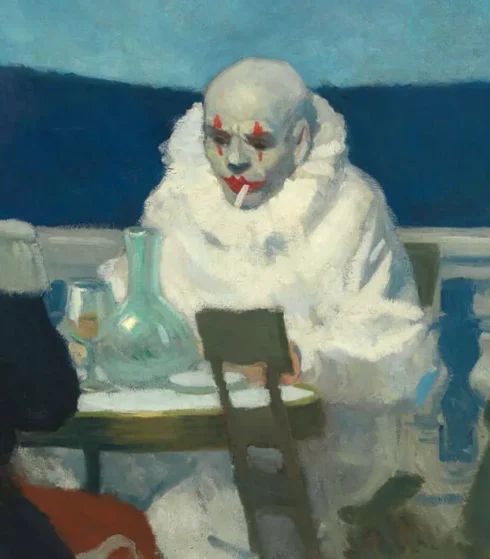
Edward Hopper (Soir Bleu, detail. 1914)
“In the context of this new movement, liminal spaces, including so-called backrooms, are a type of emotional space that conveys a sense of nostalgia, lostness, and uncertainty. “
Karl Emil Koch (Musee magazine, 2025)
“It is only rarely that a psychoanalyst feels impelled to investigate the subject of aesthetics even when aesthetics is understood to mean not merely the theory of beauty, but the theory of the qualities of feeling.”
Sigmund Freud (The Uncanny, 1919)
“And blessed mornings,
Meet for the eye of the young alligator,”
Wallace Stevens (Nomad Exquisite 1923)
Its funny how topics seem to come to you, rather than you looking for them. Same as being drawn to a book on the shelf and having it somehow be the perfect book for you at that precise moment. This is the literary kismet theory. Its absolutely true however. But the aesthetic idea of ‘liminal space’ seems to be cropping up again. Hyperallergic has a fine short essay by Ed Simon (who has also written nice stuff on Hopper AND on statues of Donald Trump).
“In an image posted by Dave Columbus to the Facebook group “liminal photography” on November 11, 2025, the sheer eeriness of the abandoned mall is evident in all of its forlorn splendor. Gray-carpeted and white-walled, the back wall features a ’70s color scheme of painted orange-and-green squares. The image exemplifies the popular internet aesthetic of “liminality”: the exploration of spaces that appear “in between,” that are uncanny and uncomfortable despite being mundane or familiar. Emptied of stores and absent of humans, Columbus’s photograph captures the melancholic discomfort of liminal aesthetics — the strange, simultaneous pull of disquiet and nostalgia that makes this bottom-up, crowd-curated digital movement among the most pertinent and explicit artistic reactions to the strange, surreal experience of living in our particular moment of dystopian late capitalism.”
Ed Simon (How Liminalism Became the Defining Aesthetic of Our Time, Hyperallergic 2026)
There are no formal definitions for the internet derived aesthetic. And if you sample many of the photographs there are some precariously close to surrealism, and others that inch into science fiction. A good many do not meet any definition of liminal. Many of the rooms photographed are windowless. Claustrophobia is an element found in a lot of ‘uncanny’ psychological case studies. There seems a lot of uncanniness and relatively less ‘liminality’. As it were.
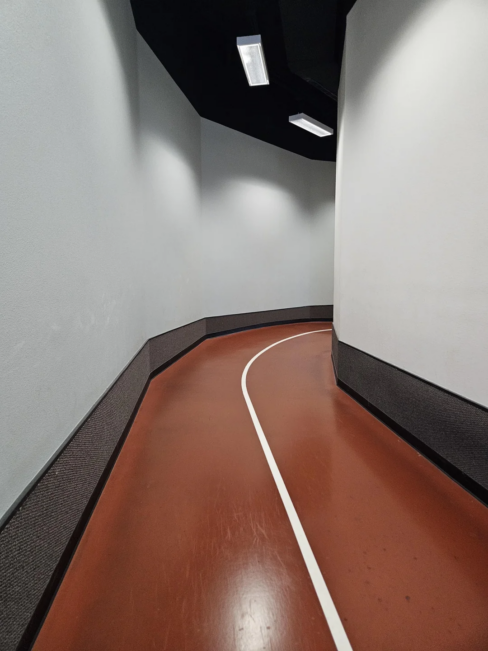
Courtesy of uPresentEuphoric2216 (Hyperallergic)
Simon’s essay brings up Edward Hopper, and its a cogent comparison. As is DeChirico. It is worth pondering that few painters today seem able to capture this sense of the liminal. There are, obviously many who are able to photograph locations that feel liminal. Simon mentions Hopper’s Early Sunday Morning (1930), an early social critique (among other things) of the ‘boarded up storefront’ theme. Hopper’s painting depicts stores not yet open, or closed for Sunday. But the feeling is of a population gone, migrated away for unclear reasons. The feeling is not warm and optimistic. And Hopper, like a lot of that generation of American ‘white men’ in the arts (Theodor Dreiser, Wallace Stevens, William Carlos Williams, Robert Frost, Charles Ives, Sinclair Lewis, Rockwell Kent, Sherwood Anderson, George Ault, Charles Sheeler, Stieglitz, even Norman Rockwell and Grant Wood), were mostly from the midwest, or New England, from little towns. There were some urban children, but throughout there is a quality of WASP lonliness, of flinty stoic unadorned seriousness. Most wore suits a lot. Also they shared a sense of being deeply repressed. Of emotional paralysis. That paralysis was overcome through the work. The work was unapologetic in its rigour, in its craft. The work is often, in fact, with this generation, profoundly sensitive and insightful, compassionate, but never sentimental (except Rockwell of course). A generation later, barely, came Pollock and John Cage, Barnett Newman and Clifford Still, and Charles Olson and Theodore Roethke, Robert Lowell, Tennessee Williams and then, almost as transitional figures: Faulkner and Hemingway. The latter two born in the very last two years of the 19th century. The emotional Puritan that runs through this group took a toll. Suicide and depression, and a deep alienation, alcoholism. The qualities of the liminal aesthetic would not feel strange to any of these men, I don’t think. Now there are obvious differences in the list above. Not all are WASPs for one thing, not all are repressed (Tennessee Williams certainly was not, not in that way, but he was affected and shaped by the condition of the others). Two women artists, both painters, feel like a sort of Greek chorus – Georgia O’Keefe, born in 1887 in Sun Prairie, Wisconsin, and Agnes Martin born in 1912, in Macklin, Canada. Both spent most of their lives in New Mexico, in and around Santa Fe. The Navajo lands of New Mexico intuitively feel to embody the feminine, perhaps.
But it is those artists born in the 1880s that I feel were the real precursors to the liminal. The second group were the radical modernists. The first group were not radical in that way. They were the conservatives. The second were reacting to the first. And now in the second decade of the 21st century, the end of modernism is a fact. And whatever this is (post modernism never felt as if it were much more than marketing) I might argue it is an aesthetics of resolution.
The liminal space is one that is uncanny (more on that below) but it is also about de-population. The liminal aesthetic is free of human life. The viewer (it is voyeuristic) is alone. It is also about spaces that ‘once were alive’. Abandoned buildings, especially governmental or civic institutional space is the most prevalent. It is an aesthetic of ghosts.
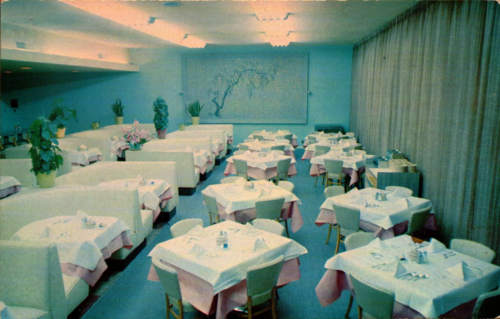
Restaurant, McCarran Field. 1956. Photographer unknown.
One of my premises here is that the current ‘liminal’ aesthetic is the product of that Puritan masculinity (as is, to a certain extent capitalism itself) and that the liminal is also an aesthetic of conclusion, of the end. (Berger said of neanderthals and early homo-sapiens, that they were the people of ‘arrival’). I quote that Berger remark a lot. And I think the 21st century in the West (maybe everywhere, who knows) marks us as the people of departure, or the people, the culture of resolution, or leaving. The people of withdrawal — interestingly the title of my previous post. (uncanny that).
“Word meaning is a phenomenon of thought only insofar as thought is embodied in speech, and of speech only insofar as speech is connected with thought and illuminated by it. It is a phenomenon of verbal thought, or meaningful speech — a union of word and thought. “
L.S.Vygotsky (Thought and Language)
The liminal is also largely silent. The archetypal liminal image is almost post-linguistic. At the end of poetry comes an uncanny silence.
Peter Schjeldahl, writing of Wallace Stevens…
“For most of his life, Stevens was an elaborately defended introvert in a three-piece suit, working as a Hartford insurance executive. He came slowly to a mastery of language, form, and style that revealed a mind like a solar system, with abstract ideas orbiting a radiant lyricism. { } The key sentence in the biography, for me, tells that Stevens, who was prone to being depressed, “hated depression—hated it.” So do a lot of people, but few fight it as tenaciously as Stevens did. He relied, for stability, on the routine demands of his office job. (Whenever free of them, he commonly drank to excess.) He projected his struggles as abstract patterns of human—and, beyond human, of natural and metaphysical—existence. “
Peter Schjeldahl (The Thrilling Mind of Wallace Stevens, New Yorker 2018)
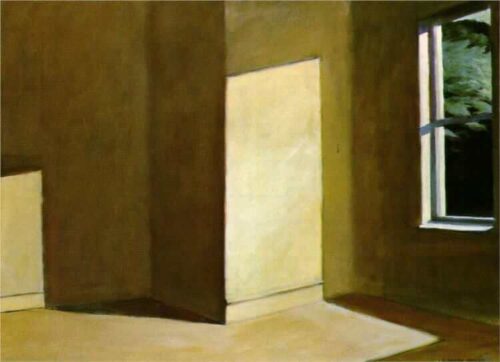
Edward Hopper (Sun in Empty Room, 1963)
But I want to get back to Vygotsky, to reverie, and how we narrate ourselves, ourselves to ourselves. This development of meaning is what children are doing when they climb trees and drift off into reveries. Children day dream endlessly. They tell themselves stories. As a society, we tell ourselves fewer stories today. At the end of the world is silence.
“The leading idea in the following discussion can be reduced to this formula: The relation of thought to word is not a thing but a process, a continual movement back and forth from thought to word and from word to thought. In that process, the relation of thought to word undergoes changes that themselves may be regarded as development in the functional sense. Thought is not merely expressed in words; it comes into existence through them. Every thought tends to connect something with something else, to establish a relation between things. Every thought moves, grows and develops, fulfills a function, solves a problem. “
L.S. Vygotsky (Ibid)
This is correct, I think. Theatre, unsurprisingly, is perhaps most crucial in its relationship to human community and to religion and to philosophy. And this touches on the origins of theatre, of memorization, and what is meant by performance.
“In mastering external speech, the child starts from one word, then connects two or three words; a little later, he advances from simple sentences to more complicated ones, and finally to coherent speech made up of series of such sentences; in other words, he proceeds from a part to the whole. In regard to meaning, on the other hand, the first word of the child is a whole sentence. Semantically, the child starts from the whole, from a meaningful complex, and only later begins to master the separate semantic units, the meanings of words, and to divide his formerly undifferentiated thought into those units. The external and the semantic aspects of speech develop in opposite directions — one from the particular to the whole, from word to sentence, and the other from the whole to the particular, from sentence to word. “
L.S. Vygotsky (Ibid)
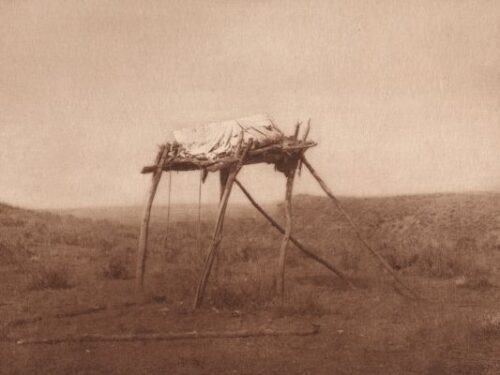
Edward S. Curtis, photography (Burial Platform, Apsaroke, 1908)
In almost all discussions of ‘the liminal’, there is reference to Freud’s idea of ‘the uncanny’. This early-ish essay of Freud’s has been written about quite a lot. But for the purposes of this post, the critical aspects are that the uncanny (experience) is a return of something familiar. It is largely the castration complex (in the example Freud uses, Hoffman’s story The Sandman it is the child’s fear of losing his eyes). Ergo, the uncanny is the return of something of our repressed infantile sexual history. Something we thought forgotten and/or overcome. Now, the second example is that of the ‘double’ (doppelganger) — an expression of the primary narcissism of the child. The child (and there is some debate about how old exactly does primary narcissism end) projects multiple versions of itself. This is part of the desire for immortality. But again, after such narcissism has been overcome, its return elicits feelings of discomfort. A feeling of an emotional return to a primitive state.
Freud also makes note of the double’s role in the formation of the super-ego. That the super-ego projects unwanted material onto the ‘double’. There are several competing interpretations of Freud’s notes on the super ego and the double — including an internecine psychic war revolving around utopian fantasies that are also rejected, and the ambivalence of all wishes or desires for personal satisfaction (at the expense of Utopian desires for society overall).
“The fact that an agency of this kind [the super-ego] exists, which is able to treat the rest of the ego like an object–the fact, that is, that man is capable of self-observation–renders it possible to invest the old idea of a ‘double’ with a new meaning and to ascribe many things to it–above all, those things which seem to self-criticism to belong to the old surmounted narcissism of earlier times. But it is not only this latter material, offensive as it is to the criticism of the ego, which may be incorporated in the idea of a double.”
Sigmund Freud (The Uncanny)
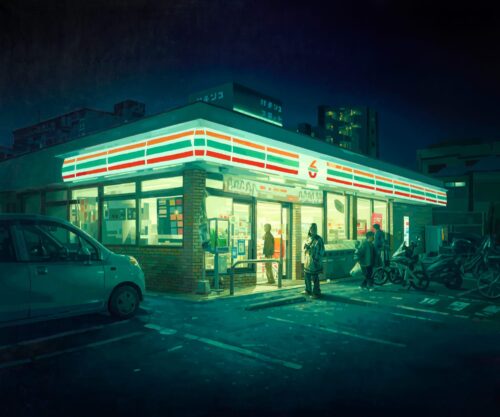
Keito Morimota
There is another aspect to the Uncanny — touched on above, but which needs be expanded ; and that is the return of primitive beliefs. But not necessarily just infantile narcissistic urges or desires, but proto-collective animistic and magic beliefs. Structurally close to a ‘return of the repressed’ this is not the return of personal belief, but of a kind of tribal or historical set of codes or signposts for earlier societal practices. The appearance of something that feels as if it must be superstition is usually quickly ascribed to some rational explanation. This is found in dreams, too. We dream something and then feel we see the dream come true. This is a private and usually unspoken confirmation of magic.
So, to return to the ‘liminal’ as an internet phenomenon, and that hundreds of thousands of followers have responded to it, is worth noting. This is a spontaneous aesthetic recognition of something — some elusive inexplicable (uncanny) feeling — familiar and yet not. It is also a recognition of ‘our’ history, of our societies history and the fact we live on the cusp of some kind of final judgement.
“In The Sense of an Ending: Studies in the Theory of Fiction, Frank Kermode observes that “[m]en, like poets, rush ‘into the middest,’ in medias res, when they are born; they also die in mediis rebus, and to make sense of their span they need fictive concords with origins and ends, such as give meaning to lives and poems”. Kermode is, of course, speaking of a temporal register, but his point applies equally well to the experience of space, place, and spatial relations more generally. As individual or collective subjects, we find ourselves always and already in the midst, located in a perpetual, though mobile, state of the in-between or entre-deux. Ever bound to a particular situation—that is, at a site within a cognisable spatial assemblage or formation—we define our position in relation to others, establishing limits, boundaries, borders, or other such markers to help determine our sense of place amid the expansive, perhaps unrepresentable extension of space.”
Robert T. Talley, Jr. (Landscapes of Liminality)
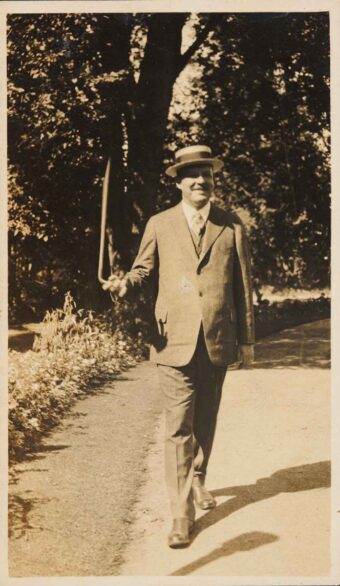
Wallace Stevens (1922)
Here again, I think there is a growing sense of ‘our’ place in a societal and historical narrative and that place is the beginning of the end. The resolution.
The German word for Uncanny is “unheimlich,” which means not from home. But Freud was using the word’s secondary meaning (sort of) which is something from the home that has been hidden, not meant to come to light. Family secrets in one sense. This is very close to another version of the Oedipal narrative. And part of the anxiety of the uncanny is the question of is the hidden really hidden after all?
“The uncanny seems to be related to beliefs we once held when we were children that we’ve repressed or covered over or hidden away to become adults. We cover over these beliefs because, of course, those beliefs are wrong and we don’t want to be wrong. We want to be grown up. We want to be rational people with proper attitudes about the world. (Clowns aren’t scary, Ray, stop behaving like a child!) And this process of maturation, of giving up our childish things, takes a lot of time and effort on our part. It would be absolutely horrifying to imagine, as adults, that our child-self had a better understanding of the world than we do. This, for Freud, is the uncanny—it is the dread we feel in situations in which our childish fantasies and fears appear more real and more true than our adult worldviews.”
Ray Malewitz (What is the Uncanny? Oregon State Guide to English Literary Terms,)
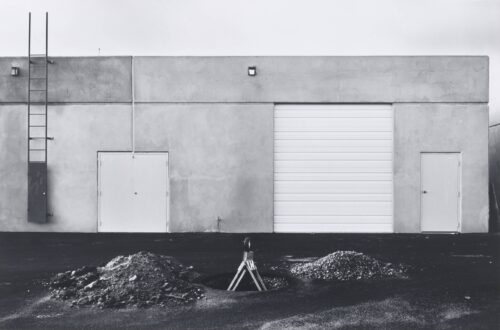
Lewis Baltz, photography (Industrial park, Irvine CA.)
One can find a lot of literature devoted to the hidden family secret. From Jane Eyre to Absalom Absalom, to Shepard’s Buried Child. But this theme is deeply embedded in the novel form (East of Eden by John Steinbeck, or The Great Gatsby to Pride and Prejudice etc). But the Uncanny also surfaces as acute ambivalence (Patricia Highsmith Tremor of Forgery, a favorite of mine). Or Pynchon’s Crying of Lot 49. And if one wanted, one could add nearly all of Pinter’s plays. Because I think, ultimately, that this is age of the uncanny. But a slightly revised uncanny. A liminal uncanny.
By the 1980s suburbia was in thrall to the shopping mall. I would guess at least 50% of those malls built in the 1980s are closed now. And I would guess at least a third of all internet ‘liminal’ photos are of closed malls. It is an irresistible subject for the uncanny prospector. They are also material allegories of Capitalism’s many failures-. Starting about the same time (in their current incarnation) were ‘industrial parks’. By the turn of the 21st century the Industrial park was ubiquitous. Certainly the American landscape was shaped by industrial parks and by shopping malls. The aesthetic of both defined nearly every single U.S. suburb.
But ‘liminal’ per se, as in liminal space, is by definition a transitional space linking spaces with purpose. They are transitory and without real identity.
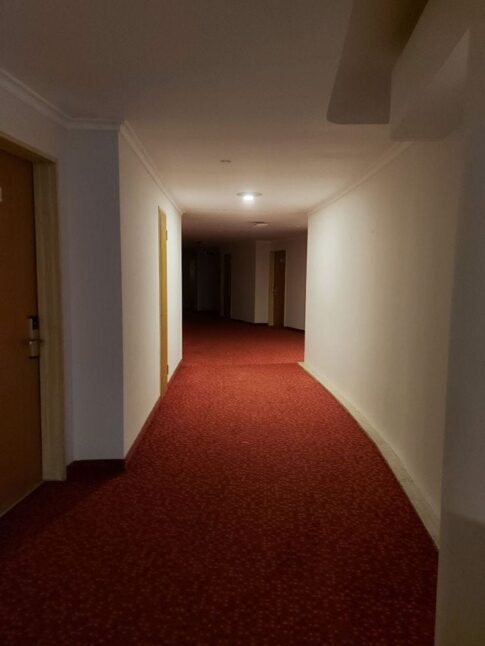
Absolute Infinity of Unknown, Backrooms. (original photo seems unknown)
The aesthetic that developed via the internet and the Backrooms phenomenon is now overly saturated, but that itself is fascinating. Hollie Sykes makes good points on this…
“A significant chunk of the images summoned by a Pinterest search for Liminal Space features spaces reminiscent of some universal childhood. Think elementary schools, indoor play areas, swimming pools with slides, single-family home interiors from the nineties and early aughts. Many of these are dark and deserted, meaning they also fall into the previous category, but the childhood scenes give them a certain unsettling patina not present in the others. I’ve touched on the contemporary addiction to nostalgia before, and this particular strain has Gen Z all over it. If the live-action Disney remake is the late-stage capitalist hallmark of Millennial nostalgia, then pastel renderings of pre-2008 suburban neighborhoods and Y2K product labels on Amazon are the Gen Z analog. These things are obviously only reflective of a certain type of childhood, but they fetishize the middle class suburban landscape in a Tim Burton-esque way.”
Hollie Sykes (Demystifying the Liminal Space, July 20th 2025)
Nostalgia is a huge topic. But as we (western society) circle the drain and have to face the new landscape of the Data Center (the 2026 shopping mall in a real sense) I think its useful to identify the aspects of the uncanny, and to differentiate from the full tilt nightmare (see Data Center) of Trump’s America. The emergent reality of these last handful of years is that of a billionaire class (well, the .00001% of multi billionaires) that has taken over political decision making. The U.S. is in the hands of Bezos and Gates and Ellison and Musk and of Zionist leadership — and the weird normalizing of porn, of military rape (mostly the IDF but not entirely) and the absolute strangeness of social media in general.
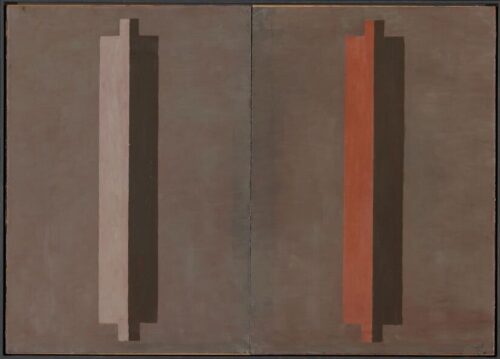
Carolus Enckell
“Freud’s essay on the uncanny follows closely upon his essay “Mourning and Melancholia” from 1917, a work that was likewise deeply influenced by the vicissitudes of war, and precedes by one year the publication of Beyond the Pleasure Principle (1920). In the latter work, Freud explicitly writes about the “war neurotics” who are subjected to the compulsion to repeat as a result of their war trauma, revealing the ways in which trauma and anxiety destabilize linear narratives and one’s relationship to the present. In the essay “Mourning and Melancholia” Freud discusses possible psychic reactions to a real, perceived, or anticipated loss. The engagement with anxiety in both essays has generally been understood in terms of trauma, and trauma is usually perceived as an overwhelming past experience (as Cathy Caruth argues, an experience that was so intense that we missed it) whose intensity nevertheless haunts the present, causing the shell shock symptoms experienced by war neurotics.”
Heidi Schlipphacke (The Place and Time of the Uncanny, Pacific Coast Philology, Vol. 50, No. 2)
The first World War marked the end of a massive creative cross pollination throughout Europe, but especially in the Hapsburg Empire. The war was the greatest destablizing event of recent times and ideas like the uncanny were reactions to the constant backdrop of trauma that existed in daily life. The uncanny is, finally, about anxiety.
“The horizontal, multiplicatory model of uncanny duplication and imprecise mirroring returns again in the form of the “Ersatz,” another move Freud associates with the uncanny in his essay. In particular, Freud insists that the fear of possible damage to one’s eyes is a substitution for castration anxiety: “The study of dreams, fantasies and myths has taught us also that anxiety about one’s eyes, the fear of going blind, is quite often a substitute for the fear of castration”. The fear that harm will be done to the eyes is, hence, itself a substitute of another fear, the fear of castration. Fear stands in for fear, anxiety for anxiety. Although fear of castration itself holds a central place in Freud’s thinking, as the motor of a civilized society, the logic behind culture, its logic is ultimately no more significant than that of any other abstract fear. If the fear of losing one’s eye or sight stands in for the fear of losing one’s penis [Kastrationsangst], then the fear of losing one’s penis stands in for the fear of losing an eye. “Angst” hovers, in this sense, on the surface. Its ostensible object of concern is not the penis or the eye per se, but loss itself.”
Heidi Schlipphacke (Ibid)
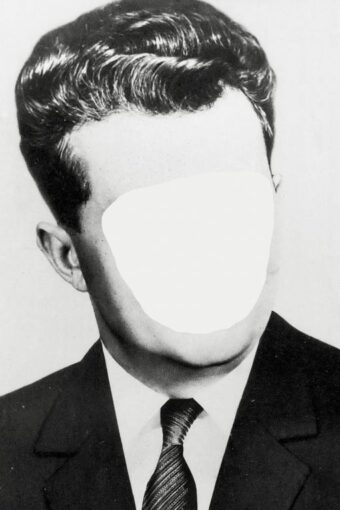
Anton Rollland (Last Christmas of Ceausescu)
A few years later Freud, in a lecture, made a comment that still is much discussed and debated.
“”Rather, he writes, “it was not the repression that created the anxiety; the anxiety was there earlier; it was the anxiety that made the repression” . The boy’s love for his mother made him anxious, and this internal danger posed by his own libido led, then, to repression.”
Heidi Schlipphacke (Ibid)
Anxiety is there before all else. The rise of the aesthetic of ‘liminality’ feels like a compensatory filler for the deceptively traumatic backdrop to 21st century life. The astonishing degree of fear mongering in media today is breathtaking. Climate change, AI, the assault on children — from turning daughters into Only Fans content creators to Jeffrey Epstein. From Zionist child rape to Zionist rape and torture of Palestinians. To bio engineered ticks and micro plastics, to food additives to 3d printed meat. From Covid vaccines to Covid itself, from nuclear war to various extinction events. This goes well beyond the fact that marketing has learned that fear is a great tool to sell everything from corn flakes to condoms, this is now obsessive fetishized manufacturing of various terrors. If feels as if there is a need for terror. But a need for whom? Of this I can only say for the ruling class, for certain. Maybe others, maybe not.
“The notion of trauma and its concomitant anxiety as quantitatively overwhelming, as an experience that can be generated anew at any time without any obvious referent, is as frightening as the child’s fear of the dark, the scenario with which Freud enigmatically ends his essay on the uncanny. If this fear is not the projection into the future of a past trauma, the recognition of something long repressed, but rather a mode of being that indicates an overwhelming presence of quantity, then the darkness itself is an image of this experience that exceeds perception and refers to nothing.”
Heidi Schlipphacke (Ibid)
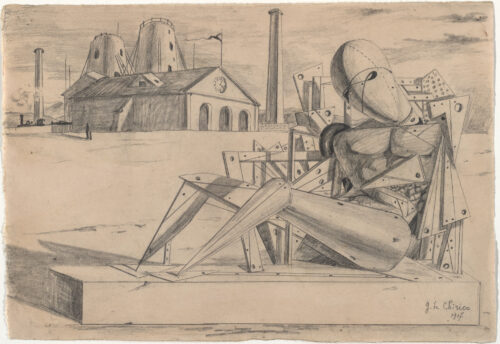
Georgio De Chirico (Solitude, 1918)
And then Schlipphacke (in a really excellent essay) gives what amounts to a definition of the liminal.
“The process that produces anxiety is, Freud now claims, “neither conscious nor preconscious”; the anxiety exists neither in the now of the consciousness, nor is it produced in the past, prior to the formation of the thoughts. It exists temporally in a time in between the past and the now, a point in time for which we have no concept. Likewise, the space itself is one that blurs the boundaries between accepted categories: the anxiety emerges “between quotas of energy” “in some unimaginable substratum.” Spatially, we are invited to imagine the unimaginable—a space between prescribed amounts of energy. Freud seems to reintroduce a depth structure here to the moment of anxiety, the indication of trauma, but he is pointing once again to an in-between space, between below and above, a space for which we have no concept.”
Heidi Schlipphacke (Ibid)
The role of darkness in Freud’s lectures on anxiety and fear, on the *Uncanny*, are reminiscent of Hopper, again. And of George Ault. The two great painters of nightime (Hopper is celebrated for his treatment of ‘light’, and yet his light is poignant BECAUSE of his nights). The popularity (if that’s the word) of this liminal aesthetic suggests that society has moved much closer to a point for which we have no concept — a place for which we have no coordinates. A place GPS can’t track you. It feels fitting that the mall has been replaced by the Data Center. In fact the interior of data centers are very like liminal spaces. Strictly speaking they are not liminal in the formal sense (they have purpose…of a sort) but their purpose is self erasing in a sense. Or, like the uncanny, it closes the history of meaning itself.
There is no day or night in Data Centers. They run 24/7. Like all liminal spaces there are no windows. And the most pronounced design element is repetition. Compulsive repetition of the same. Banks upon banks upon banks of terminals and heat producing infernal machines without purpose. The aesthetic liminal (or liminal aesthetic) is, in fact, not repetitive. In fact, it is the small deviation which creates (often) the sense of liminality. One part of liminal desire is, I suspect, the anti GPS quality — the escape from conformity. The sense of sameness is not quite the same as repetitiveness. The genuinely liminal is without use value. It is also, at least it is implied, that it lacks exchange value as well. It is a reality of eternal anterooms. The Data Center represents nightmare because it only exists for very narrow purposes. It is pure purpose. Pure capital.
“It is only in the end that the sexual threat emerges. But it had always been there latently, in the coupling itself and in the proliferation of the Heimliche and the Unheimliche; when one makes contact with the other, it closes again and closes the history of meaning upon itself, delineating through this gesture the figure of the androgyne.”
Helene Cixous (Fictions and Its Phantoms: A Reading of Freud’s The Uncanny, New Literary History 7.3)
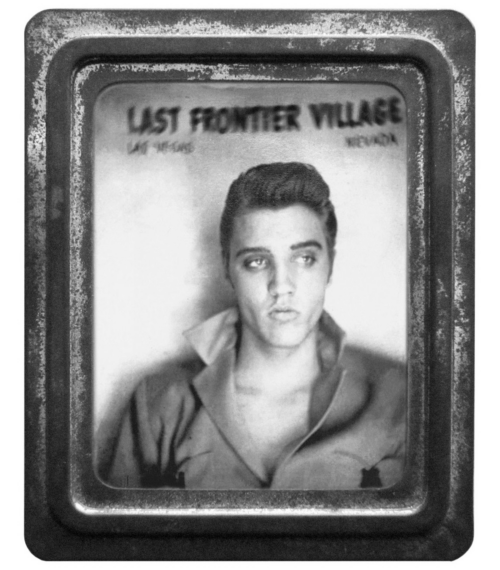
Elvis Presley, Photomatic booth Last Frontier Village, Las Vegas, 1957 apprx.
In Kafka we find the uncanny most acutely as ‘timelessness’. In The Castle, there is no objective time. This is true of a number of writers (Camus is another, often). There is a relationship between violence and time when we speak of dreams, and of the uncanny. There is also a relationship to what can only be called ‘unreality’.
“As to the cause of the change, it is the loss of the figure’s vitality. The reason why this particular figure has lost its vitality is that, in it, the imagination adheres to what is unreal. What happened, as we were traversing the whole heaven, is that the imagination lost its power to sustain us. It has the strength of reality or none at all.”
Wallace Stevens (The Necessary Angel)
Today, technology (certainly AI and quantum physics) challenge our ideas of what is ‘real’. Its curious that AI cinema seems to utterly lack the uncanny. Digital tech is all unreal. There is no nostalgia for ‘home’ in something we know can be unplugged. CGI and AI created image may fool us as real, temporarily, but upon reflection (deep reflection) the falseness of this manufactured uncanny is discovered. TV shows like The Walking Dead were utterly without uncanny affect. The endless TV forensic crime shows speaks to some kind of need to de-uncanny. (sic) To remove the potential for the uncanny. To remove that sense of home, of the search for home. It serves to normalize our exile from ourselves. But what exactly is the relationship between the liminal space and the uncanny?
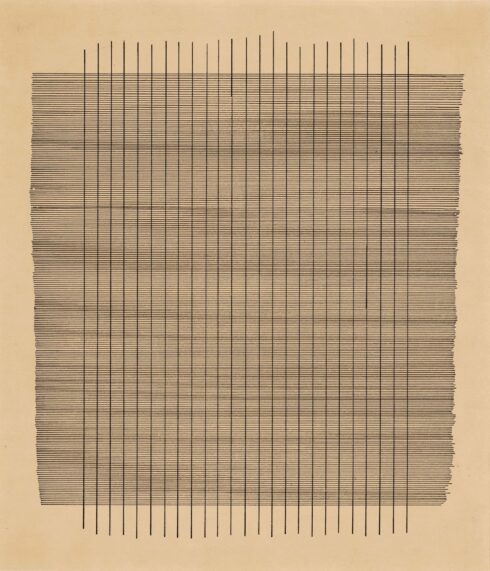
Agnes Martin
“The internet has already been compared to God. Like the monotheistic God, it is abstract and distant; yet, simultaneously, it can be personalized and contextualized into the present. In its own way, the internet shares with God the same divine qualities of omniscience, omnipresence, and even omnipotence. It is quite possible that the internet will give rise to a new form of spiritual perception … a Digital God.”
William Indick ( The Digital God: How Technology Will Reshape Spirituality:2015)
This is white-person academic thinking. (First off, in most of the global south the internet remains remote. Only 16% of homes in Ghana have a computer, for example. In Ethiopia it is 5% of homes. In Myanmar it is 3%. In the Netherlands it is 95% and in Norway it is an astonishing 98%. In Singapore it is 88%.) The white world, or more precisely the advanced Capitalist world worries about digital gods. They don’t do that in Niger or Pakistan or Belize. No, the digital erases certain ideas and experiences of the real. The rise of the liminal aesthetic feels like a reaction to a sense of lostness. We feel as if we live in waiting rooms. We feel as if we are forever walking down empty hallways. There is also something in the liminal that IS uncanny. For beyond the waiting room is something, a familiarity. A dentist or a food court or an airport lounge. Or just a storage closet. But this is the unsettling quality of Heimat…. of home. And therein lies the source of longing. I have said before all stories (in the 21st century) are about exile, homesickness, and crime. If Freud’s second position is correct, then anxiety is bound up with home, and with homesickness. The liminal space is appealing on some level because of all that it is not. And here that aspect of the double (doppelganger) is raised again. I might argue the liminal space is always where the doppelganger appears. Anxiety is embedded in all that we are, and is now (unconsciously?) being manufactured for profit. In fact, only in a society in which exchange value is so profundly dominant can the liminal appear.
To Donate to this blog use the paypal button at the top of the page. Donations also help keep the Aesthetic Resistance podcasts afloat.
At the risk of engaging in low-grade generational discourse, a funny thing about Gen Z’s engagement with media (in the heart of empire anyway) is the dissolution of the primary source. If you hear about a new figure and try to locate what kind of main media the figure is from (even if you are hip to new forms: a podcast, a social media account, a twitch channel?) they often do not understand the nature of the question, and provide kind of just-so statements of being (“He’s just a guy, he’s a known guy”).
Spending time on Tiktok can shed some light on this because the “primary page” concept from earlier days of social media (which exists but really only in vestigial form) has largely been replaced by the algorithm: figures are dispersed in and throughout the algorithm, and the benchmark of your popularity is how thoroughly you are dissolved in it. Your algorithm won’t feed you content directly from Druski’s account–it emerges from the wash of stimuli, and spam accounts will repost clip compilations of “moments” whose origins are unknown. (Many creators have caught on to this and run their own accounts with names like user456789 and post their own clip compilations en masse, taking some form of agency over the way that public figures seem to just emerge out of static).
This kind of observation is widespread, social media is fragmenting into a sea of undifferentiated difference. But this diffusion of individual figures into a liquid slosh seems to have a great impact, for even their friends appear to them this way, and they understand on some level that they appear this way to others. Druski is not from the television, or from Twitch, or from anywhere, he, your mother, your highschool bully, or anyone could emerge from any digital door at nearly any time.
All to say I think your point that the appeal of the liminal is connected to its freedom from GPS location is spot on, perhaps in more ways than one. Tiktok comments (prone to repeating each other’s statements with the kayfabe that they are brand new and unique) often make note of an oddity: “This is supposed to be creepy, but somehow I’m desperate to go there….” (the idea that this could be an intended effect of a piece of visual expression is almost entirely alien to them). In short, the appeal is in the lack of GPS locateability, but also an implied freedom from the social paranoia innate to contemporary life, that the weighers of your social rank and (therefore) human value are not here, either because this is the far-flung past of nostalgia or a tiled pool from your memory that is only for you. We’d rather have the empty dream than daily life’s overfull nightmare.
Appreciated this post very much!
” In short, the appeal is in the lack of GPS locateability, but also an implied freedom from the social paranoia innate to contemporary life, that the weighers of your social rank and (therefore) human value are not here, either because this is the far-flung past of nostalgia or a tiled pool from your memory that is only for you. We’d rather have the empty dream than daily life’s overfull nightmare.” — thats a great observation. The weighers of your social rank ….its freedom not only from GPS I guess but from algorithms. From whatever is going on in data centers.
The idea that “the liminal space is always where the doppelganger appears” is inspired, John. This is central to the uncanniness of theater, which is the source of much of its transformative power. Were you writing recently about the “hauntology” of Derrida and Mark Fischer, etc? That’s certainly connected as well, making me think we’re experiences another return of the gothic sensibility, this one linked to the iconography you point toward of the post-war American boom when the future seemed comforting and at hand. As far as anxiety goes, the child-rearing practices of the European west are guaranteed to generate multiple forms of attachment wound rooted in a terror of abandonment. Anxious attachment wounds are a sub-category here. In Thailan, I’m told, folk wisdom demands that an infant never touch the ground for the first year of life. In the west, instead, we fill our huge, dependent brains with terror and the result is an anxious personality structure ideally suited for the extraction of labor and conformity. And, of course, only such traumatized people could think up AI and imagine it as something positive.
it is the uncannieness of theatre. (Oddly I’d not thought of that in this context). But I feel there is a lot more to discuss about the ‘doppelganger’, and liminal space I suspect. The fact that there are hundreds of thousands of responses to photos of the liminal is pretty remarkable when you think about it. There is something in this idea, and in the images, that clearly resonates with people in the West right now. And my thinking was along the lines of how anxiety is being revealed in some way. And this ties to theatre, too. And the trauma of life under advanced capitalism has reached some sort of breaking point. YOur quite right that only this cluster of traumas would yield AI and data centers. I always feel people are largely missing the real threat of data centers. Its not surveillance. Thats impossible anyway (as imagined). Its more tied into this sort of final reckoning with our denaturalized and psychically battered lives. The culture is almost asking for data centers even as most people instinctively fight against them.