


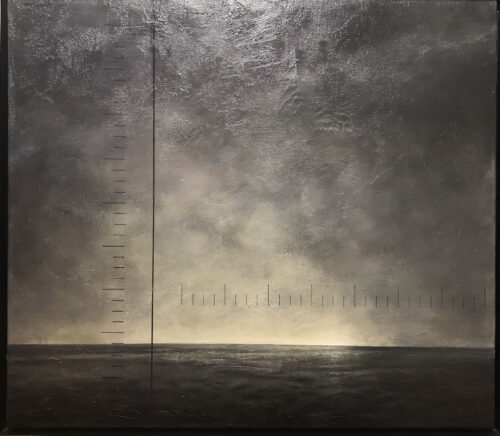
Dozier Bell
“The father society has collapsed. It’s not so much that the father doesn’t talk or pay support or has left the house, but rather that the image of the working, teaching father has faded from the mind. An image that has existed brightly in the mind for thousands of years has faded.”
Robert Bly (Forward to Society Without a Father Alexander Mitscherlich )
“Sometimes a man stands up during supper
And walks outdoors, and keeps on walking,
Because of a church that stands somewhere in the East.
And his children say blessings on him, as if he were dead.”
Rainer Marie Rilke (Sometimes a Man, Bly tr.)
“The force that through
the green fuse drives the flower … is my destroyer.”
Dylan Thomas (The Force that Through the Green Fuse, collected poems)
“My wager is that someone exposed to art can tell that a bad car loan is being is being sold as a good one with more discernment than someone who has no interest or experience in art”
Paul Chan (Second Nature)
Twenty first century western man no longer has the skills he had a hundred or two hundred years ago. Most teenagers today, at least in the U.S. can no longer write cursively nor can they read cursive writing. Basic math is a problem for many, but they have smart phone calculators handy so its not seen as a problem. There are certainly a lot of DIY centers, and TV shows, but they exist in a context of hobby and recreation. And those men (especially) who are have learned carpentry or electrical repair etc — they see an uncertain future of robotic replacement. I happen to think this is not entirely true, but that’s not the point.
“In view of the enormous number of past cultures and the number that still exist today, it is obvious that the mode and dynamics of adaptation developed by man differ from those of other social animals. Human specialization has avoided developing specialized tools for a special environment such as flippers or fins; instead man has specialized in non-specialization (K. Lorenz). In other words, his speciality is ‘tool-making brain’, an inventiveness that compensates for his failure to develop hereditary bodily tools and ways of behaviour. “
Alexander Mitscherlich (Society Without a Father)
A few paragraphs later:
“How far the conscious extends is obviously not fixed; it varies from individual to individual, from culture to culture, but it can hardly be doubted that in the course of observable history it has encroached on the realm of unconscious mental processes, and has made its greatest advances where, as Alfred Weber says, civilization has gone furthest in covering up the natural with a technical environment, thus creating a ‘second natural environment’.”
Alexander Mitscherlich (Ibid)
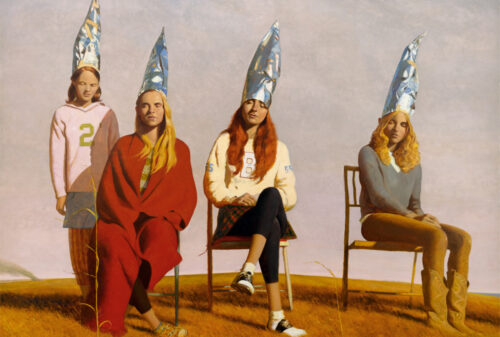
Bo Bartlett
Mitscherlich notes that man’s surplus aggressive drive has survived technological changes (which have been huge) and all other social revolutions. This is still a pertinent observation. Perhaps more pertinent than ever before, in fact. Mitscherlich suggests that the social changes of the last hundred years have caused a regression to the most basic urges of the human.
“…perhaps the present situation shows with special clarity one of the tendencies immanent in human social organization – to relapse from rational into deluded behaviour. The extent of paranoid distortion of reality that afflicts the politics of the present day can hardly be overrated. “
Alexander Mitscherlich (Ibid)
Mitscherlich observes that the diaries of Romain Rolland were hugely insightful in describing the delusions that came from the social trauma of the 1914. What he describes as “collapse of the sense of reality that extended into the highest ranks of the intellectual aristocracy of the belligerent nations on both sides.” Imagine if he were alive today. But this sense of unreality was noted by Edward Said in his final interview. And dozens of others, in fact. It is the age of delusion. The age of unreality.
Allow me another quote here from Mitscherlich: ” The psychological situation of such a person is characterized by a reign of terror exercised by his conscience associated with intolerable guilt feelings and fears. Formal orthodoxy, self-righteousness, and conformity of this are just as great an obstacle to humanization, that is, increased freedom of decision, as is subjection to the blind dictates of inner drives. Also closer analysis of the over-adapted often reveals secret ‘excesses’ or striking departures from the social norm, and still more often their self-righteousness is associated with the satisfaction of sadistic impulses in a way that inhibits any refinement of human relations. The sad situation of such ‘moral judges’ has a great deal in common with that of ‘moral sinners’.”
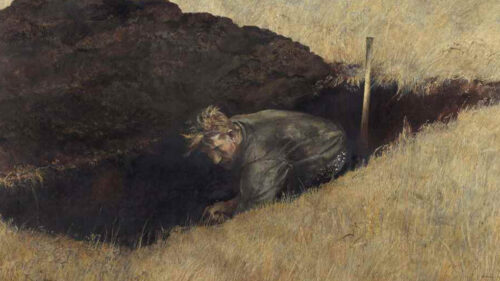
Andrew Wyeth
Over adaptation. I have written many times before about the ruthless new super ego. I think it began to appear mid 20th century. It has continued to grow and intensify.
“Evil is never done so thoroughly and so well as when it is done with a good conscience.”
Blaise Pascal (Thoughts of Blaise Pascal)
Good conscience is today a kind of self marketing.
There is something in the experience of missing or absent Fathers that re-activates the destructive female principle. The Kali the destroyer idea. As if only with this paternal absence does this destroyer/Mother appear. This is a very Jungian idea, this tension between opposing forces. I am told the morale on US navel vessels, those in the Arabian Sea, is very poor. The tour for these sailors has been extended to grotesque lengths. The men want to go home. They don’t want to fight. They listened to a frightening irrational speech by an Evangelical General. The general suggested they were to fight to bring on Armageddon. This speech given by a mad christian fanatic who assumed all agreed with him. The end times were coming. But these boys, really, do not want a suicide mission. Armageddon. They want to go home. They want their mothers. And so small acts of sabotage occur. On the USS Gerald Ford the toilets were stuffed with tee shirts. The ship had to return to port for repairs. This is a Freudian act of rebellion.
“In the final formulation of the theory of instincts, the self-preservation instincts — the cherished sanctuary of the individual and his justification in the “struggle for existence” — are dissolved: their work now appears as that of the generic sex instincts or, in so far as self-preservation is achieved through socially useful aggression, as the work of the destruction instincts. Eros and the death instinct are now the two basic instincts. But it is of the greatest importance to notice that, in introducing the new conception, Freud is driven to emphasize time and again the common nature of the instincts prior to their differentiation. The outstanding and frightening event is the discovery of the fundamental regressive or “conservative” tendency in all instinctual life. Freud cannot escape the suspicion that he has come upon a hitherto unnoticed “universal attribute of the instincts and perhaps of organic life in general” namely, “a compulsion inherent in organic life to restore an earlier state of things which the living entity has been obliged to abandon under the pressure of external disturbing forces” — a kind of “organic elasticity” or “inertia inherent in organic life.”
Herbert Marcuse (Eros and Civilization: A Philosophical Inquiry into Freud)
Regression.
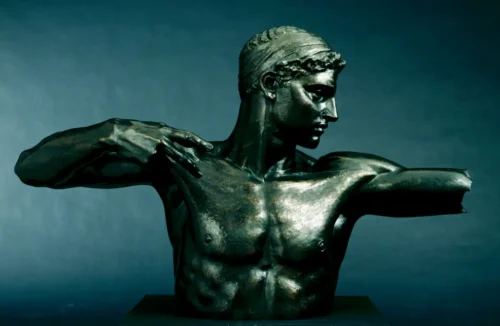
Hamo Thornycroft (Teuceer, 1880s)
“The preliterate mind, playing with the image of the sun as center of energy, the vitalizing principle, evolved God the Father who energizes and fecundates the feminine earth. Patriarchy replaced the worship of Earth Mother with that of Sky Father. (The halo associated with Christ is a relic of the solar aura of the Father even as the serpent associated with the maternal deities is spurned by the emergent patriarchy in Genesis.) When the experience of the father is positive, the child experiences strength, support, the energizing of his own resources and modeling in the outer world. When the experience of the father is negative, the fragile psyche is crushed.”
James Hollis (Under Saturn’s Shadow)
There are myriad issues surrounding this idea of regression when investigating Trump’s America. First is the danger of giving exaggerated importance to Trump (this is easy to do given he is driving blindly on the wrong side of the dead end street at 90mph. Which I think is a country western song of Hank Snow’s). But I digress. Trump himself is obviously a symptom. But those billion dollar aircraft carriers did not get to the Arabian Sea based solely on the word of Trump. They are almost living symbols of the surplus aggression of this age. Pointless and malfunctioning, hated by sailors who are also inthrall to them. That toilets on one overflowed shit to the degree the ship had to return to port, is simply too perfect an allegory (or fairy tale).
“The primary processes of the mental apparatus, in their striving for integral gratification, seem to be fatally bound to the “most universal endeavour of all living substance — namely to return to the quiescence of the inorganic world” The instincts are drawn into the orbit of death. “If it is true that life is governed by Fechner’s principle of constant equilibrium, it consists of a continuous descent toward death.” The Nirvana principle now emerges as the “dominating tendency of mental life, and perhaps of nervous life in general.” And the pleasure principle appears in the light of the Nirvana principle — as an “expression” of the Nirvana principle…”
Herbert Marcuse (Ibid)
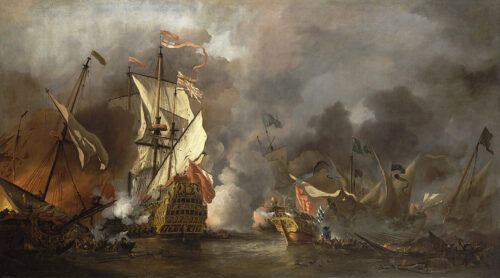
Willem van de Velde, , the Younger (1687)
Here I am reminded of Adorno’s essay Natural History. A notoriously difficult piece, it is hugely important to the current crisis, I think.
“While Adorno had been directly involved in the neo-ontological movement in the mid-twenties, he had fully separated himself from it by the time thathe presented his lecture on natural-history. That he nevertheless ended up on this occasion dressed partially in Heideggerian uniform is explained to a degree by Leo Strauss who describes the condition of philosophy in the early 1930s: “One has to go back to Hegel to find another professor of philosophy who affected in a comparable manner the thought of Germany… His domination grew almost continuously in extent and in intensity… Eventually a state was reached which the outsider is inclined to describe as paralysis of the critical faculties: philosphizing now seems to have been transformed into listening with reverence to the incipient mythoi of Heidegger.”
Robert Hullot-Kentor (Introduction to Adorno’s Idea of Natural History)
I find it curious (though maybe I shouldn’t) that so many of the bourgeois student class (and certainly, too, older leftists and dissidents of some stripe) reject Freud and also Adorno. The flip side of this same coin is Peter Thiel and his well attended lectures on the coming anti-christ. Thiel is not John Hagee or Pat Robertson, he is a Girard scholar of sorts and tech bro queer fascist who got a degree at Stanford Law School, (Jurist Doctor). Interestingly born in Frankfurt am Main, Germany but raised in South Africa (of fucking course he was) where he attended a German language grammar school that supported Nazi values, as did the entire South African German community. This is only to point up , again, that those German Jews fleeing Nazism in the 30s (Frankfurt School scholars) were at the mercy of US government whims and impulses. So they kept their heads down and took whatever jobs they could. But I digress again.

Emmanuel Monzon, photography
“Heidegger’s philosophy was the form of mythic terror taken by the disaster of the 30s. In the “Idea of Natural-History,” where myth and nature are synonymous, Adorno writes that neo-ontology is nothing “other than what I mean by ‘nature'”. It is a fateful structure of existential invariables.Just as all of Adorno’s writings struggle with myth,a struggle he analyzed with great concision in his study ofthe Odyssey in the Dialectic of Enlightenment, it is not surprising to find Ulysses’s tactics employed in Adorno’s development. The dialectic of enlightenment, the course of Ulysseus’ voyage, is the production of a second natural immanence. The self develops by becoming like what it masters at the same time that it dissolves its affinity to its object. In terror, Ulysses becomes Udeis, “nobody,” a model of Polyphemos’ undifferentiated nature. Ulysses develops this unconscious self-sacrifice, that wins him a favored position with the Cyclops, as a conscious ruse. He takes Polyphemos’ side against himself and offers him wine to better enjoy a slaughter that would include Ulysses himself: “Take Cyclops and drink. Wine goes well with human flesh.”
Robert Hullot-Kentor (Ibid)
The current Epstein files storyline feels increasingly like a chapter from Homer, if adapted for special needs teenagers. Or a vaudeville version of Aeschylus. The Cyclops ate human flesh, but so did, apparently a few Hollywood celebrities. The advance of AI and digital tech has mostly destroyed customer service. The average daily life for the working class today has seen a dramatic increase in frustration and stress because, at least in the US, nothing works and even the most banal of jobs or activities is made difficult and designed for maximizing profit. A profit for the proprietors of the system. The ruling class, essentially. Daily life is cut off from history, from the idea of the Father, the idea of the Mother. Both have been generalized and made abstract. Both, when they appear, feel like AI deep fakes.
“For Theodor Adorno, the idea of fate is connected to his speculations about art. Adorno understood fate as being the preexisting uses and meanings that determine one’s place in what is loosely called the “order of things.” Fate is experienced as the way the authority of the past weighs upon a thing, a place, or a person, and the way this weight burdens and directs how something is valued, how a place is treated, or where someone Adorno believed the burden of this weight that feels like fate is lifted within an artwork. For him, the interior, or composition, of a work acts like an echo chamber. When visual and conceptual elements enter a composition, they are deprived of their social bearings and become unmoored from the historical determinations that ground them in an intelligible reality. By turning elements into echoes of themselves within the matrix of its composition, an artwork loosens the grip social reality holds over those elements and frees them from their fate,their preexisting uses and meanings. They lose, in other words, their place in the order of things, which enables them to relate and belong in ways neither predictable nor predetermined. And this, for Adorno, is one of the most emancipatory aspects of art. It creates new relationships out of what already exists to remind us what is still possible with what is given. Art is radical insofar as it is able – like nothing else – to free whatever enters into its grip and, as he puts it, “negate its fatefulness.”
Paul Chan (Second Nature)
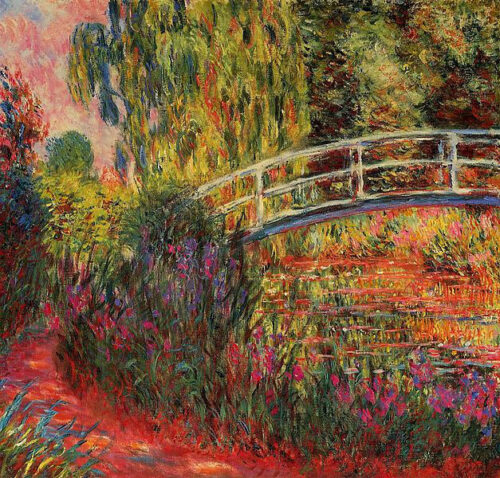
Claude Monet
Somehow the advances of science, progressive for decades upon decades (even if it contained the seeds of regression) stagnated suddenly…or maybe it was gradual. I’m not sure. There were exceptions to this. But even the exceptions demand examination. At a certain point science came to occupy our unconscious. Or at least it served as a rent collector for the psyche.
“Already, as far back probably as 2,000 B.C., the void that corresponds to what we would call the collective unconscious was conceived of as separated into two parts, two opposites, two creatures or potencies, that were possessed of a sort of consciousness, which had come about, perhaps, just because the void had already been separated into opposites. At least, we are told that they were accompanied by an intelligence, a word, called Mummu. This situation reminds us of how Jung, in his “Answer to Job,” repeatedly points out that Yahweh had an intelligence, conceived of as a separate person within the deity, but that he repeatedly failed to consult with this intelligence, which might have informed him of certain things he was overlooking. In the case of Apsu and Tiamat, this intelligence functioned like a fiat, emerging out of the depths of the unknown and unknowable abyss, that gave utterance to the way things had to be. It was the creative utterance of a god that causes whatever is spoken to come into being. The creation myth in Genesis starts in this same way, by just such a spoken fiat: “God said, Let there be light: and there was light.”
M. Esther Harding (The Parental Image)
How did contemporary Western society trend so dramatically toward authoritarianism? I don’t think it was hard, to be honest. Jung and Freud both were concerned with the unconscious and how the ethical existed, or didn’t, there. And how the Super-Ego developed and evolved.
“Thus everything depends on whether the forces of consciousness developed by the evolutionary process can reach full development before the simultaneously produced release of instinctual drives results in catastrophe. { } We, however, are conconcerned with the social order, not just from the point of view of the historical process in the narrower sense, but from that of the development of life as a whole. The authority of the mythical traditions is no longer sufficient to bring about a social integration of mass society; its ultimate outcome is always dictatorship.”
Alexander Mitscherlich (Ibid)
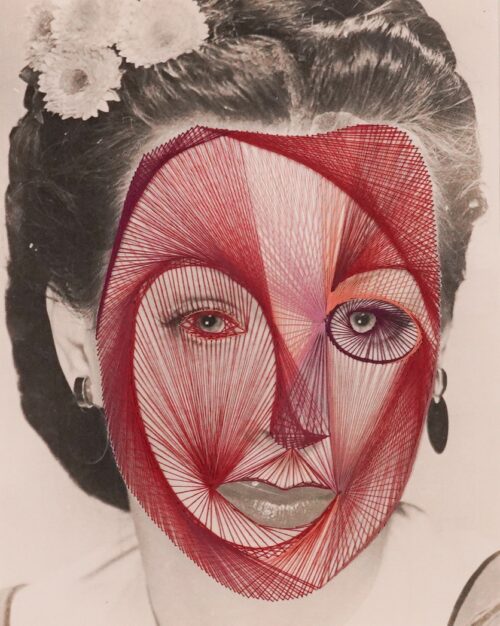
Maurizio Anzeri
Emmanuel Todd had an amusing interview that I want to quote from, two different quotes.
“Weltwoche: Who is responsible for the Nord Stream sabotage?
Todd: Of course the Americans. But that is completely unimportant. It is normal. The important question is: How can a society believe that it could have been the Russians? We are dealing here with an inversion of possible reality. That’s a lot worse. The study of such a society is fascinating.”
Die Weltwoche (Jürg Altwegg)
“Weltwoche: A few days ago, when you also wanted to cancel this interview, you spoke quite desperately about “Western irrationality”.
Todd: The behavior of the West is a complete mystery to me. I was only able to understand the implosion of the Soviet Union at the time because I am an avid reader of science fiction novels. Now, in this war, it seems to me like in Philip K. Dick’s “Ubik”: You never know where you are. The newspapers tell us how the Russians are shooting at prisons they have occupied. That they shoot at nuclear power plants that they control locally. That they blow up pipelines that they built themselves.
Weltwoche: Who is responsible for the Nord Stream sabotage?
Todd: Of course the Americans. But that is completely unimportant. It is normal. The important question is: How can a society believe that it could have been the Russians? We are dealing here with an inversion of possible reality. “
Die Weltwoche (Jürg Altwegg)
These are fascinating remarks. And while I’m quoting from a German magazine, I will quote American David Mamet on the subject, really, of this blog post. Also from the German magazine.
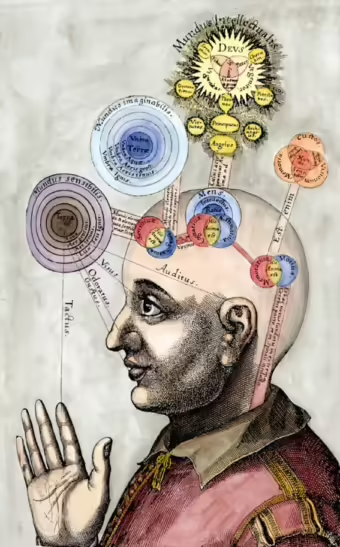
Robert Fludd (16th century)
“Once upon a time, a man was expected to know how to do things. To fix a hinge, gut a fish, light a fire that would last the night. His worth wasn’t measured by his eloquence but by his dependability, by the quiet assurance that when something broke, he’d find a way to mend it. His knowledge was not theoretical; it was born of trial, bruised knuckles, and repeated failure. He knew the world by touching it. That man is now an artifact. His skills are curiosities, his instincts outdated. { } Today, we have reimagined masculinity as pathology.{ } “Authenticity” has become a moral currency; sincerity is mistaken for truth. But the world doesn’t bend to sincerity. The bridge doesn’t hold because the engineer means well. We have confused self-expression with self-mastery. The former requires only emotion; the latter, discipline. And discipline, moral, physical, or intellectual, is now considered oppressive. The result is a generation that cannot distinguish freedom from chaos. The boy raised without rules becomes the man allergic to responsibility.”
David Mamet (Men Without Maps, Die Weltwoche 2025)
Now, what is interesting here is that Mamet cannot reach at all the right conclusions because (I suspect) his own masculinity has been in crisis for his entire adult working life. But the observations themselves are perceptive. These problems are not a secret. But Mamet also suffers from a closeted anti-intellectualism. (The fact he is a Zionist explains a lot actually). But I will say Mamet has innate talent. He can write. He has never written a masterpiece, though Glengarry Glen Ross is close. And yet even his most craven commercial paycheck project will containt ‘something’, some tiny moment of real quality. Of transcendence.
But back to this idea of the lost Father. One of the problems with the Mamet essay is his idea of (without saying it) heroism. And Paul Chan (an artist mostly, interestingly) observes that Odysseus, in The Odyssey, is unlike Nestor or Achilles, or other Greek protagonists. He is cunning (polutropos), wily, resourceful, not physically powerful. Adorno and Horkheimer, of course, have a long (and quite brilliant) dissection of Odysseus in Dialectic of Enlightenment.
“…the Homeric narrative effects one; by using an exoteric form of representation, it dissolves the hierarchical order of society in the very process of glorifying it. To celebrate the anger of Achilles and the wanderings of Odysseus is already a wistful stylization of what can no longer be celebrated; and the hero of the adventures shows himself to be a prototype of the bourgeois individual, a notion originating in the consistent self-affirmation which has its ancient pattern in the figure of the protagonist compelled to wander. The epic is the historico-philosophic counterpart to the novel, and eventually displays features approximating those characteristic of the novel. The venerable cosmos of the meaningful Homeric world is shown to be the achievement of regulative reason, which destroys myth by virtue of the same rational order in which it reflects it.”
Adorno & Horkheimer (Dialectic of Enlightenment)
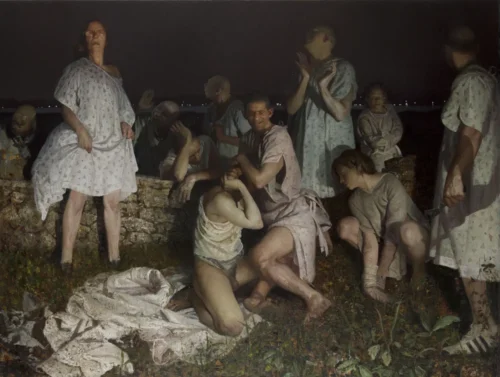
Vincent Desiderio
I don’t want to belabour this, but describing Odysseus as the prototype of the bourgeois individual is important, as is this idea of the hero compelled to wander. The stranger in the landscape. I once thought this idea of the stranger was a product of modernism, in a sense. At least refined in modernity in some fashion. But now I think its a lot more primordial. And this primordial quality, though, is more crucial in contemporary society than in any earlier, I think. The fragile nature of how we mature, and the generalized trauma of just growing up today results in an ever more complex transition to adulthood.
The young, those say still in high school, or first year of college, live in this grey zone of uncertainty. Here is where I feel fairy tales are very useful. For everyone lives out a metaphorical life while living through material one. We are each a fairy tale. Marie Louise von Franz analyses Faithful John in her book Shadow and Evil in Fairy Tales. In early all fairy tales that originated in Europe the expression of ‘lostness’ is (almost always in fact) represented by the forest. The transition to literal and metaphoric, as well as spiritual maturity always involves exile. Travel and return.
In Faithful John, there is much focus on travel. On a self created exile. But an exil born of love (lust). And as in many Brothers Grimm fairy tales desire is closely related to prison and a journey downward. Faithful John is also a precursor to Beckett. Parents found in cooking pots, not garbage cans. That connection, the father beneath a lid, in an urn of sorts. In a pot. Where does that come from?
“I feel something immensely significant in the brief scene of the King’s turning to a negative female power for help in leaving the forest. The King has been hunting too hotly and is lost. How much do we know of the early life of our fathers? This introductory drumroll to the story seems a true prelude for the lives of so many men I know. The King chooses protection from the risk of finding his own way and chooses magical escape over discipline and suffering. With that rejection of risk, he rejects his own destiny. This is a common choice in a culture such as ours in which the help that would have come through initiation has been lost. Adults live in fear of one kind or another—fear of failure, poverty, isolation, fear of loss of soul in the destruction of the earth. Those fears create a mood of “being lost in the forest.” Men in their twenties and thirties respond to those fears by leaning on a corporation, or an addiction, and sometimes by living off a woman, which can have the unanticipated effect of putting him in touch with a negative side of her nature.”
Marie Louise von Franz (Shadow and Evil in Fairy Tales)
Today, with the constant threat of War, a manufactured Capitalist compulsion, those most subjected to the violence are young men and women in the military, and children who are being killed at extraordinary rates. And then the Epstein files. Children again. Abused by men who should be, but cannot be, Fathers. Trump cannot be a Father, really. He is far more at home in killing and raping. Or in sending thousands of young men and women to zones of violence on huge ships. Ships of violence. There is not much difference, really, between abusing children and sending them to die in conflicts in which OTHER children (and adults) will also die. The spectre of the grave is everywhere in the news cycle today. There are also mini colonizations throughout western culture. Evangelicals colonized the Air Force Academy. Gay men colonized theatre, certainly. Mormons colonized the FBI. The environment is hostile and threatening so groups form small communities, but they rarely function as community, they function more like small mafias. They are parasitical.

Hall in bunker, built circa WW2. Albania.
“What does one really inherit from one’s father, apart from his physique, perhaps, and what does one acquire from him? What happens in emotional communication with him, and what social task is associated with this relationship? One can admire one’s father, one can feel sheltered and protected by him, or one can fear him; and finally one can despise him. At different times one can do all these things. Besides these so varying emotional attitudes, however, there is something else. One can learn from one’s father, one can be initiated by him into ways of dealing with things, or one can do without him in the process.”
Alexander Mitscherlich (Ibid)
These mythic journeys are largely impossible today. Getting lost in the forest is impossible with GPS. That sounds funny, but there is a truth to it. You can get lost but its the wrong kind of lost. Surveillance keeps track of us. It is a kind of imprisonment. The idea of the wanderer is archaic and increasingly so are a variety of other archetypes.- Throughout the 20th century the figure of the exile was ubiquitous in literature. It is interesting how today, with massive displacement of populations, the exile feels (like the Father) to be fading. There is a sense in which the ground for such allegory is no longer fertile. I wrote last post about the ‘land of the Giant’ (in relation to the Jack and the Beanstalk tale). I found myself these last weeks returning to this image, even in my dreams. It’s not just that this landscape is inhospitable, and barren, it is the sense of its being incomplete — it is at the top of the beanstalk.
When you read fairy tales you are immediately reminded of Kafka. The logic is the same, and inexplicable quality found in daily life, of daily banality, really, too. It is like the King James Bible without the finger wagging. And there is an interesting question here about the miraculous as it appears in fairy tales, and in the Old Testament. As the idea of miracles faded there was nothing come to replace it. More incompleteness.
“ Psychoanalysts have correctly emphasized that Freud’s last metapsychology is based on an essentially new concept of instinct: the instincts are defined no longer in terms of their origin and their organic function, but in terms of a determining force which gives the life processes a definite “direction” (Richtung), in terms of “life-principles.” The notions instinct, principle, regulation are being assimilated. “The rigid opposition between a mental apparatus regulated by certain principles on the one side, and instincts penetrating into the apparatus from the outside on the other, could no longer be maintained. Moreover, the dualistic conception of the instincts, which had become questionable ever since the introduction of narcissism, now seems to be threatened from quite a different direction. With the recognition of the libidinal components of the ego instincts, it became practically impossible “to point to any instincts other than the libidinal ones” to find any instinctual impulses which do not “disclose themselves as derivatives of Eros. This inability to discover in the primary instinctual structure anything that is not Eros, the monism of sexuality — an inability which, as we shall see, is the very token of the truth — now seems to turn into its opposite: into a monism of death.”
Herbert Marcuse (Ibid)
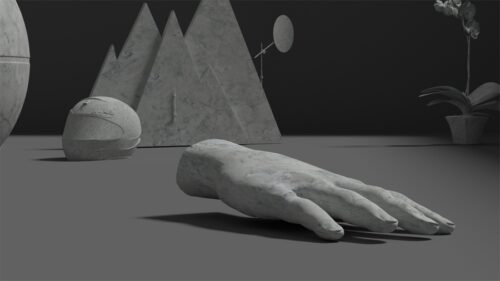
Maria Taniguchi
Freud turned toward the repetition, regressive/compulsive aspect of Eros. Sadistic constituents of Eros are examined.
“ He took the heads of the two children and put them on their necks and smeared the wound with their blood, and they were immediately alive and all well and played as though nothing had happened. The king was overjoyed, and when he saw the queen coming, he hid Faithful John and the children in a big cupboard and asked her if she had prayed when in church. She said that she had, but that all the time she was thinking of Faithful John and how unhappy he had been because of them. The king answered, “Dear wife, we could give him back his life, but it would cost us our two little sons who would have to be sacrificed.” The queen turned white and was terrified, but she said that they owed Faithful John something for his faithfulness. The king was happy that she thought as he had and, opening the cupboard, brought out the children and Faithful John, and said that they should praise God that Faithful John had been freed and that they had their sons again.”
Marie-Louise von Franz (Ibid)
Fathers and sons. Repetition and regression. Now von Franz adds: “The poison in the story might in one way be regarded as the king’s projections, but it is also the poisonous blood in the bride, the red horse, and the wedding shirt. The poisonous element, personified in other stories in the shoemaker, this time is an element within the bride from which she has to be cleansed until she is the anima figure. Her poison is the cause of all the misunderstandings; it is responsible for the king’s misunderstanding of his faithful servant.” The bride in this particular tale is extraordinarily beautiful. Bewitching. Often in such tales this beauty is the source of destruction, at least for those who try to approach her. This is a strange dynamic I cannot entirely grasp. There are echoes of earlier prohibitions in such ideas. The beautiful princess or bride is contaminated with poison (sometimes connected to having sex with a seductive demon who lives in the forest!). These poisoned qualities are unconscious impulses that need to become conscious. The man’s search in such stories almost always entails travel. Downward (sometimes up, as with Jack) and there are aspects connected to the underworld, the world of the grave and earlier sacrifices. The female (for Jungians) is the anima. Accepting that assertion provides interesting conclusions.
“If we try to interpret this motif psychologically, we might say that the anima has a function which we define as a connection with the deeper layers of the unconscious. She represents a bridge to the collective unconscious; that is, if a man tries to make conscious moods and fantasies which get him from behind, if he meditates on them, them he can penetrate into the deeper layers of the unconscious. One has to ask oneself, “Why do I get so upset about this and that?” If a man asks that, he will find what lies behind his anima and that she is the bride of the demon. ”
Marie-Louise von Franz (Ibid)
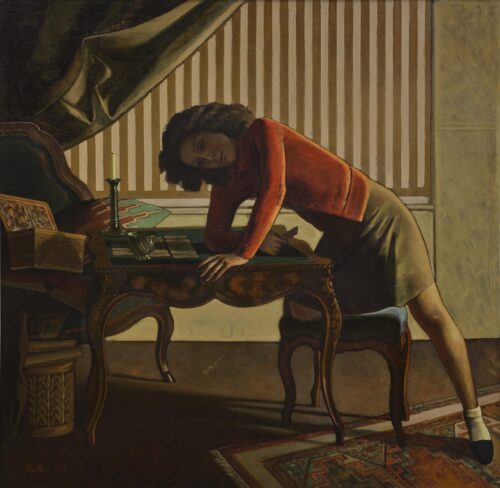
Balthus
The landscape of the Giant (Jack and the Beanstalk) is the landscape of the grave. Gaza today is both a literal grave and an allegorical one. It is even more than that, of course. It is the source of poison, of spiritual contamination. I sometimes think we all spend inordinate amounts of our lives searching for maps to help us avoid walking into graveyards. That the most contaminated societies today look for every opportunity to restrict travel makes perfect sense. Displacement for some, but a kind of paralysis for others. You cannot move. I think this tension is seen in ideas such as 15 minute cities. The obvious fact is such an idea makes absolutely no sense. But there it is anyway. Western culture today cannot navigate the material world. Technology does that.
“The dying king’s situation is beautifully illustrated: the dominant principle of collective consciousness, the king, is fading away, is dying, and the female principle is not represented, for there is no queen and no other female figure, except for the hidden picture of the Princess of the Golden Roof shut away in a room. So the beginning illustrates the state of affairs where the anima is completely repressed and the relationship to the feminine principle is cut off and shut away. Moreover, the living woman is on the other side of the great sea, that is, far from consciousness. { } In Catholicism the mother archetype is represented by the Virgin Mary, but in Protestantism even that is cut out and the female principle is not represented at all. A forbidden chamber in which there is a positive and luminous figure is a frequent theme in fairy tales. It symbolizes a repressed complex, that is, a living psychological factor which consciousness does not want to contact.”
Marie-Louise von Franz (Ibid)
Men such as Peter Thiel and Alex Karp are deeply repressed. In their cases, I suspect, their sexuality is partly a denial of the father. In the story of Faithful John, the Princess of the Golden Roof comes from above and not below. Which is somewhat unusual. The infantile citizen of contemporary America cannot reach or climb anywhere.
“Faithful John’s advice to the prince seems very alchemical: he tells the prince to make the golden animals, birds and fishes, vessels and tools, which will attract the princess. He sets a trap for the anima.{ } The modern psychological parallel would be active imagination, through which one can literally attract the contents of the unconscious. If you succeed in producing the right kind of symbol, either by drawing, or writing a fantasy, or by actual active imagination, you can, to a certain extent, constellate your own unconscious.”
Marie-Louise von Franz (Ibid)
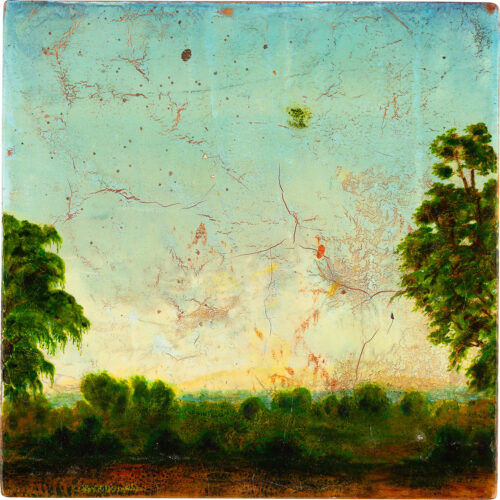
Joan Nelson
This is one role of art, of imagination, of the progressive dimension of culture. It links to the ideas related to Adorno and second nature.
“Brief as this critique of Heidegger is, there is obviously a great deal to be said about it: while Adorno criticizes Heideggerian ontology as idealist according to the priority of the ratio evident in the pretention to totality, a critique that in its focus on the problems of contingency, actuality, and the glorification of the status quo, importantly parallels Marx’s critique of Hegel, the form of Adorno’s study is itself part of the idealist tradition; it is immanent criticism that has excluded the claim to totality: Heidegger’s work is measured according to its own concept, historicity, yet, in contrast to the Hegelian movement of the concept, no systematic hierarchy of concepts emerges. Not only is Heidegger treated immanently, but so is the modern history of philosophy. It is measured against its claim to objectivity. As is evident with Heidegger in particular, the course of this history is, altogether, one in which the ratio consumes its relation to its object. However the ratio attempts to establish objectivity, it seals itself off from objectivity. Historically the ratio produces a second nature, ultimately the mythical, invariable existentials of neoontology. These absolutes are meanings inserted into reality. They are allegorical, to be conceived as part of the “original-history of signification” explained in the essay’s second part. This second nature is unable to interprete itself as what it is because its starting point is the ratio.”
Robert Hullot-Kentor (Ibid)
For the purposes here, history becomes second nature, unconscious of itself. It is the repression of mimesis and the exaltation (sort of) of ratio. The history of subjectivity, then, as the ascension of this instrumental form of thinking, a form that Heidegger for one, traces back to the pre-Socratics.
Paul Gagner
And in terms of fairy tales and societies’ psychopathy at the moment, Adorno posited that “Benjamin showed this perception of nature as history to be the form of allegory and indicates that this form is somehow related to the organization of constellations of concepts.” I have written, in this blog, a couple other times about Hullot-Kentor’s intro to the Adorno essay and about the essay itself. It is dense material. So I will wrap up here. The story Faithful John, or Jack and the Beanstalk are very close to Kafka, and Beckett, and Handke at times. And Thomas Bernhard certainly. Today’s entertainment industry is in the business of erasing the allegorical. The ugliness of the western world, at least the urban areas, is that which Beckett so compulsively created, again and again. But there are aspects of the fairy tale in Shakespeare (Ted Hughes understood this in his book Shakespeare and the Goddess of Complete Being. There is a blackness , literally, that runs through the sonnets and plays both, culminating in the storm of The Tempest. Hamlet’s mourning robes to the skin colour of Aaron the Moor and Othello both, to the robes of Richard III. The qualities of the fairy tale are exactly what Hollywood and mass media cannot tolerate. Parents in garbage cans, Winnie buried in beach sand to her waist, and then her neck. This is the expression of something anti-instrumental.
“Education confined to the transmission of learnt obedience and the imprinting of an absolutist conscience leads to men’s partial infantilism, prevents the development of a personal conscience, the prerequisite of which is the experience of closeness and intimacy.”
Alexander Mitscherlich (Ibid)
To donate to this blog and to the Aesthetic Resistance podcasts, use the paypal button at the top of the page.
Speak Your Mind