



Gunther von Hagens
“For ye see your calling, brethren, how that not many wise men after the flesh, not many mighty, not many noble, are called:
But God hath chosen the foolish things of the world to confound the wise; and God hath chosen the weak things of the world to confound the things which are mighty;
And base things of the world, and things which are despised, hath God chosen, yea, and things which are not, to bring to nought things that are:
That no flesh should glory in his presence.”
1 Corinthians 26;29
“Although the power of making visible the forms of the dead has been claimed for one sort of incense only, the burning of any kind of incense is supposed to summon viewless spirits in multitude. These come to devour the smoke. They are called Jiki-ko-ki, or “incense-eating goblins;” and they belong to the fourteenth of the thirty-six classes of Gaki (pretas) recognized by Japanese Buddhism. They are the ghosts of men who anciently, for the sake of gain, made or sold bad incense; and by the evil karma of that action they now find themselves in the state of hunger-suffering spirits, and compelled to seek their only food in the smoke of incense.”
Lafcadio Hearn (Ghostly Japan)
“Once he was staying near the city of Vārāṇasī at the deer park in Ṛṣipatana (Where Seers Fly). And it was there that a monk walked by who was tormented by thirst. Then he came upon a well. A young woman who had just filled a pot with water was standing beside it. “Sister,” the monk said to her, “I’m tormented by thirst. Please offer me some water.” In that young woman there arose a meanness. Since she clung to her possessions, she said to the monk, “Monk, if you were dying, I still wouldn’t give you any water. My water pot wouldn’t be full.” The monk, tormented by thirst and despairing, continued on his way. That young woman, who had practiced, developed, and cultivated her meanness, then died and was reborn as a hungry ghost. And so she is racked with sensations that are searing, piercing, distressing, agonizing, and acute. Therefore, Maudgalyāyana, this is the lesson to be learned: Work hard to rid yourself of meanness! It is this, Maudgalyāyana, that you should learn to do. ”
Phra Malai Klon Suat (Andy Rotman tr. Hungry Ghosts)
“The selling of the President is the selling of his phallus.”
John Steppling (The Phallic Burden)
“Mailer, Updike, Roth–the Great Male Narcissists who’ve dominated postwar realist fiction are now in their senescence, and it must seem to them no coincidence that the prospect of their own deaths appears backlit by the approaching millennium and on-line predictions of the death of the novel as we know it. { } “Most of the literary readers I know personally are under 40, and a fair number are female, and none of them are big admirers of the postwar G.M.N.’s. But it’s Mr. Updike in particular they seem to hate. And not merely his books, for some reason–mention the poor man himself and you have to jump back: ‘Just a penis with a thesaurus.’”
David Foster Wallace (Review of Updikes’s Toward the End of Time, Observer 1997)
Discussing the Greek myth of Erysichthon, (Hellenistic and later Roman) Anselm Jappe writes…
“This is one of those typically Greek myths that evokes hubris— immoderation due to blindness and ungodly vanity—which ends up provoking nemesis, the divine punishment suffered by Prometheus, Icarus, Bellerophon, Tantalus, Sisyphus, and Niobe, among others. One cannot help but be struck by the contemporary relevance of this myth. In particular, those who like to present the destruction of the natural environment as the transgression of an equally natural order may see it as an archetypal anticipation of their anxieties: disrespecting nature necessarily attracts the wrath of the gods, or nature itself … Yet it goes much further: it is not a natural disaster that befalls the ancestor of the madmen who are today destroying the Amazon rainforest. His punishment is hunger, a hunger that grows with eating and that nothing satisfies. But hungry for what, exactly? No food can appease it. Nothing concrete, nothing real meets the need felt by Erysichthon. His hunger is unnatural and that is why nothing natural can soothe it. Instead, it is an abstract and quantitative hunger that can never be assuaged. However, the desperate attempt to allay this hunger drives him in vain to consume food, very concrete food, destroying it and thereby depriving those who need it. The myth thus anticipates, in an extraordinary manner, the logic of value, of the commodity, and of money: while all production aimed at satisfying concrete needs finds its limits in the very nature of these needs and begins its cycle anew, the production of exchange-value, which is represented in money, is limitless. The thirst for money can never be quenched because money is not intended to satisfy a specific need. The accumulation of value, and therefore of money, is not exhausted when the “hunger” is satiated, but immediately begins again for a new, expanded cycle. ”
Anselm Jappe (The Self-Devouring Society)
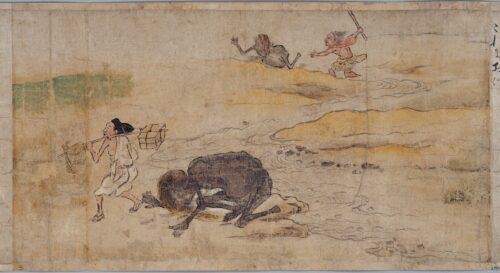
Gaki Soshi scrolls,. Heian period, 794 – 1185.
This also sounds a lot like the Buddhist notion of ‘hungry ghosts’.
“The realm of hungry ghosts is one of the unfortunate realms of rebirth in the Buddhist cycle of existence, and those reborn there are said to have led lives consumed by greed and spite. Hungry ghosts are often described as having enormous stomachs and tiny mouths, forever thwarted in their search for food.One of the earliest sources about hungry ghosts is the ten stories about them in the Avadanasataka (One Hundred Stories), a Buddhist scripture from the early centuries of the Common Era, and these ten stories are elegantly translated in this volume. These hungry ghosts know the error of their ways, and they sometimes appear among humans, like the ghosts that haunt Ebenezer Scrooge, as augurs of what may await. Their bodies trigger disgust, but their aim is to inspire in us a disgust with the human thoughts that lead to such wretched bodies. Hungry-ghost stories are meant to shock us out of our complacency.”
Andy Rotman (Hungry Ghosts)
Hunger. But, per Jappe, for what? Hunger for what? I have asked this, I suspect many watching the new Hunger Games that bounce between Gaza, Kiev, and Mar a Lago. What do any of the western political leadership class want exactly? One glib answer is ‘more’. But more of what? Do hungry ghosts inevitably lead us to Jeffrey Epstein?
There is also the myth of King Midas. A related cautionary tale.
“…the troubling similarities between the lofty king of Thessaly and our situation go even further. His behavior evokes not only the logic of the inverted world of commodity fetishism, but also, more directly, the behavior of the subjects who live under its reign. The furious impulse that intensifies with every attempt to appease it and leads to the physical disintegration of the individual— who previously spent all of his resources and violated the most basic affections to the point of coercing the women around him into prostitution—recalls the journey of the addict in withdrawal. Some drug addicts thus embody the logic of capitalism, for which they serve as a sort of metaphorical figuration. More generally, Erysichthon clearly possesses the traits of the narcissist, in the clinical sense of the term.”
Anselm Jappe (Ibid)

Red Stamnoi, 450 BC (Chicago painter, representing King Midas)
“This awareness of relativity seems to constitute progress in the sciences of the 19th and 20th Centuries, ranging from the study of history (since historicism), political economy (subjective or relational value theory), natural science (quantum physics), linguistics (Saussure) and philosophy (postmetaphysical thinking, linguistic turn) and flows into the general postmodern anti-essentialism and relativism. But it only seems to be so. For precisely because science and knowledge are always sociohistorically determinate, they are subject to conditioning by social forms that imply relations of fetishism, power and force (alternatives remain to date unknown), and also always in the wake of apologetic thinking. It could not be otherwise where knowledge is innately knowledge for the benefit o f power. In the commodity-producing system of Modernity these apologetics take on the form of ideology.”
Robert Kurz (The Substance of Capital)
Commodities relate to each other as units of abstract time. In other words as ‘value’. And most classic Marxist theory focused on surplus value, the extraction of which is bedrock exploitation of the worker. This, coupled to the insistence upon growth constituted capitalism. Jappe and others, though (including Jappe’s mentor Debord) began to sense the critical psychosocial and existential aspects of this form of the reproduction of society.

Lin Shu, photography (Shigong Pagoda, Fujian province 1670)
“We believe, of course, that forms of thought—symbolic expressions—are part of the history of the societies in which they have developed, and that they often provide the best means for understanding those societies. However, the point here is not to establish direct links between these forms of thought—for example, the great philosophical systems—and class relations, in the vein of “historical materialism.” The latter invariably saw in almost all thinking from the seventeenth to the nineteenth century the expression of the “rise of the bourgeoisie” and its aspirations to free itself from feudal and clerical domination. This type of analysis is not incorrect, and it has often led to important results. But what we are proposing here concerns another level of analysis—another “geological layer”— in the history of bourgeois society. This is a level of analysis that touches on the constitution of the subject and its deep psychological dimensions, in the hope that one day a “materialist” history of the human soul might be unearthed. We do not mean “material” in the sense of presupposing an ontological preeminence of material production or “labor,” but in the sense of conceiving the symbolic sphere as neither self-sufficient nor self-referential.”
Anselm Jappe (Ibid)
Ok — so in a sense Jappe is really more interested (at this point anyway) with a direction taken to some degree by Debord, and by the Frankfurt School. I wrote last time that vulgar Marxism had making a comeback. And certainly there has developed an official or institutional acceptance or Marxism from a purely economic perspective. The psychoanalytic (and cultural) is seen in a highly critical light for the most part.
We have to examine the psychic formation of the individual (sic) in western society, in terms of both how the economic affects him or her, but also how this damaged entity affects the economic. This is why Anne Carson’s book on coinage is so relevant.
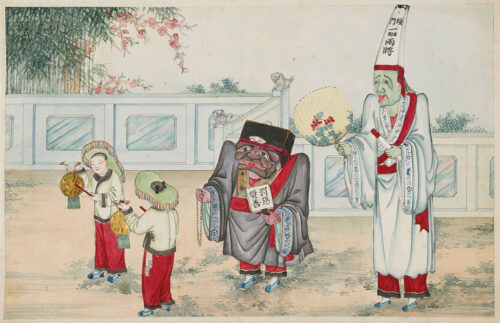
Anonymous (Qing Dynasty, the black & white impermanences)
“ Narcissism, in the psychoanalytic sense, is on the contrary a weakness of the ego: the individual remains confined to a primitive phase of psychic development. It does not even reach the stage of Oedipal conflict, which gives access to “object relations.” It is the opposite of a strong and glorified self: impoverished and empty because it is unable to flourish in true relations with external objects and people. It limits itself to reliving the same primitive impulses over and over again.”
Anselm Jappe (Ibid)
This is white subjectivity, white and masculine. This was (per Jappe) the Cartesian subject, the European white man who identified with a superior form of self. But such reflections, at this particular moment in time, will lead us to the Jeff Epstein story. It is a very hard topic to write about without sounding jaundiced and cynical, or sanctimonious . The most obvious problem is that we don’t know the full story. Someday, maybe, all the files will be opened. I doubt that will happen anytime soon, however. I am aware that a shockingly high number of child predator cases have been prosecuted over the last twenty five years. More than I would have expected. And while ephebophilia is not surprisingly common, or even hebephilia, I am admittedly shocked how prevelant pedophilia is- and I make this disctinction because there are clear and different symptoms and behavior associated with hebephilia and ephebophilia. This is a pretty radioactive topic though and not the point of this post. The point is that the Epstein files seem to have uncovered massive networks of child predators replete with baroque nomenclature and codes (see: grape soda, pizza, etc). And also by the (I would have thought) niche perversions associated with Satanic worship and cannibalism. And in fact the sexual abuse of very young children has been on the rise for decades, if one believes some of the figures.

James Lumsden
In fact there is a point at which one has to wonder how reliable are the numbers and at what point do we have to re-define ‘perversion’. But there are also the deep and indelible ambivalence associated with the Epstein case. And this is true of nearly all sex crimes, where abuse is both seen with revulsion, but often with hidden desire. Desire that cannot be admitted. Trump was, after all, elected President. I recently saw a grey haired gent with a red MAGA cap and a red tee shirt that read “I don’t care if Trump is a pedophile”.
“Although there is no full regression of the personality to pregenitality in conversion hysteria, nevertheless there is, especially in women, often a regression to the instinctual aims of incorporation. This is shown not only in the predominant role played by identification in conversion hysteria but also in more direct signs. The fellatio idea is extraordinarily common in the unconscious fantasies of hysterical women (globus hystericus). Analysis shows that this idea is a distorted expression for the wish to bite off and incorporate the penis. This fantasy is abundantly overdetermined. In individual cases the following meanings seem to be of different relative importance. It may mean (a) a displacement upward of genital wishes, (b) the idea of impregnation, (c) a revenge on the man who possesses the envied organ, that is, an expression of active castrating tendencies, and (d) an incorporation of the castrated penis and an identification with the man ”
Otto Fenichel (The Psychoanalytic Theory of Neurosis)
“Being a convicted sex offender did not make Mr. Epstein an outcast, not when he seemed to have something to offer.”
Molly Jong-Fast (Op Ed NYimes 2026)
Titian (Three Ages of Man, 1515)
Now there are real questions about narcissistic personalities, about capitalism, and about masculinity in relation to Epstein. Pinker and Chomsky are forever tainted by their association now. If Epstein was a Mossad honey trap (seems that is exactly what he was) then this was the most successful honey trap in history. But many celebrities and politicians have been caught in controversy because of sexual indiscretions. But Epstein is different. Epstein was selling illicit and illegal sexual favours. And this, in fact, seemed to be his appeal. I see little indication that Epstein was particularly charming or attractive himself. Many alleged victims saw Ghislaine Maxwell as the brains of the operation, noting Epstein did not ever suggest an acute mind or talent. No, Epstein was the guy who could supply ‘whatever’ you wanted. Epstein had a private jet (many, actually) and his own private island. And he had access to the rich and famous- Or rather — he cultivated acess.
Part of Epstein’s appeal was his rolodex. Epstein conveyed permission by virtue of who he knew. There was a sense of protection granted by having a Stephen Pinker at your party- As Dennis Riches noted, Epstein was a lot like an updated Playboy magazine. There was always some small element of ‘seriousness’ embedded with the naked flesh. There was always that TED Talk dimension. Yes, sure, sex trafficking, pedophilia, child rape — but also ‘serious’ discussions about neuro-implants and whateverthefuckever. About space travel and it was all horseshit. But it granted a veneer or respectability that assuaged guilt.
It may be that I am overestimating guilt as a factor in any of this. I suspect we are entering into a post guilt age. But all this stuff; Epstein, rich Zionist friends and protectors, and those, like Elon Musk, who desperately wanted to be on the inside. Musk is the world’s richest man (or one of the top three) and yet is basically a hair plugged grifter from a rich racist South African family. And he was chasing Epstein. I doubt for any specific perversion as much as wanting to part of the ‘scene’. As Lady Victoria Hervey put it, ‘if you weren’t in the files, you had to be some sort of loser’.
The marketing of the USA — is a marketing of wealth as a virtue unto itself. Epstein was liked partly because he was rich. It may have been a sham wealth, to some degree, but it was still wealth. But this entire narrative is also about masculinity.

Compendium rarissimum totius Artis Magicae sistematisatae per celeberrimos Artis hujus Magistros
The often referred to ‘crisis of masculinity’ is a crisis born of marketing and advertising. It is the commodified masculine (and feminine). Germain Greer wrote a very good monograph titled ‘The Beautiful Boy’ a while back. It explores various depictions of boyhood from Hellenic times to contemporary fashion mags. Today the representations of ‘boys’ are nearly all pornographic. Advertising and marketing changed ideas about ‘art’.
“The subject developed in the era between Descartes and Kant is a pure subject of knowledge, and therefore an individual subject. In parallel, between Hobbes and Rousseau, the political and public dimension of the modern subject-form was developed. The work of Hobbes corresponds to that of Descartes, and not only in terms of a mechanistic vision of the world. Hobbes asserted politically the same radical separation between the social atom and a world alien to it as Descartes did epistemologically. His theory is truly the “mother of all bourgeois theories” because it considers the isolated individual and its drive for self-preservation and self-affirmation to be the basis of any form of society. Almost all political theories formulated after, including those hostile to the consequences Hobbes drew, would take this statement as a given. Yet in truth, this is hardly the case, as many anthropological works have shown—notably the theories of Marcel Mauss and his school of thought on the social bonds created by the gift, where the individual has always existed as a member in a chain or network.”
Anselm Jappe (Ibid)
but….
“Another fundamental stage in the formation of the subject was the development of the notion of homo economicus. This took place mainly in Great Britain between the end of the seventeenth and the beginning of the nineteenth centuries, through the work of Locke, Mandeville, Hume, Smith, Malthus, and others. Their “economic” theories were based on a completely new anthropological concept: for the first time in history, material gain was affirmed as an end in itself. According to this view, the vocation of human” “teenth centuries, through the work of Locke, Mandeville, Hume, Smith, Malthus, and others. Their “economic” theories were based on a completely new anthropological concept: for the first time in history, material gain was affirmed as an end in itself. According to this view, the vocation of human beings is not to be virtuous but to accumulate wealth. When traditional virtues are an obstacle to the creation of material wealth, they must be abandoned and replaced by others. The definition of a science of economics and its autonomization from other fields of knowledge went hand in hand with an effective autonomization of the economy itself: rather than providing society with the material basis for what it considered truly important (service to God, glory, civic life, contemplation, etc.), the economy became the supreme end to which the other spheres of life were called upon to contribute and to submit.”
Anselm Jappe (Ibid)
Vishnu in his fish avatar, Matsya, vanquishing the demon Hayagriva . Gouache drawing. Date unknown.
Material gain as an end in itself. Horkheimer and Adorno wrote of this. The disciplining of the self, the Panopticon of our mind. Means become ends. I even quoted Horkheimer in my last blog post…
“…reason becomes a kind of adding machine that manipulates analytical judgments.”
Max Horkheimer (The End of Reason)
“The modern subject is precisely the result of this internalization of social constraints. One is all the more disciplined when one accepts these constraints and succeeds in imposing them on oneself against the resistance that arises from one’s own body, feelings, needs, and desires. It is violence against oneself that first defines the subject: on this point the philosophers of the Enlightenment are very clear. Women, “negroes,” children, servants, and generally members of the lower classes were deemed inferior precisely insofar as they proved unable to internalize these constraints in a sufficient manner. ”
Anselm Jappe (Ibid)
The Enlightenment never wavered in its commitment to discipline. Jappe adds “This is the “democratic” dimension of the subject-form: the virtual right for everyone to participate in the same form of internalized submission. It is difficult to see anything “emancipatory” in this gradual spread of the subject-form, which, conversely, indicates the extent to which capitalism has overcome any truly external opposition.”
The long process of becoming a subject – one that is able to work. Those qualities that might interfere with work would be and were slowly eliminated. I can think of a number of thinkers and teachers who would be useful in understanding the Epstein story– Robert Bly, Fr. Seraphim Rose, and a good many Buddhists.

Lantern slide, 1922, Clement Lindley Wragg.
Even now I am sometimes awe struck with the genius of Freud. And when I have to read the inevitable stupidity denouncing his work I take some comfort in the fact that (as Freud knew) the people most loudly attacking him are those most in need of reading him.
“Narcissism then consists of being unable to differentiate between the ego and the id, with an intrauterine life as the prototypical example. It would therefore be prior to the formation of the ego, without knowing any divide between the subject and the world; it would be the original state of the human being after birth, when the pleasure principle reigns supreme. In Group Psychology and the Analysis of the Ego (1921), he writes: “Thus, by being born we have made the step from an absolutely self-sufficient narcissism to the perception of a changing external world and the beginnings of the discovery of objects. And with this is associated the fact that we cannot endure the new state of things for long, that we periodically revert from it, in our sleep, to our former condition of absence of stimulation and avoidance of objects”
Anselm Jappe (Ibid)
Clara Thompson writes in her introduction to Fritz Wittels paper (and Wittels is much neglected today):
“The paper discusses the over-promiscuous psychopath and the criminal psychopath. The creative psychopath is not presented. The fixation point in psychopaths is found in the phallic phase where sex differentiation is not yet decisive and the Oedipus conflict and castration fear have not yet appeared. Thus the psychopath is bisexual without guilt; i.e., unlike the neurotic he feels no need to conceal his bisexuality. The Don Juan plays up his feminine side as well as his masculine.”
(International Journal of Psychoanalysis, 1938)

Jack Youngerman
And in a sense we arrive at Jeff Epstein. But there are several tributaries of influence and meaning going on here. There is the fact Epstein was a Zionist. That gal pal Ghislaine Maxwell was the daughter of Israel’s most famous spy (Robert Maxwell), and there are a host of wealthy donors (Lex Wexner for one, a bi sexual multi millionaire who owned Victoria’s Secret). There is Noam Chomsky and Stephen Pinker. Together they form a kind of cultural backdrop, a Conde Nast glossy magazine cover for the topic of kiddie porn and human trafficking. There are also the pop gothic P. Diddy side bar, a truly sordid series of accusations ranging from sexual abuse and rape, all the way to the drinking of blood to preserve youth. Epstein was trailed by a now massive cultural armada. I think, interestingly, Jappe himself touched on how this works with his monograph on Celine.
“We do not have to call attention to the fact that Céline, even disregarding any political orientation, was a bard of resentment, a resentment of the highest degree, directed against everything and everyone, a resentment on a cosmic scale. This was his terrible strength: expressing, without mediations, nakedly and crudely, the emotions that life in modern, bourgeois and capitalist society can effectively arouse. From this point of view, Céline is unsurpassed. He represents a real temptation. The first time you read the Journey to the End of the Night, when you are young, can be just as unsettling as one’s first reading of Nietzsche or the first time you contemplated Munch’s The Scream. And in every such case it is necessary to avail oneself of a subsequent distancing in order to distinguish how much truth each such example contains from its simple shock effect.”
Anselm Jappe (From Celine to Videoclip)
It had just this effect on me. There are other books that do similar things, Henry Miller’s trilogy, and Naked Lunch. For resentment is a gigantic almost unreal aspect of contemporary life. Modern bourgeois capitalist society — and now that society is transforming itself into Melmoth the Wanderer. It is Maturin’s novel in particular (long a favorite of mine and also considered the last of the classic English gothic novel) since the Wanderer is a Wandering Jew stand in. It is a prototypical narrative of a stranger. The figure that moving forward haunts contemporary literature.

Giovanni Lanfranco (1622, Hagar in the Wilderness)
“ Fascism (which by its iron discipline saves its subject peoples the trouble of moral feelings) no longer needs to uphold any disciplines. In contradistinction to the categorical imperative and all the more in accordance with pure reason, it treats men as things—as the loci of modes of behavior. The rulers were anxious to protect the bourgeois world against the ocean of open force (which has now really broken into Europe), only so long as the economic concentration had made inadequate progress. Previously, only the poor and savages were exposed to the fury of the capitalist elements. But the totalitarian order gives full rein to calculation and abides by science as such. Its canon is its own brutal efficiency. It was the hand of philosophy that wrote it on the wall—from Kant’s Critique to Nietzsche’s Genealogy of Morals; but one man made out the detailed account. The work of the Marquis de Sade portrays “understanding without the guidance of another person”: that is, the bourgeois individual freed from tutelage.”
Adorno and Horkheimer (Dialectic of Enlightenment)
Adorno and Horkheime note that self preservation is the constitutive principle of science. Eventually it passes down from the disspossed bourgeoisie to the cartel bosses and to the likes of Jeff Epstein. Epstein weaponized shame.

Alberto Giacometti
“ Indeed, at the boyish age of thirteen the problem of the origin of Evil already haunted me: at an age “when games and God divide one’s heart,” I devoted to that problem my first childish attempt at the literary game, my first philosophic essay—and as regards my infantile solution of the problem, well, I gave quite properly the honour to God, and made him the father of evil. Did my own “â priori” demand that precise solution from me? that new, immoral, or at least “amoral” “â priori” and that “categorical imperative” which was its voice (but oh! how hostile to the Kantian article, and how pregnant with problems!), to which since then I have given more and more attention, and indeed what is more than attention. Fortunately I soon learned to separate theological from moral prejudices, and I gave up looking for a supernatural origin of evil.”
Friedrich Wilhelm Nietzsche (The Genealogy of Morals)

Deborah Law Hu Young
What is most remarkable about the Epstein files is the carelessness of the ruling class (and its minions, its stenographers and clerks) in their correspondence with him. Kathy Ruemmler, the chief Counsel for Goldman Sachs, for example, and former White House counsel had a many years long close friendship with the child trafficker. She openly, in emails, advised him how to deal with tough questions about the age of the girls on his island. She’s a LAWYER. But when you have Barack Obama on speed dial you feel untouchable. And partly you are. And there is, running alongside all this the manner in which the ‘public’ are waking up to the reality of propaganda and conditioning. And its coming in often somewhat incoherent ways from deeply flawed sources. But still, it has changed a lot of core perceptions about the political class.
“Francavilla indicates the road that imperialism, the most terrible form of the ratio, has always taken: “Take its god from the people that you wish to subjugate, and then demoralize it; so long as it worships no other god than you, and has no other morals than your morals, you will always be its master … allow it in return the most extreme criminal license; punish it only when it turns upon you.”
Adorno and Horkheimer (Ibid, quoting Histoire de Juliette, Vol V)
There still remains, however, the nature and implications of the success of Epstein’s operation. Staggeringly successful. But for whom? Means become ends. Reason is calculation. The calculation of risk. Everything is financialized. Everything is an offshoot of exchange value. Still, this unravelling of the social fabric is directly related to narcissism. And its worth exploring the nature of this particular expression of narcissism.
“the concept of ‘‘sexuality’’ developed as a consequence of the formation of modern nations and might have been integral thereto, in that a focus on individual behaviors and bodies connected each citizen to the notion of the body politic. On the other hand, the late-twentieth-century political focus on sexuality has unique features that speak to more recent global and national political changes. Both these long and recent histories of national imagery rely on the homology between the individual citizen and the nation—a process that goes a long way toward explaining why sexuality might be such an emblematic terrain in the political imagination of contemporary nations. { } This instability of the identification of the self with the nation and of both the nation and individual subjectivity is what makes sexuality central to the national imaginary on a number of levels. On the one hand, as cultural historian George Mosse has noted, the modern nation has been centrally defined by middle-class notions of respectability, making sexual conduct and imagery (including images of chastity) key to the concept of the liberal democratic nation.∞≠ But middle-class notions of respectability themselves, as Foucault has written, beg the questions ‘‘how, why, and in what forms was sexuality constituted as a moral domain?’’∞∞ To answer these questions, Foucault asserts that ethics are conceived as operating not just through behavior but more fundamentally through ‘‘practices of the self.’’ Sexuality operates in this mode of ethics as a privileged arena of personal conduct, acting, as he writes elsewhere, as ‘‘a great surface network in which the stimulation of bodies, the intensification of pleasures, the incitement to discourse, the formation of special knowledges, the strengthening of controls and resistance, are linked to one another, in accordance with a few major strategies of knowledge and power.’’∞≤ The four ‘‘strategic unities’’ that Foucault names as specific mechanisms of knowledge and power in operation since the eighteenth century (the hysterization of women’s bodies, pedagogization of children’s sex, socialization of procreative behavior, and psychiatrization of perverse pleasure) can then be linked to Mosse’s notion of national respectability and Bhabha’s formulation of the national self. Indeed, if sexuality is a privileged arena for the exercise, articulation, and negotiation of power.”
Andrea Slane (A Not So Foreign Affair: Fascism, Sexuality, and the Cultural Rhetoric of American Democracy)
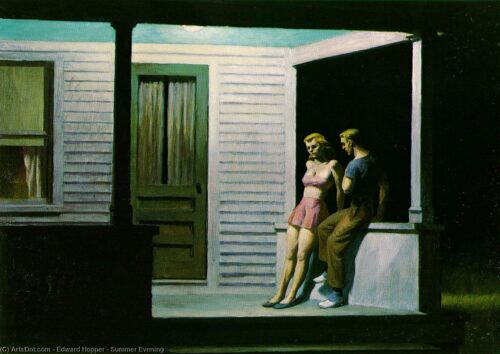
Edward Hopper
Slane notes that in 1996 the Republicans came up with ‘Contract with America’, a sort of typical arch conservative bit of sloganeering that equated fascism (WW2, the nazis) with big government. The big government that supposedly liberals lust after, and that Reagan built his political career on fighting. It is both fascist, then, AND communist. Same same, right? And in both cases the conservative wants small government and the focus on the family- and all of this is, of course, pure fiction. Its a fairy tale. But it is a fairy tale that Americans have been inculcated with for decades (long before WW2).
“These uses of nationalist melodrama, I will argue, draw on the variants of the genre forged to combat Nazism in the course of World War II. Though not evident in this particular document, anti-Nazi melodrama is often explicitly invoked by conservatives who wish to malign liberal social policies. According to a formula very similar to the one implemented in the course of the war, fascism here equals the ‘‘big’’ federal government that Democrats purportedly desire, which encourages ‘‘perversion’’ through the support of gay and lesbian rights and persecutes innocents through legal abortion. Democracy is once again charged, first and foremost, with defending the narrowly defined family { } . By the 1980s, the ‘‘Moral Majority’’ had broadly targeted secular humanism as the primary internal threat. In this way, contemporary nationalist melodrama typically casts progressive politics as conspiring to destroy the fabric of the nation through its influence in the public schools, movies, publishers, academia, courts, and finally government.”
Andrea Slane (Ibid)
Secular humanism is the right wing version of ‘cultural marxism’. The cultural marxism trope is popular with a brand of vulgar marxist (coining the term ‘compatible left’). This is the ‘internal’ threat. The enemy within. The corrupting (from the left) force that infects pure revolutionary fervour. From the right it is the fifth column commie agents; also infecting pure democratic values.

Reefer Madness (1936)
In that sense the cultural marxism/compatible left meme is not too far from Reefer Madness. The enemy within utilizes gender, sexuality, and the family in many of the same ways Nazi propaganda did, and in fact is employed to distinguish between the two. And there is a fear of infection that cannot be controlled. And there is a manipulation of moral perspective. The early precursor to this is, of course, the Apostle Paul, and the battle between flesh and spirit. Frank Kermode made a extensive analysis of this, but suffice it to say, the key aspect here is a transformation in interpretation from fleshly (literal) to spiritual (allegorical).
There is a good deal more to say on this topic (Pauline conversion etc) but for now…
“The consolidation of the conservative image of American democracy as grounded on strict gender roles and monogamous reproductive heterosexuality after 1945 involved the merging of Nazism with Soviet Communism under the common label of ‘‘totalitarianism.’’ Coined in the 1930s and reinforced by the Nazi-Soviet Pact of 1939, the term drew together elements of Stalinism (which stood in for all communisms) and Nazism, and directly opposed them to the concept of democracy. The melodramatic themes of the destruction of the family and the church continued to be dominant focal points, fanned by the flames of perceived trouble in the American family itself. Fear of internal infiltration and weakness extended the power of this conservative image of American democracy to the policing of American families (especially mothers) through the boom advice fields of child psychology and home economics, the purging of homosexuals from government o≈ces, and the persecution of America’s domestic critics on the Left. What was ‘‘unAmerican’’ to social conservatives in the 1950s thus bore considerable resemblance to the selective image of fascism in the 1940s: too-powerful women, anti-Christian socialists, queers, and civil rights activists were seen to threaten the American way of life from within.”
Andrea Slane (Ibid)

Gillian Carnegie
But by the turn of the 21st century, I think, the erosion of energy from the right (or in a sense the split between the rise of Evangelical and Charismatic Christianity and more traditional forms) allowed in the reactionary counter revolutionary bourgeoisie — The florid preaching of Billy Graham (rabidly anti communist) became the mainstream, and the earlier versions of Graham were often clearly pro Nazi in the 1930s. But the U.S. was never really anti Nazi. You also had the variables of new age theology and its reactionary source material found in the educational theories of Rudolph Steiner. And the symbology of much New Age (slightly Germanic) practice was one of a number of reasons Heidegger remains so prominent. But anti Communism and homosexuality were linked as the greatest danger to American democracy. And here it is worth mentioning that in the early 60s (after the 1961 and 1962 Supreme Court decisions against school prayer) there was a battle between conservative white churches and the government (seen as infiltrated by communists and atheists and homos… and Jews!) and between black churches and white churches. Black Churches being accused of being communist. Now this is a decade after HUAC.
But by the sixties Fascism as an epithet was reclaimed by the ‘new’ left. Marcuse employed Freud (and Norman O. Brown) and attacked the lack of specificity in the term ‘totalitarian’ which was always, really, part of the rhetoric of liberal anti communists and arch conservatives.
The never ending American melodrama of who is most ‘democratic’ (i.e. most American) always circles back to sexuality. And as Freud was de-radicalized as it travelled across the Atlantic, the critique of the patriarchal family was minimised and criticism of mothers overly emphasized. The jingoism of American democratic debate is never without a fair amount of misogyny.
“In the 1920s and 1930s, the momentum behind this concept of the mother’s blame for the actions of the child steadily increased along with the influence of neo-Freudian thought. In the course of World War II, the cultural concept of the bad mother thus informed much of the political psychology of fascism.The two-pronged social conservatism of theories of the psychology of fascism (concerning sexuality and gender), while certainly to be found in Freud’s theory, was highly exaggerated in the application of his theories to the analysis of fascism, making them just as expressive of anxieties about American sexual relations as about fears concerning Germany. While somewhat contradictory on this account, Freud himself sought to distinguish erotic ‘‘perversions’’ from their mass manifestation. The pleasure that is potentially derived from the aggressive activities of a group is not sexual in nature; rather, ‘‘the satisfaction of the instinct is accompanied by an extraordinarily high degree of narcissistic enjoyment, owing to its presenting the ego with a fulfillment of the latter’s old wishes for omnipotence.’”
Andrea Slane (Ibid)

Matt Saunders , solorized photography.
“The same is true of masochism, another condition commonly attributed to the Nazi subject. Freud saw in a more general way that civilization required the directing of some portion of the aggressive instincts inward to back up the harsh superego, which ‘‘obtains mastery over the individual’s dangerous desire for aggression by weakening and disarming it and by setting up an agency within him to watch over it, like a garrison in a conquered city’. The superego actually longs for punishment of the subject for its forbidden desires through guilt. Freud focuses here on the Oedipus complex but concentrates less on forbidden sexual desire for the mother than on murderous desire directed against the father. He writes,‘Since civilization obeys an internal erotic impulsion which causes human beings to unite in a closely-knit group, it can only achieve this aim through an ever-increasing reinforcement of the sense of guilt.’”
Andrea Slane (Ibid)
This is not quite correct but for now, it’s close enough and points up the erosion of guilt in today’s culture. Unless I’m wrong and there has been a profound increase in the role guilt plays in the collective consciousness of the U.S. One of the mysteries of the Epstein narrative is what Uncle Jeffy was offering, exactly? The answer is whatever you wanted. Or was everyone being blackmailed? It seems unlikely that the latter is the case (though clearly many many many WERE being blackmailed) so what did Jeff have to offer? And second, by all accounts Epstein was not overly charismatic or charming. Film of him, in conversation suggest quite the oopposite. How many people knew he trafficked children for sexual exploitation? The answer is nearly all of them. In 2005 police in Florida opened investigations into Epstein for solicitation for prostitution, with a minor. In 2007 the FBI collects SIXTY more counts against Epstein.
The entire time-line, including the insane NPA (put under seal) is here https://www.npr.org/2025/07/25/nx-s1-5478620/jeffrey-epstein-crimes-timeline-legal-case
Everyone knew.
In a way, we must return to the Hungry Ghosts.
“Defined by a fusion of rage and desire, tormented by unfulfilled cravings and insatiably demanding impossible satisfactions, hungry ghosts are condemned to inhabit shadowy and dismal places in the realm of the living. Their specific hunger varies according to their past karma and the sins they are atoning for. Some can eat but find it impossible to find food or drink. Others may find food and drink, but have pinhole mouths and cannot swallow. For others, food bursts into flames or rots even as they devour it. Japanese hungry ghosts called gaki must eat excrement while those called jikininki are cursed to devour human corpses. According to Hindu tradition, hungry ghosts may endlessly seek particular objects, emotions or people, those things that obsessed them or caused them to commit bad deeds when they were living: riches, gems, children, even fear or the vitality of the living.”
Linda Heaphy (Hungry Ghosts, Kashgar 2017)
Epstein could only appear under Capitalism. And like Zionism today (and of course Epstein was an arch Zionist) this is a moral plague on humanity. Zionism has torn away the last frail veil that hid the beastial cruelty and emptiness of western society. Uncle Jeffy is the avatar for the society of the spectacle. And this is also, then, about the nature of narcissistic hollowness in today’s culture. Exchange value. Why did a powerful US lawyer fawn over this man? Give away a career carelessly? This is also about a ruling class that feels absolute indifference to the suffering of others (like Zionists). Chomsky called Uncle Jeffy his ‘dear friend’. The Gramscian moment of ‘morbid symptoms’ is upon us. The unquenchable desire for more of everything is now like a bacterial infection metastasising throughout the white west.
To donate to this blog use the paypal button at the top of the page. Donations also keep the Aesthetic Resistance podcasts going.

” The point is that the Epstein files seem to have uncovered massive networks of child predators replete with baroque nomenclature and codes (see: grape soda, pizza, etc).”
Rather the opposite, actually. Back in the day neo-nazi message board 8chan interpreted the leaked DNC emails discussing boring details of party planning as secretly salacious because the(again neo-nazi) board which often traded child porn used “cheese pizza” as a code phrase and they assumed everyone else did also. What the Epstein files actually show is that the actual pedophile elites used none of this code at all and instead just did standard wink wink nudge nudge shit because they assumed none of these emails would ever be public.
there are literally dozens of texts and messages from the ‘elite’ using code words. If not hundreds, probably. So Im not sure what you mean. But I agree they felt untouchable.