



Helen Frankenthaler
“When Hegel was lying on his deathbed,” teased Heinrich Heine, “he said: ‘Only one man has understood me,’ but shortly afterwards he added fretfully: ‘And even he did not understand me.’ “
Heinrich Heine (Religion and Philosophy in Germany)
“…the ideas are stars, in contrast to the sun of revelation. They do not appear in the daylight of history; they are at work in history only invisibly. They shine only into the night of nature. Works of art, then, may be defined as the models of a nature that awaits no day, and thus no Judgment Day; they are the models of a nature that is neither the theater of history nor the dwelling place of mankind. The redeemed night.”
Walter Benjamin (Selected Writings, letter to Christian Florens Rang: December 9, 1923)
“In analysis the person is dead after the analysis is over.”
H.D. (Tribute to Freud)
I had the second part of, what I think, will be a three part dialogue with Guy Zimmerman (Aesthetic Resistance podcast, link below) on the legacy of Murray Mednick, and of the Padua Festival, and just theatre in general. As Guy noted we began this discussion over thirty years ago. I mention it because there was a related topic (indirectly to be sure) that came up on social media about and in an interview with Vivek Chibber (on Jacobin) on the origins of capitalism. And Guy had been talking about coinage via Anne Carson and her book (Economy of the Unlost). And Chibber is terrible, just to begin and many of the more cogent Marxists out there wrote counter arguments to this interview (this for one https://weaponizedinformation.wordpress.com/2025/12/15/capitalism-did-not-float-in-on-the-market-chibber-jacobin-and-the-political-function-of-western-marxism/).
And what I realized is many of Guy’s points would be argued against by some Marxists. And my feeling is that several versions, including Guy’s, are correct. And the desire for correction, for seeing this question (origin of capitalism) is treated as if history is a science project. Capitalism is not a ‘thing’. The word is referring to, per the Oxford Dictionary, “an economic and political system in which a country’s trade and industry are controlled by private owners for profit.” There are myriad forms of profit, and of the relations that evolved around (the crucial) aspect of ‘private ownership’. It is very hard for western culture to accept even slightly contradictory definitions for anything. In fact, this desire for correction often feels like the most salient quality of western society. And this veers into my previous few posts on science, quantum physics, and it also veers into art and culture and psychoanalysis.
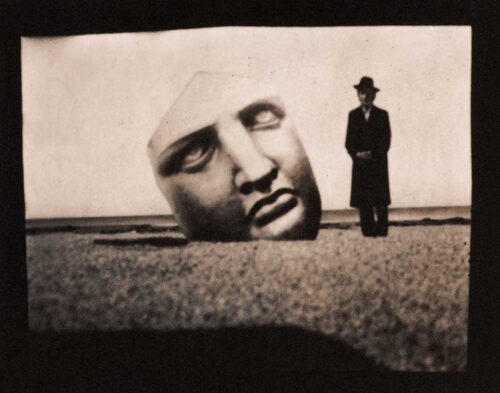
Ruth Thorne Thomsen, photography.
Now I want to digress briefly to touch on two separate topics, but topics that are related. There is a significant uptick (on social media but in general, too) of self described ‘historical materialist Marxists’. Once called Vulgar Marxists or Factory Marxists, these are thinkers who see Marx in terms entirely of economic determinism, an oversimplified model where the economic base determines the cultural (superstructure) in a mechanistic manner that elides human agency and is nearly fatalistic. The origin of this was the Second International and in particular the writings of Karl Kautsky. This results in, actually, the loss of philosophical debate and tends toward a parody of Marx. Gabe Rockhill is the poster boy for this, but there are others and recently there was an interview with John Bellamy Foster relating to Georg Lukacs’ book The Destruction of Reason. Adorno is singled out (as he often is in such circles) for his review of the Lukacs book (see below). But the pejorative use of the term (Vulgar Marxist) really came later, it seems. In fact Lukacs early work (which he himself denounced later under guidance of the USSR cultural commissars) helped define the problem with Kautsky and the Second International. Lukács had actually defined ‘vulgar Marxism’ as ‘the forgetting of Marx’s method in favour of his conclusions’.
“The same mistake in vulgar socialism, which we have analysed above, is repeated here in another form. When the Socialist Revolutionaries say: “In essence, the relations between farmer and farm-labourer, on the one hand, and between independent peasants and the money-lenders, the kulaks, on the other, are exactly the same,” they are reproducing in its entirety the mistake of, say, German vulgar socialism, which, in the person of Mühlberger, for example, stated that in essence the relations between employer and worker are the same as those between house owner and ten ant. Our Mühlbergers are equally incapable of distinguishing between the basic and the derivative forms of exploitation, and confine themselves to declamations on the subject of “exploitation” in general. Our Mühlbergers are equally incapable of understanding that it is precisely the exploitation of wage-labour that forms the basis of the whole predatory system of today, that it is the exploitation of wage-labour that leads to the division of society into irreconcilably opposed classes, and that only from the point of view of this class struggle can all other manifestations of exploitation be consistently gauged, without lapsing into vagueness and abandoning all principles.”
V.I. Lenin (Vulgar Socialism and Narodism as Resurrected by the Socialist-Revolutionaries, 1902)

Brad Holland
But more to the point here, which is Lukacs’ late work (The Destruction of Reason). Adorno wrote a review of it, not long after it came out. But others, over the years have returned to it at times. Susan Sontag was one, who found it coarse and with a reactionary aesthetics.
“Lukacs distinguishes three main streams in twentieth-century literature; modernism. critical realism, and socialist realism. Representatives of the three streams would be Franz Kafka, Thomas Mann, and Maxim Gorky, respectively. We may simplify Lukacs’ descriptions of these streams as follows. Modernist literature is bourgeois literature that is characterized by ahistorical angst in the face of monopoly capitalism..'”.critical realism, although ideologically bourgeois, is a literature of historical, sober optimism that does not reject socialism. Socialist realism is similarly historical and optimistic. Unlike critical realism. however, it uses a socialist perspective “to describe the forces working towards socialism from the inside’. Whereas critical and socialist crealism can form a common front against the cold War, modernism inadvertently supports the forces of destruction.”
Lambert Zuidevaart (Methodological Shadowboxing Marxist Aesthetics : Lukacs and Adorno)
Lukacs is the one who came up with the Grand Hotel Abyss meme (taken over by Hollywoood, which should tell you something). But the vulgar mechanical Marxist always tend to adopt a schoolmarm quality of prudery. They also trend toward a Norman Rockwell idea of ‘realism’. They would deny this, but if you cannot, as a reader, see the real world ‘reflected’ (a favorite adjective of Lukacs) in Kafka then you are either a cloistered monk or … I don’t know.
“If it is a question of historical relationships, words like sick and healthy should be avoided altogether. They have nothing to do with the progress/reaction dimension; they are brought in purely for the sake of their demagogic appeal. The dichotomy between healthy and sick, moreover, is as undialectical as that between a rising and a declining bourgeoisie, which itself derives its norms from a bourgeois consciousness that did not keep pace with its own development. I will not deign to stress the fact that Lukács groups completely disparate figures under the concepts of decadence and avantgardism (for him they are the same thing)—not only Proust, Kafka, Joyce, and Beckett but also Benn, Jünger, and perhaps Heidegger; and as theoreticians, Benjamin and myself.”
Theodor Adorno (Extorted Reconciliation)
John Foster Bellamy calls the Lukacs’ book ‘magisterial’ (The New Irrationalism, MR 20025). And he spends a lot of time deconstructing George Lichtheim’s attack — but no time discussing Adorno’s essay. Lichtheim, of course, WAS a deeply reactionary (and not very good) writer and likely did have US government connections (if not sponsors). Adorno on the other hand…
“Simplifications like the one Lukács makes in his excursus on Benn not merely fail to recognize the nuances; rather, along with the nuances they fail to recognize the work of art itself, which becomes a work of art only by virtue of the nuances. Such simplifications are symptomatic of the stultification that befalls even the most intelligent when they fall in line with directives like those ordaining socialist realism. { } It remains an open question whether the regression one senses in Lukács, the regression of a consciousness that was once one of the most advanced, is an objective expression of the shadow of a regression threatening the European mind—the shadow that the underdeveloped nations throw across the more developed ones, which are already beginning to align themselves with the former; or whether it reveals something of the fate of theory itself—a theory that is not only wasting away in terms of its anthropological presuppositions, that is, in terms of the intellectual capacities of the theoreticians, but whose substance is also objectively shriveling up in a state of existence in which less depends on theory than on a practice whose task is identical to the prevention of catastrophe.”
Theodor Adorno (Ibid)
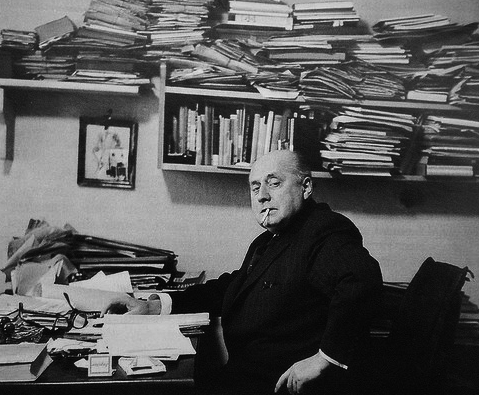
Gottfried Benn
Lukacs sees Freud (and Nietzsche) as simply pure fascists. Attacking Gottfried Benn is particularly curious, though. Benn, a poet, was also a physician who served in the German medical corps in WW1.
“…the shadow gather together there,
two poplars show a road,
you know — where.
Perspective
is another word for his way of standing still: to mark down lines,
the lines grow farther on
according to the laws of plans which put out shoots — Jungle plants throw out shoots — multitude of birds also, crows
thrown out in winter dawn from early heaven —
then to allow them all to sink —
you know — for whom.”
Gottfried Benn (Robert Bly tr.)
Benn is cited as an irrationalist. And a decadent by Lukacs. But as already observed so is Beckett and Proust and Joyce. The absolute absurdity here is ignored by Bellamy Foster the better to drive home his single dubious point. That Marxist thinkers seemed to lose a revolutionary optimism. I wonder why. But of course Bellamy Foster sees only irrationalism in Heidegger (and I have written on Heidegger, and it remains one of those problems, in terms of philosophy. Like Celine in literature) and in most everyone not a strict historical materialist. But he supports the ‘materialists’, even if they become cartoons, like Lukacs. But more, it is that hatred of culture western leftists are guilty of — with very rare exceptions (T.J. Clark, John Berger, Manfredo Tarfuri, and a very few others).
But to return to Bellamy Foster’s point, but first to lay out a few historical realities.
“A simple preference for democratic organizations did not dictate the Western Marxist repudiation of Leninism; rather to the Western Marxists the yawning political and social gap between Europe and Russia prohibited an identical praxis for each. Leninism bore the indelible marks of specific Russian conditions: a relatively small proletariat, a massive agrarian population, a feeble bourgeois culture. The last was decisive: The impact of bourgeois and national culture sharply distinguished Western European from Russian society. As Gorter wrote, in the Netherlands – the oldest capitalist country – bourgeois culture and values were drummed into the working class for centuries. The same could not be said of Russia.”
Russell Jacoby (The Dialectic of Defeat)

Paul Riedmüller, mixed media
To western Marxists (then AND now) bourgeois culture is infused with nearly everything. The early efforts in Europe by Leninist-Marxist communists were met with a reality that Muscovites never really learned to recognize.
“the fact that conditions in Western Europe are utterly different from those in Russia. There you had an agrarian revolution – revolution with some 95 per cent of the population in favor… In Germany the peasants are counterrevolutionary. In Western Europe the proletariat is tightly organized; in Russia the masses were not organized.” This from a letter of Paul Levi (Lenin and the Comintern). Levi noted the soviets bypassed the ‘cultural structure’ of society. “It’s the same old nonsense that Moscow always wants to believe..:” Levi was of course expelled from the Party.
“Lenin and the Bolsheviks failed to weigh the cultural atmosphere of Western Europe, which damned the insular party to irrelevancy. Lenin’s ideas on organization were not “absolutely false” but bore the imprint of the specific stages of the Russian Revolution: absolutism, feudalism, illegality. “Certainly in the western lands there is a subjugation of the proletariat by the bourgeoisie. But the bourgeoisie practices its domination in the form of ‘democracy’. . . These were the conditions in which Rosa Luxemburg lived and worked.”
Paul Levi (Brief to Lenin)
This digression is getting rather long, I realize. But I think its important to realize just how ossified and out of touch the white western Marxist can be, especially the inheritors of a kind of vulgar Marxism. Remember Levi was writing over a hundred years ago. The new irrationalism is something I have written about, Adorno and other Frankfurt thinkers wrote about, and lot of more persuasively than Bellamy Foster. It was Rosa Luxemburg chastised Lenin and others, at the time, for neglecting the ‘subjective’ factors in creating a revolution. Today she would be labeled an irrationalist. Lenin loved the factory model. He said so, he wrote so. Luxemburg did not agree. She saw no ‘education’ received by factory labour. (I’d have to agree).
Isabelle de Borchgrave
“Luxemburg’s Russian Revolution does not require extensive discussion. Yet its West European perspective is often minimized; she did not condemn the Bolshevik practices in themselves but in regard to their impact on Western Europe. Their success encouraged slavish imitation: This was the danger. She feared that the European working class would succumb to imitating the Bolsheviks. Therefore she wanted to delay founding the III International until active West European parties could check the influence of the Bolsheviks. She also resisted adopting the name “Communist party” as foreign to German revolutionary traditions.”
Russell Jacoby (Ibid)
It should be noted that Rosa absolutely supported, with great insistence, the Bolshevik revolution. She saw the brutal and insufferable conditions that led to it: “under the conditions of bitter compulsion and necessity.” Lenin wrote on ‘left’ communism (an infantile disorder). But there were practitioners in Europe. And several bureaus of the commintern opened in Europe-.
“Two in particular challenged the Comintern by adopting “left” positions: Amsterdam and Vienna. The Amsterdam Bureau included Gorter, Roland-Hoist, and Pannekoek, “its spiritual leader.” It openly criticized the Comintern and even held a conference. Moscow quickly closed it for its insubordination. The Vienna Bureau fell under the sway of exiles from the defeated Hungarian Revolution, including Lukacs, and met a similar fate.”
Russell Jacoby (Ibid)
My point is the penchant for ‘displine’ among Communists. And one might argue a tendency toward masochism.
“Left” communism was a political expression of Western Marxism; are inextricably linked but not identical.’Left’ communism did not speak a philosophical language, although it contested the Bolsheviks politically. Briefly, “left” communism in Germany, Italy, and the Netherlands wrote off parliaments and trade unions as vehicles for revolution. { } A gut hatred for authoritarianism and bureaucratization marked the “left” Communists; they prized autonomy and selfregulation of the proletariat. From this perspective they mounted a critique not only of the bourgeois institutions of the parliament but of the vanguard and Leninist party (with the important exception of Bordiga, who is discussed in Chapter 5). Consequently, they celebrated (again with the exception of Bordiga) workers’ councils, factory councils, and Soviets. Unlike parliamentary or trade union bureaucracies, these rested on the autonomy and independence of the proletariat. For the “left” Communists, the vanguard party shared a lethal weakness with bourgeois institutions: It substituted leadership for the self movement of the proletariat. On its most theoretical level the “left” Communists justified their political positions by themes familiar to Western Marxism, the decisive role of class consciousness and subjectivity.”
Russell Jacoby (Ibid)

Kaws
The debates of this period, within communist thinkers are extensive. The point, though, is that ‘left’ communism saw bourgeois ideology as a huge problem and impediment to revolution. Jacoby summerizes the position (via Pannekoek, the Dutch communist) of ‘left communism’:
“The hegemony of bourgeois ideology, or the control of education, culture, and schools, constituted the concrete force that suffocated the revolution; and this hegemony, rooted in the long history of a tenacious and supple bourgeoisie, distinguished Western Europe (and countries, colonized by West Europeans – the United States, Australia) from the Soviet Union.” (Ibid)
There is a massive amount of writing that analyses the early work of Lukacs (much of it in the archives of Telos) but there remained a struggle in his thinking regards the legacy of Capitalism.
“Untouched by any depth psychology. Lukacs reiterated that the incorporation of the “whole personality” is a ‘decisive weapon’. “Party members enter with their whole personality into a living relationship with the whole of the life of the party.” Active participation precluded that the party degenerated into “mechanical obedience.” For Lukacs, the party transcended a political tool. “Freedom – as the classical German philosophers realized – is something practical; it is an activity. And only by becoming a world of activity for everyone of its members can the Communist Party hope to overcome the passive role assumed by bourgeois man.”
Russell Jacoby (Ibid) {quoting History and Class Consciousness}
Marcia Marcus
As Jacoby notes later (echoing Adorno, actually) the traces of the Hegel of subjectivity and consciousness never quite leave Lukacs thinking. This digression is relevant however for how today’s new mechanical Marxists see culture. They too want to erase subjectivity and consciousness (Freud after all is a fascist in the mind of the later Lukacs, but probably in the earlier one, too).
It is worth noting that Horkheimer wrote Eclipse of Reason a decade before The Destruction of Reason.
“In 1941, arguably one of the bleakest years in all of modern history, the Frankfurt School reluctantly acknowledged for the first time the crisis of the emphatic concept of reason that had been a mainstay of its work for much of the previous decade. The disillusionment was abrupt. Although in his earliest days Max Horkheimer had in good historical materialist fashion denounced the dualism and idealism he saw in Cartesian rationalist metaphysics, he had come staunchly to defend a dialectical notion of reason against the irrationalist alternative he identified with the threat of fascism.”
Martin Jay (Reason After it’s Eclipse)
Many of Horkeimer’s conclusions actually resemble the later Luckacs. Crucially, many do not however. And the journey is very different. Seven years before writing The Eclipse of Reason, Horkheimer wrote what amounts to a long preface to it…
“Rationalism itself had established the criteria of rigidity, clarity and distinctness as the criteria of rational cognition. Skeptical and empirical doctrines opposed rationalism with these selfsame standards. Skepticism purged the idea of reason of so much of its content that scarcely anything is left of it. Reason, in destroying conceptual fetishes, ultimately destroyed itself…None of the categories of rationalism has survived.”
Max Horkeimer (The End of Reason, 1941)
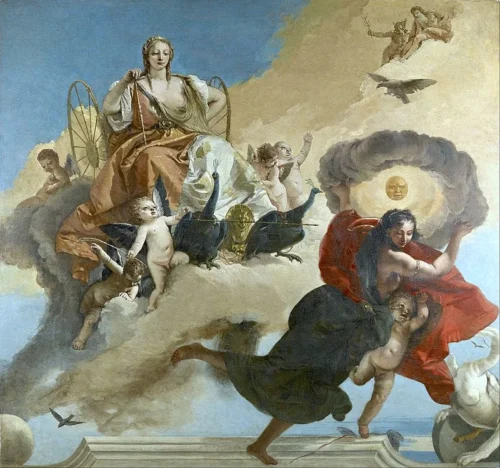
Tiepolo (Juno and Luna, 1735)
Horkheimer saw only a vestige of Reason in the contemporary world (circa 1940s) — valuing means over ends, and a stringent instrumentality.
“…reason becomes a kind of adding machine that manipulates analytical judgments.”
Max Horkheimer (Ibid)
Reason had ignored class division, and this led to its demise.
“The result is the political horror that was now sweeping over Europe, which must be understood as more than an expression of atavistic irrationalism: “the new order of fascism is reason revealing itself as unreason.” Holding on to a faint hope that fascism might not have the last word, Horkheimer concluded his jeremiad with a modified evocation of the famous alternative Rosa Luxemburg had posed in her World War I Junius Pamphlet: “the progress of reason that leads to its self-destruction has come to an end; there is nothing left but barbarism or freedom.”
Martin Jay (Ibid)
There was (and this is in Dialectic of Enlightenment) the reduction of Reason to mere reasonableness. An adjustment to conformity. And this is what happened to psychoanalysis when it traveled from Vienna and Berlin to the USA.
“As he had argued in his earlier essays, the shattering that climaxed in the Enlightenment was an outcome of the self-liquidation of reason, not something brought to it from the outside. “If one were to speak of a disease affecting reason, this disease should be understood not as having stricken reason at some historical moment, but as being inseparable from the nature of reason in civilization as we know it. The disease of reason is that reason was born from man’s urge to dominate nature.”
Martin Jay (Ibid) {quoting Eclipse of Reason}
Now this is exactly where the late Lukacs would object. And most of the mechanical Marxists of today. But this question, or idea, can be found in Freud, in Heidegger, in Benjamin, in a very different flavour, and a number of others). James Grotstein in his way discusses this, too.

Candida Hofer, photography (Mexico)
“Why the shadow had fallen was not, however, explicitly spelled out. The mathematicization of nature, the triumph of the exchange principle, capitalist reification, the fetish of technology, bureaucratization, positivist thought—all were plausible candidates for the celestial body that had passed before the rational sun. Or to return to another of Horkheimer’s metaphors, all were plausible pathogens for the “disease” of reason. But at times, it bears repeating, Horkheimer seemed to assume the eclipse or degeneration was inevitable—“the transition from objective to subjective reason was not an accident”—as the germ of reason’s self-liquidation was present at the origin. Its disease was thus a form of autoimmunity run amok. For all its self-congratulatory leaving behind of the world of myth, rationality had revealed itself to be entangled with it from the beginning and was still
entangled at the end.”
Martin Jay (Ibid)
Freudian anthropology, of course, deals with the historical formation of the psyche, both individual and collective. And in a sense it makes perfect sense that Freud is now greeted with such hostility on the left. And it also accounts for the hostility to art and culture.
“…the excess of rationality, about which the educated class complains and which it registers in concepts like mechanization, atomization, indeed even de-individualization, is a lack of rationality, namely the increase of all the apparatuses and means of quantifiable domination at the cost of the goal, the rational organization of mankind, which is left abandoned to the unreason of mere constellations of power.”
Theodor Adorno (Aesthetic Theory)
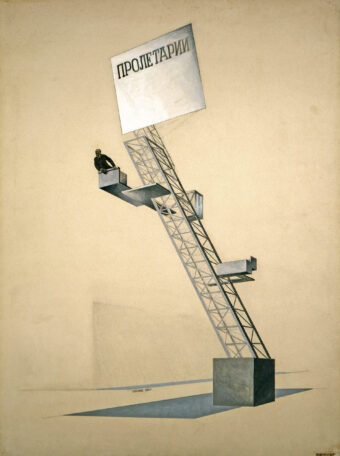
El Lissitsky (Lenin, The Tribune, 1920)
Today we see this logic of means over ends in everything from AI to transhumanism. But also, one might argue, in contemporary physics and quantum theory. The various projects that are funded by everyone from the defense industry to the U.S. state department have no goal save for discovery — which is a shorthand for future profitable discoveries. The fact that quantum projects are so necessarily expensive is a reality few seem to want to discuss. But to stay on message here, as Don Rumsfield used to say, the idea that Kierkegaard is an irrationalist, and honestly, even Nietzsche, or Freud a fascist, is absurd (however popular) and the fact this vulgar Marsxist charlatanism is as popular as it is fills me with dread. And it comes down to culture, really. Another figure/thinker who is pilloried constantly by the Mechanical Marxists is Gillian Rose. Partly because she wrote A LOT about Adorno and endorsed, in general, the Frankfurt School, but also because she stopped writing about Marxists. Her best book is probably The Broken Middle (1992) that is all but ignored today. Rose died tragically young (48) of ovarian cancer. She also wrote about Simone Weil and Rene Girard and, gasp, Freud. But her cultural analysis is quite erudite. And I am reminded of figures like Erich Auerbach and Franco Moretti, or even Frank Kermode. The mechanical Marxist (or whatever) either exhibit a veiled hostility to culture, or seek moral and political instruction in artworks, or are simply cynical about it all.
“If the equivocation of the middle — the Janus-faces of our failing -makes us flee, existentially, or in commentary and criticism, in one way or another to the beginning — pagan or erotic, spiritual or religious — this choice and chosen anxiety of beginning may now appear as the beginning of anxiety — the law helplessly held at the middle by such a flight. Thus the beginning, too, is Janus-faced: looking both to the anxiety of beginning and to the beginning of anxiety since the law is always already begun.”
Gillian Rose (The Broken Middle)
This is the opening paragraph (from Rose’s book) of a chapter on Kierkegaard and Freud. And it reminds me a bit of some things Hiroyuki Hamada wrote to the group on the Aesthetic Resistance podcasts.
“Just as artists (in this case Hollywood actors), become irrelevant in the grind of capitalist routines and the absence of meaningful cultural momentum, the Marxist conversations can become irrelevant and useful in perpetuation of the very structure they seek to oppose. What can pass as political commentaries or philosophical discussions today could appear rather too obvious and lacking deeper dialectical analysis to those who are keen on the deterioration, because what the society accept as such moved onto the realm of functional part of the structure itself, unintentionally devouring it from within.”
Forgive the syntax as this was just some thoughts scribbled together in a private conversation. The point is absolutely important. Many of these Vulgar Marxists are building a brand (see Rockhill ). There is something of a sadistic core to mechanical Marxist rhetoric. It is accusatory and passive/aggressive in tone. Behind every curtain is Capitalism. And I want to add, this constant ‘gotcha’ sort of research showing the CIA funded this or that magazine or radio program or research project is both naive and a bit ridiculous. Everyone works for the man. Full stop. Universities are funded by billionaire fascists, or by front groups. It does not mean you are doing the bidding of the funding organization. In fact, rarely does that occur. It simply means everything is funded by the ruling class. (Bellemy Foster teaches at the University of Oregon who’s biggest donors are Phil Knight (Nike), the Schnitzer family, Steve Ballmer…and others.)

Jaco Putker (photopolymer etching)
“How to proceed, how to begin, when law precedes desire and intelligibility: desire and intelligibility do not precede law; when anxiety defines sin, not sin anxiety; when will to power as risk or ressentiment lords over will to life, mere self-preservation; in short, when existence is always already invested – conceptual and commanded.”
Gillian Rose (Ibid)
Law is the authority — in the beginning was authority.
“It was not the repression that created the anxiety; the anxiety was there earlier; it was the anxiety that made the repression.”
Sigmund Freud (Anxiety and Instinctual Life)
“In Minima Moralia, in fact, Adorno explicitly defended a way of thinking that goes beyond argumentation where the goal is always to be right: “the very wish to be right, down to its subtlest form of logical reflection, is an expression of that spirit of self-preservation which philosophy is precisely concerned to break down. . . . To say this is not, however, to advocate irrationalism, the postulation of arbitrary theses justified by an intuitive faith in revelation, but the abolition of the distinction between thesis and argument.”
Martin Jay (Ibid) { quoting Adorno, Minima Moralia)
Art bears a relationship to this idea of a beginning. It is found in mimesis, but it is also the promise of happiness.

Data center (Innio, China)
“The comparative virtues of noetic and dianoetic versions of reason continued to occupy Horkheimer and Adorno in a conversation they had in 1956, the notes of which were taken by Gretel Adorno. While chastising Heidegger for being too one-sidedly against discursive argumentation, Adorno nonetheless conceded that “there is really something bad about advocacy. . . . Arguing means applying the rules of thinking to the matters under discussion. You really mean to say that if you find yourself in the situation of having to explain why something is bad, you are already lost.” Horkheimer added with a touch of scorn, “The USA is the country of argument,” which Adorno then trumped by pronouncing— without providing a justification—that “argument is consistently bourgeois.”
Martin Jay (Ibid) {quoting Adorno Toward a New Manifesto}
When I first read that remark, years ago, that argument is bourgeois, I realized this was an actually profound observation (and why does Martin Jay say without justification? Because he wants to argue, too, in the halls of academia). Now in the age of social media it is nakedly obvious argument reigns over all. It is also linked to the calculative engine of consciousness today, and to anal sadistic tendencies. There is a deep repression, and a resentment built into argument. That turning away, both individually and societally, the turn that launches civilization in a sense (perhaps) is also tied to a denial of death. Even habitual argument is infused with a kind of death. Repetition. It is also the beginning of non identity. (a bit more on that below).
Motto of the Hanseatic League (Quoted in Freud’s Our Attitude Toward Death): ‘Navigare necesse est, vivere non necesse’. (‘It is necessary to sail the seas, it is not necessary to live’)
The more I read University papers, the more I have discussions with academics, the more this quality of literal physical suffocation occurs. And this new Marxist course correction has an unpleasant quality of discipline. And it is interesting that the word ‘disciple’ comes from the Latin discipulus, which means a learner or one dedicated to learning. The word ‘disciple’ comes from the Latin discere, to grasp in the sense of learning, but also of one dedicated to learning.
But the point here, in Gillian Rose’s look at Kierkegaard and Freud, is that before everything is the Law, or authority, or the Father, in a semi symbolic sense. The authority is there regardless.

Francisco de Zurbarán (Crucified Christ, with painter, 1650)
“Death, like repetition, has two meanings for Freud: negatively, death is linked to the compulsion to repeat, which retards analysis or makes it fail – the passive relation to death; positively, it is linked to risking one’s life, daring death, the active relation to death; or, negatively, repetition backwards, blocked memory, or recollection fixated on a screen type; and positive¬ly, repetition forwards, ‘perfect memory’ or a ‘freely mobile ego’. The beginning of anxiety was first seen as ‘a consequence of the event of birth’. It began, as it were, with the beginning of human life, the effect of anxiety arising subsequently as ‘a repetition of the situation then experienced’. This position was modified so that it provided merely the means for making a distinction between realistic and neurotic anxiety in situations of external danger. Anxiety is generated ‘realistically’ when the reaction to the danger adapts itself to the new situation adequately for dealing with it, ‘neurotically’ when the original situation dominates the new and results in inexpedient paralysis. ‘Anxiety’ here means repetition of the original trauma, or ‘unpleasure’, which cannot be discharged, now understood, not as the event of birth, but as internal libidinal danger. The ‘quota of libido’ attached to a repressed idea becomes unemployable and changes into anxiety, which arises from the repressed instinctual impulses.”
Gillian Rose (Ibid)
Anxiety begins at birth, but birth is not instantaneous. The new ‘world’ appears in stages, in fragments. The instinctual reaction is fear — but I think of a specific inexplicable kind of fear. The infant has not learned fear. But there is something. And metaphorically the infant looks away.
“The anxiety of beginning is discernible whenever the account of the beginning of anxiety returns to its middle, the ego, ‘a frontier creature’, which ‘tries to mediate between the world and the id’; and when the theoretical or metapsychological accounts of the repetition of the life and death instincts, with all their adverted and admitted insufficiencies, meet the practical accounts of the five resistance repetitions which make for or against a successful analysis.”
Gillian Rose (Ibid)
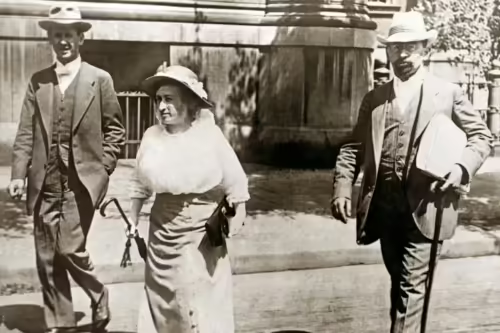
Rosa Luxemburg with Paul Levi, left, and Kurt Rosenfeld. 1914
The desire to return to an earlier state of things. Repetition. The compulsion to repeat. Children are content to have the same story read to them over and over and over and over. Rehearsal is the most neglected aspect of theatre. Memorization. Repetition.
“The idea of ‘the compulsion to repeat’ is itself repeated: as a psychoanalytical explanation of anxiety and of analysis resistance, qua the repetition of unpleasure, and then in a reflection on the child’s inherent tendency to ‘repeat’ both pleasurable and unpleasurable experiences. It re-emerges as a metapsychological notion applicable to ‘instincts’, to ‘germ-cells’, to metapsychological concepts and, ‘unwittingly’, steers ‘into the harbour of Schopenhauer’s philosophy’.”
Gillian Rose (Ibid)
There are a host of questions here, regards language, the learning of how to articulate one’s own feelings, etc. We learn ‘how’ to behave when we are ‘afraid’. Much of this stuff comes from Freud’s Beyond the Pleasure Principle. (and here is where the disciplining of psychoanalysis usually starts).
“‘Beyond the Pleasure Principle’ introduces a deep ambiguity into the meaning of ‘the compulsion to repeat’, between the metapsychological and the analytical meanings: this divergence of forwards and backwards evinces the anxiety of beginning — the delineation of an untheorizable, existential repetition forwards, which emerges from the consideration of what repetition means in ‘anxiety’, in ‘life’, and in ‘death’.”
Gillian Rose (Ibid)
“the possibility of making the first painting again was so powerful that Pollock used ‘one’ as the name for a work ‘four times in three years.”
T. J. Clark (Farewell to an Idea: Episodes from a History of Modernism)
Allow me another quote from Rose:
“…three ego-resistances — knowledge resistance, transference resistance and the gain from illness — id resistance, and super-ego resistance. Knowledge resistance, the easiest to overcome, implies that repetition forwards is not a question of knowledge: one may come to know of a repression without thereby overcoming it; and, nevertheless, still repeat it backwards. Transference resistance means repeating the repression in the relation to the analyst, acting it out symptomatically instead of overcoming it. The authority of the analyst is paradoxical: essential to moving the analysand beyond repetition backwards, yet potentially dangerous in that the authority may reinforce repetition backwards so that relation to an external authority is again substituted for taking a relation to one’s own authority.”
Gillian Rose (Ibid)
I think knowledge resistance is likely even more common today.The third ego-resistance is ‘gain by illness’, also increasingly common today, and that is the patient taking the illness into him or herself because of not wanting to give up the substitute relief. This is also seen in opiate addiction. The fifth resistance is the last discovered and is sabotaged by the need for guilt and the desire for punishment. (See Pasolini’s Salo, or the One Hundred Days of Sodom)
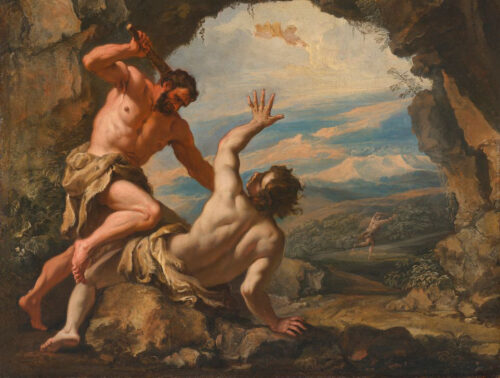
Ricci Brothers (Cain smiting Abel, Garden of Eden) 1716
“The guilt, the ‘moral’ factor, may be unconscious and it may require an alternative ego ideal — ‘prophet, saviour and redeemer’ which analysis does not permit the analyst to provide. The religious terminology indicates Freud’s linking of this destructive need with religious projections: ‘the general character of harshness and cruelty exhibited by the ideal – its dictatorial “Thou shalt”’, and implies a critique of paternalistic religion — the erotic religiosity of desire and its refusal — which prevents a repetition forwards.”
Gillian Rose (Ibid)
This has consequences for political organization. That harshness, ‘thou shalt not’….the voice of authority, is mimetically reproduced in a deformation of natural maturation, it is tied to sado/masochism and to the identification with the aggressor. It is the boss, the slave driver, the priest at confession, and today the echo is heard in AI companions and all computer voices. These voices overtly imitate hospitality management graduates but beneath that is something else. James Baldwin said sentimentality is the mask of cruelty. The computer voice is kindergarten teacher and torturer.
“Adam’s ‘innocence’ does not provide the beginning yet ‘innocence is ignorance’. The beginning is not, however, the end of innocence understood as initiation into knowledge. The fall or beginning involves initiation into prohibition: ‘it was the prohibition itself not to eat of the tree of knowledge that gave birth to the sin of Adam’.{ } ‘Innocence is ignorance’, but not immediately, not at the beginning. Innocence is not ignorance until it enters into the opposition of ignorance and knowledge. Before that encounter, innocence is already anxious, but in a diffuse, unfocused way. It expresses itself as ’a sympathetic antipathy and an antipathetic sympathy’: the discovering anxiety of the child, ‘a seeking for the adventurous, the monstrous, and the enigmatic’; a pleasing, captivating, not a troublesome anxiety. This guiltless anxiety — like guilty anxiety yet to come — does not refer to anything definite, but ‘is freedom’s actuality as the possibility of possibility’. It is the encounter with a third which will make the difference and effect the passage to the contraries of ignorance and knowledge. But this ‘hostile’ third power is ambiguous: it is both alien and what qualifies man as spirit. For ‘man is a synthesis of the psychical and the physical; however a synthesis is unthinkable if the two are not united in a third’, or, rather, if the two are not disunified in the third — which opens up the opposition between soul and body in the first place. ‘Anxiety’ is the term for this relating of a relation for it captures the ambiguity of the ‘source’. Even the metaphysics of this third, referred to as the relation of ‘spirit’, presupposes the denouement: ‘Innocence still is, but only a word is required and then ignorance is concentrated.’ The ‘word’ turns out to be the commandment: ‘Only from the tree of the know¬ ledge of good and evil you must not eat.’ The word is enigmatic: it is not understood.”
Gillian Rose (Ibid) {Kierkegaard, Concept of Anxiety)
The word is commandment. Judgement follows upon that.

Maha Maamoun, photography
“Adam’s ‘innocence’ does not provide the beginning yet ‘innocence is ignorance’. The beginning is not, however, the end of innocence understood as initiation into knowledge. The fall or beginning involves initiation into prohibition: ‘it was the prohibition itself not to eat of the tree of knowledge that gave birth to the sin of Adam’.”
Gillian Rose (Ibid)
The character of man is infected with the Law. The law precedes the word. As Oscar Wilde said, ‘I can resist everything except temptation’. But as Kierkegaard lays out in painstaking detail, even temptation, perhaps especially temptation, is infused with anxiety.
“Decree, dictatorial force of the factory overseer, draconian penal¬ ties, rule by terror – all these things are but palliatives. The only way to a rebirth is the school of public life itself, the most unlimited, the broadest democracy and public opinion. It is rule by terror which demoralizes.”
Rosa Luxemburg (The Russian Revolution)
There are several final points in what ended up being one long digression; first is Lukacs and Freud. Lukacs actually wrote an essay on Freud, for a magazine, back in 1922. And in fact, oddly, there are a number of references to Lukacs that describe him as a student of both Marx and Freud. Never mind…
“Every psychology so far, Freudian psychology included, suffers in having a method with a bias towards starting out from the human being artificially insulated, isolated — through capitalist society and its production system. It treats his peculiarities — likewise the effect of capitalism — as permanent qualities which are peculiar to “man” as “Nature dictates.” Like bourgeois economics, jurisprudence and so on, it is bogged down in the superficial forms produced by capitalist society; it cannot perceive that it is merely assuming forms of capitalist society and in consequence it cannot emancipate itself from them. For this reason it is similarly incapable of solving or even understanding from this viewpoint the problems besetting psychology too. In this way, psychology turns the essence of things upside down. It attempts to explain man’s social relations from his individual consciousness (or subconsciousness) instead of exploring the social reasons for his separateness from the whole and the connected problems of his relations to his fellow men. It must inevitably revolve helplessly in a circle of pseudo-problems of its own making.”
Georg Lukacs (Freud’s Psychology of the Masses, Red Flag Magazine 1922)
Its interesting how simplistic this is, but I also found this bit from Ross Wolfe (Charnel House, blog, and I like the blog, its very useful, just not Wolfe’s opinions much).
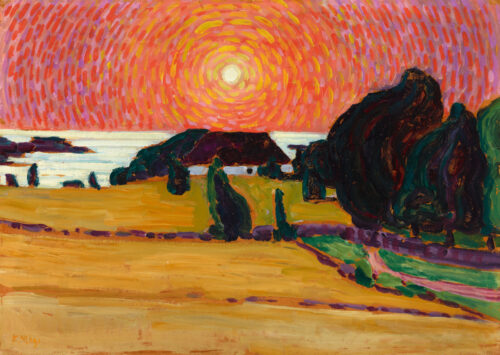
Konrad Magi (1913)
“Much has been written over the years about the similarity between and compatibility of Marxian sociology and Freudian psychology. Here is not the place to evaluate those claims. Suffice it to say, for now, that both social critique and psychoanalysis have seen better days. Both doctrines have lost whatever pretense they once had to scientific status and today are relegated mostly to the humanities.”
Ross Wolfe (Charnel House, intro to Karl Korsch and Georg Lukacs on Freud)
Here is Lenin “The extension of Freudian hypotheses seems ‘educated’, even scientific, but it is ignorant, bungling […] There is no place for it in the Party, in the class-conscious, fighting proletariat.”
Clara Zetkin (My Recollections of Lenin)
There is another interesting sort of footnote on all this. I quote a couple things by Victor Cova (Platypus Affiliated Society). I honestly do not know much about the PAS, except they issued statements defending Israeli genocide and demonizing HAMAS. That’s sort of all you need to know. Are they spooks of some sort? LaRouchites? I have no idea. Chris Cutrone is the shot caller and he’s a hopeless pro Imperialist asshole — so maybe I know more than I thought.
But…its not Cova that interests me here, or the PAS, but a couple observations of Cova’s about Wilhelm Reich:
“For Reich it is the disintegration of the Marxist party from 1914 onwards which makes it both possible and necessary to rely on Freudian concepts in order first of all to understand the workers’ authoritarian personality structure which had led to that disintegration in the first place. { } Yet far from being a heretical move to correct Marxism or complement its understanding of material conditions with a science of subjectivity, the introduction of psychoanalysis into theory was meant by Reich as a return to Marx in the context of the practical disappearance of the party and of class-consciousness more broadly. Fascism, as the inheritor and caricature of socialism, itself was the prime symptom of the death of the party, but Reich also considered the economism of both the Social Democrat and Communist parties to be further symptoms, as well as “the camouflaging of defeats and the covering of important facts with illusions.”
Victor Cova (PAS, On the Marxist use of psychoanalysis to understand fascism)
OK, Reich is a complicated thinker, flawed, driven to madness and imprisoned. Rejected by Stalin and the USSR. I am slightly defensive about Reich because I knew a Reichian who had been a patient of a top student of Reich’s. And I think the above quote (however jumbled and borderline factually incorrect) touches on an important point. Reich was acutely aware of the authoritarianism of many on the left (and right). In fact he is an interesting read in conjunction with Theweleit’s Male Fantasies. Lukacs could not see Freud outside of the highly reductive accusation of a-historicism. It’s easy to make that claim, if you’ve not read Freud directly, or not read him much. Freud wasn’t a Marxist. He was not a-historical. Rosa Luxemburg feared the cultural divide between Russia and western Europe. The bourgeois sensibility of the West but also the tainted interior of Enlightenment reason. Luxemburg was instinctively sophisticated as a psychologist. And an almost closet metaphysician. But she feared the pointless loss of time and energy for a culture lacking the preconditions for revolution. Russia was indeed unique in this sense. The West now has been buffeted psychically for fifty years just from mass advertising. The Society of the Spectacle and now the internet and the attention economy have altered the bourgeoisie. It has altered everyone, in fact. There may no longer be a bougeoisie in the traditional sense. If Freud can be accused of a-historicism, it is Communists who probably can be more accused of it. The irrationalism haunting western society is not found in Nietzsche or Kierkegaard, it is found in logical positivism and TV sit coms. It is found in the instrumentalization of thought, and increasingly in the absence of thought.
The spectre of capitalist development haunts such discussions, too. The promise of modernism replaced by the promise of technology.
Jacoby quotes Arghiri Emmanuel (Unequal Exchange):“It is not the conservatism of the leaders that has held back the revolutionary elan of the masses … it is the slow but steady growth in awareness by the masses that they belong to privileged exploiting nations.”

Ilya Bolotowsky (1968)
Final footnote on the bashing of the Frankfurt School:
“The chapters of the Frankfurt School span too many decades, and include too many people and projects, to summarize here. Yet the frequent charge that it betrayed Marxism by fleeing politics is historically blind: It was in flight, but from nazism. { } If their flight from nazism is obvious, it is often ignored in evaluating the politics of the Frankfurt School. For independent left-wing exiles, the possibilities of political intervention, already checked by Stalinization, further diminished. Nor are the charges that the Frankfurt School failed to develop a theory or organization, if not a practical politics, to the point. These charges succumb to the bewitchment of words: Out of a theory of a proletarian organization springs a revolutionary organization. Nothing is more scholastic than disputes on the correct line of the proletariat when the proletariat has been silenced.”
Russell Jacoby (Ibid)
We all work for the man. Western university professors should not throw rocks from their glass houses (or Ivory Towers or something). Also, Rosa Luxemburg would not have felt at all out of step with Adorno on the waste of pointless activism.
“Loyalty to materialishttps://aestheticresistance.substack.com/t doctrine threatens to become a mindless and contentless cult of literalism and personality unless a radical turn soon occurs. At the same time, the materialist content, which means knowledge of the real world, is the possession of those who have become disloyal to Marxism. It is therefore also about to lose its only distinguishing characteristic, its existence as knowledge.”
Max Horkheimer (Dawn and Decline)
Horkheimer treated the party itself as a deadening bureaucratic structure; which it was and is today. And a final anecdote that Jacoby shares.
“The guide might also include individuals’ accounts of the accommodations. Heinz Neumann, the sharp critic of Korsch and Maslow, and the reliable servant of the Comintern, stayed at the Lux until arrested there in 1937. His wife recalled that at the end of the search of their room Neumann told her, “Don’t cry.” The secret police (GPU) leader then ordered, “That’s enough. Get a move on, now.” “At the door,” she remembered, “Heinz turned and strode back, took me in his arms again and kissed me. ‘Cry then,’ he said. “There’s enough to cry about.’ ” Neumann never returned. Along with other German Communists, in one of the infamous deals of history, his wife was delivered by the Russians to the Nazis during the Soviet-Nazi pact.”
Russell Jacoby (Ibid)
To donate to this blog use the paypal button at the top of the page. This also helps support the Aesthetic Resistance podcasts

The Rose discussion here was much appreciated. Only by chance I recently read her treatment of Adorno (The Melancholy Science) and I found it quite illuminating for my understanding of Adorno and I may dare to say some of the finer points of your blog also. Finding the contradictions or non-identity in such indissoluble Liberal monads like “argument” or “debate” is a perspective which the contemporary scene and maybe most specifically the youth are generationally bad at. Whatever passes for discourse on TikTok is quite demented with debate and argumentation (expressed as memeification of competing “takes,” and the transcendent ideal of the leftist “content creator” is the individual with the least erroneous assemblage of “takes.) And they have these horrible ghouls propped up in circles of chairs, it’s a nightmare.
You might find this interesting. Appreciate your comment. https://john-steppling.com/2019/10/the-digital-khora/