



Johannes Vermeer (detail. The Astronomer, 1668)
“Ray! When Someone Asks If You’re a God, You Say YES.”
Ghostbusters (1984, dir. Ivan Reitman)
“…in Galileo’s Dialogue on the Two Chief World Systems, Ptolemaic and Copernican, the Florentine astronomer had his spokesman, Salviati, assert that ‘we are trying to make [the Earth] more noble and more perfect… and in a sense to place it in heaven, from which your philosophers have banished it.”
Seb Falk (The Light Ages: A Medieval Journey of Discovery)
“People nowadays think that scientists exist to instruct them, poets, musicians, etc. to give them pleasure. The idea that these have something to teach them–that does not occur to them.”
Ludwig Wittgenstein (Culture and Value)
“Within the complex of machinery that is necessary to physics in order to carry out the smashing of the atom lies hidden the whole of physics.”
Martin Heidegger (The Age of the World Picture)
It’s been a bit of a long break between posts. I was working on a screenplay for a micro budgeted film, and, in general I was contemplating the purpose of …well….everything at this point. My eight year old twins came back from school the other day to inform me that the one day, billions of years from now, the Sun, ‘our’ Sun, was going to die. They were slightly troubled by this idea but kept returning to the fact that all of us would, long before this catastrophe, already be dead.
Now as it happened I had been watching an interview with Dennis Noble (and allow me a side bar to mention the stunningly offensive ‘Professor Dave’ aka Dennis Farina, a popular {sic} Youtuber whose credentials are scant–An MA from Cal State somewhere and a BA from Carlton Colleg– but who loves to make fun of Nobel Prize winners and established scientists in various fields. He called Noble a crackpot, in fact, and I think Mr Farina is worth noting because he is the embodiment of snarky white ‘entertainment’ in the internet age). And in a sense Noble’s critique of Darwinism is relevant, to a degree anyway, to my twin 8 year olds and their contemplation of an eventual Sun death. The Sun is believed to have formed around 5 billion years ago. The general textbook description is that a spinning cloud of gas and dust began to collapse due to its own gravity. These gases were just hanging around as sort of the flotsam and jetsam of earlier exploding stars and the like (in terms of narrative a D-girl intern at a story conference would put a red circle around this). This spinning process creates very hot temperatures (15 million degrees celsius) and the extreme heat causes the hydrogen atoms (the sun is mostly hydrogen) to become helium atoms (thermonuclear fusion) and this causes a good deal of energy — the heat and light of the sun. Eventually, in billions of years the hydrogen will run out. In theory. (and this is one of those cosmological truisms I will return to…sort of like Peak Oil). And at that point the sun will grow, will begin to expand (counter intuitively). It will swell to a size that will absorb the innermost planets of our solar system. And perhaps more than that. It will be well into the process of ‘star death’ by this time. The Yellow Dwarf becomes a Red Giant and then billions of years after that it becomes a White Dwarf, a sort of sad ancient low energy and drifting corpse.

Garry Fabian Miller
The Sun is considered a medium sized sun (Betelgeuse is 700 times larger than our Sun) but it constitutes 99.8% of the solar systems mass. The theory goes that billions of years past in a relatively quiet and empty part of the Milky Way there were gases and dust — hydrogen, helium, and trace elements like carbon and oxygen; all of this, as noted, the remnants of earlier (and mysterious) cosmic processes. This story cannot make sense without a heavy reliance on cyclical thinking. The story was that a shock wave from a super nova compressed these elements and ignited them. This spinning mass of gases and dust began a nuclear fusion, and this in turn drew more material into its core. But the interesting aspect of this narrative is that the Sun in its now stable phase (the Sun is middle aged and its brightness has increased gradually) will age into senior citizen sunness, and it will become too bright and too hot for life on earth. And so forth. The real question though, always returns us to the origin of the Universe. And here quantum theory intercedes once again. None (or almost none) of the origin stories for the Universe make sense in terms of math (at all) without quantum theory.
There is a new book called The Battle of the Big Bang by Niayesh Afshordi and Phil Halper.
“As we’ve now discussed, the current conventional picture of the Big Bang tells us that the universe began about 13.8 billion years ago in a singularity, a state of infinite density, pressure, and temperature. From this singularity, the universe began to expand and behaved like a giant nuclear-fusion reactor, cooking basic elements like hydrogen and helium in the hellishly hot conditions of the primordial cosmos. As the universe expanded, it cooled; galaxies started to form, stars shone into the darkness, and planets took shape, including our own beautiful blue marble. This account is the standard story of our universe, built over thousands of years of inquiry. { } …the Enūma Eliš, the Babylonian creation story; in this tale, the world was made from primordial oceans. The idea of elemental water is pervasive in antiquity. In Egyptian creation narratives, the world emerges from a sea of chaos called Nu. In the Hindu Vedas, Danu is the primordial water and Mother Goddess. In the Bible, God moves over the face of the waters before creating land, and, in the Islamic Hadith, Allah fashions a throne above the waters before making the Earth. The waters are often separated by a solid, transparent dome of the sky known as the firmament and assumed to be chaotic. The very word cosmos is perhaps better translated as order rather than as the universe.”
Niayesh Afshordi and Phil Halper (Ibid)
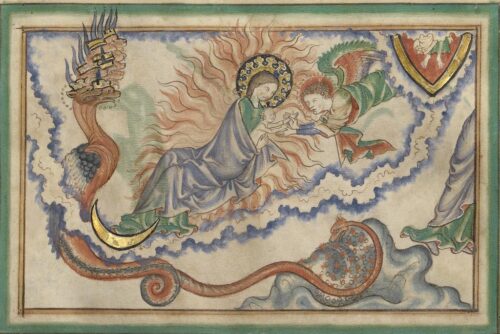
The Woman Clothed in the Sun (detail), from Apocalypse, 1255 artist unknown.
The idea of something ’emerging’ out of primordial waters has been hugely attractive to humankind since the beginning of reflection on these matters. So hold that thought a moment. The problems of origin thinking is that there are no experiments for it.
“The last assumption, that general relativity works at all scales, is almost certainly wrong, as it contradicts the probabilistic principles of quantum mechanics, our well-established theory of the subatomic world. Quantum theory tells us that particles are not little balls, as you might have imagined in school, but rather wave packets that cannot be pinned down in a point in space; the world is probabilistic and almost anything is possible. Yet, general relativity only works when particles have definite locations that deform the space-time in their local vicinity. To imagine the Big Bang singularity is to ignore the contradictions of quantum mechanics and general relativity, the pillars of the physical world. ”
Niayesh Afshordi and Phil Halper (Ibid)
The problem, or rather the first problem here is that these discussions veer into pure math at a certain point. Postulating sub atomic particles and an infinite past, becomes nonsensical (no matter how elegant the math). In fact, the whole origin issue is plagued with a problem of definitions. A problem of language, really. The Oxford English dictionary defines ‘origin’ this way: ‘the point or place where something begins, arises, or is derived’.
The Oxford English dictionary defines ‘beginning’ as: ‘the point in time or space at which something begins’.
The Oxford English dictionary defines ‘begins’ this way: ‘perform or undergo the first part of (an action or activity)’. But the second meaning is : ‘come into being or have its starting point at a certain time or place’.
And the Oxford defines ‘genesis’ this way: ‘the origin or mode of formation of something’.
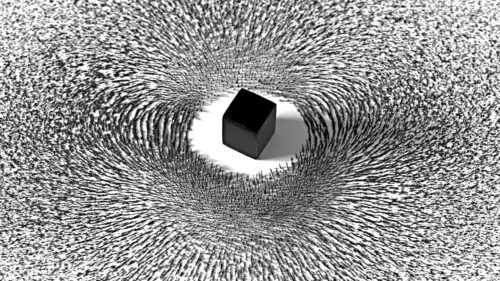
Ahmed Mater
You get the idea. We could play this game all day (Wittgenstein often did). So, when cosmologists ask how did the universe begin, they are implying a number of things already. They imply space and time. And space and time is exactly what is being interrogated here. But a quick google search will yield you a dozen (more) articles, both scholarly and popular on how physics and cosmology are struggling with a crisis of credibility. An astrophysicist and a theoretical physicist co authored a NY Times article titled “The Story of Our Universe May Be Starting to Unravel”. They focused a lot on the James Webb telescope, which I have written about before (its really neither a telescope nor a camera. Its a giant computer of sorts).
“Physicists and astronomers are starting to get the sense that something may be really wrong. It’s not just that some of us believe we might have to rethink the standard model of cosmology; we might also have to change the way we think about some of the most basic features of our universe — a conceptual revolution that would have implications far beyond the world of science.”
Adam Frank and Marcelo Gleiser (NY Times, 2023, Ibid)
My purpose here is not to catalogue the specific issues of physics and cosmology today (dark matter, dark energy, the Hubble tension, the Cosmological Constant problem, Sigma 8 tension, et al), but rather to suggest that philosophy is much needed in these discussions.
“I suggest that we must take seriously the possibility of other worlds. By this I do not mean the familiar speculations of the multiverse, or the Many-Worlds hypothesis, introduced by physics to come to terms with the Universe’s ongoing indeterminacy. Rather, it is to take seriously those worlds that physics and modern realism have otherwise dismissed. That is, worlds in which, for instance, the Earth beings of Indigenous peoples are real, the ghosts of Japanese family members are cared for, and where God talks back to evangelical believers who speak with him.”
Adrien De Sutter (Aeon, 2025)

Book of the Queen, anonymous, France 1410.
I think the problem is with consciousness, firstly, and then language. And by language I mean, really, philosophy. (if you want to read a quick clear description of ‘how’ physicists calculate things like the Hubble tension….read this https://www.sciencefocus.com/space/something-is-wrong-with-our-understanding-of-the-universe
I mentioned the assumptions associated with ideas of how the Universe came into existence. This encompasses all the ‘big bang’ theories and current discussions of quantum theory. The problems are almost endless.
“Adding to this are ever more speculative ideas about pre-Big Bang physics and the multiverse, as well as string theorists suggesting that their theories’ internal consistency may matter more than their empirical verification. With these, we risk what has been called a ‘post-empirical physics’. Unless something changes, this entails either the abandonment of fundamental physics, or a field of physics increasingly freed from empirical substantiation. In short, it risks a Universe lost to the world.”
Adrien De Sutter (Ibid)
I return to my twin 8 year olds. The idea of ‘the Sun’ dying was troubling, but not hugely so — still, it troubled *me*. And here is where I also find myself again returning to Freud. The large Hadron Collider has achieved very little but there are now plans for the building of the Future Circular Collider — budget 17 Billion dollars. As De Sutter notes, the problem with all of contemporary cosmology resides in what Alfred North Whitehead called the ‘bifurcation of nature’. The making of things abstract into things concrete. And then privileging this fallacious concreteness. But giant tunnels that hurtle subatomic particles at great speed feels very psychoanalytic to me I have to say.
Adolph Gottlieb
“How philosophers implement inquiries such as these can be seen by considering scientific activity as taking place inside large organizational structures that can be thought of as a series of loosely connected ‘workshops’. { } “By workshop I don’t mean necessarily an actual laboratory, only a carefully supervised and regulated environment in which special things can be prepared and observed: subatomic particles and their interactions, superfluids, chemical elements and reactions, protein folding, plant uptake of nutrients and toxins, and so forth. These phenomena do not appear in the surrounding world, or only crudely, rarely, and not in clear enough ways to study well. But in the special conditions of the workshop they can be made to show themselves for study and measurement. While the modern world is heavily dependent on scientific workshops, they essentially originated in the 17th century. Each workshop involves ‘frames’, or sets of assumptions and concepts that define the physical system under study. The frames remove what appears in them from the dense network of the world outside the workshops, and prioritize what appears in them over unframed experience of that world. These frames are built on pre-judgments about the phenomena. Frames are chosen based on the phenomenon to be inquired into.”
Robert P. Crease (Philosophy of Physics: A new introduction)
This is a brilliant summation of the problem. Like the James Webb Space Telescope, this is the pre-judgement world of contemporary science. Especially well funded science. This is also the Western tendency toward domination.
“When we enter a workshop, however, we are not stepping outside our everyday world and entering a magical space where we confront ‘nature’ directly. We have constructed the workshop ourselves, we have planned the projects we want to do according to our current ideas, we have built the instruments we will use with materials and designs at hand, and we interpret what we find with the concepts we already possess.”
Robert P. Crease (Ibid)
Even before Einstein there were what might be called ideological issues with the idea of science.

David Hockney
“Discovery was discovered’ argues David Wootton in The Invention of Science (Wootton 2016). European languages lacked the word prior to the 15th century, when it was ‘not an established concept’. It was widely assumed that there was no need—all knowledge humans could gain about the world already existed or had been lost, forgotten, or mislaid. In the heavens nothing ever changed, on Earth there was ‘nothing new under the Sun’. History was not conceived as a linear timeline on which fundamentally new things could appear to shake things up. { } Discovery is not in itself a scientific idea but rather an idea that is foundational for science: we might call it a metascientific idea’ (Wootton 2016). The impact of the word ‘discover’ stemmed from its being an ‘actor’s concept’. Once it’s publicly available, Wootton writes, ‘you can set out to make discoveries, knowing that is what you are doing’, in a ratification of the theoretical attitude. The concept makes possible the scientific workshop and its activity. ‘It is easy to say that our world has been made by science or by technology, but scientific and technological progress depend on a pre-existing assumption, the assumption that there are discoveries to be made’ (Wootton 2016). While the origin of discovery is historical-linguistic and its practice scientific, its structure is described philosophically.”
Robert P Crease (Ibid)
Now there is a discussion to be had regards climate change in all this. If you read reviews of Bruno Latour’s books, you will find the term ‘climate denialists’ a lot. You will also read how Russia ‘invaded’ Ukraine. I run into this a lot. Latour was interesting but also often wrong. He was very pro vaccine during Covid. In the aftermath of the lockdowns he seemed almost willfully blind to the politics of both climate and Covid. Now I only mention this because Latour is wildly popular with western liberals. With the white educated classes. Its interesting to compare him to Agamben, who for all his reactionary sort of closet anti communism, was singularly insightful about the lockdowns. And I mention Latour because he wrote about science a good deal. But I digress a bit. I want to stick with cosmology here for a while longer.

Agnes Pelton
Crease points out the basic problem, one defined by Whitehead in the 1920s (see above). Wittgenstein was highly critical of what he called ‘scientism’. And I think his critique applies across many fields or contexts today. Mark Alford writes:
“Let us approach the first of our two initial questions: what is the status of scientific knowledge? Does it give us access to reality? As before we can discount the claims of the positivist: his p-doubt is of no relevance to the issue. However we may have a hard time with the realist too. Although science and ordinary language are partially mingled, they are largely separate (there are non-scientists). Words such as “real” are ordinary language words (as the realist uses them). It is clear what is meant by “Unicorns are real”, but what is meant by “Electrons are real”? It seems to me that the only sensible way to proceed is to take the criteria of “reality” in ordinary unscientific language, and apply them unaltered to scientific entities. I.e., something is real if, given a definition of it, you can actually go out and find objects that meet that definition. Now we apply this to scientific objects:
Bacteria, other galaxies, etc. The lens, whether as part of a camera, telescope, or microscope, has become part of the ordinary process of seeing. We can therefore say that E. Coli, M31, etc really do exist.
A wave function. How do you find a wave function? In some formulations of quantum mechanics there are no wave functions. Furthermore, you can only detect a particle, not the wave function that put it there. I do not see any way of saying that a wave function is “real” in the normal sense of the word.”
Mark Alford (Wittgenstein and Scientific Knowledge)
And this from Ray Monk:
“Another example close to Wittgenstein’s heart is that of understanding music. How does one demonstrate an understanding of a piece of music? Well, perhaps by playing it expressively, or by using the right sort of metaphors to describe it. And how does one explain what “expressive playing” is? What is needed, Wittgenstein says, is “a culture”: “If someone is brought up in a particular culture-and then reacts to music in such-and-such a way, you can teach him the use of the phrase ‘expressive playing.'” What is required for this kind of understanding is a form of life, a set of communally shared practices, together with the ability to hear and see the connections made by the practitioners of this form of life. What is true of music is also true of ordinary language. “Understanding a sentence,” Wittgenstein says in Philosophical Investigations, “is more akin to understanding a theme in music than one may think.” Understanding a sentence, too, requires participation in the form of life, the “language-game,” to which it belongs. The reason computers have no understanding of the sentences they process is not that they lack sufficient neuronal complexity, but that they are not, and cannot be, participants in the culture to which the sentences belong. A sentence does not acquire meaning through the correlation, one to one, of its words with objects in the world; it acquires meaning through the use that is made of it in the communal life of human beings.”
Ray Monk (Wittgenstein’s forgotten lesson, Prospect 1999)

Moon & Zodiac, 16th century England, Egerton ms.
What is needed is a culture. This is a significant observation. As Crease points out contemporary physics exists in a highly rarified ‘framed’ culture. And one that has both ideological and psychoanalytic implications. So what does it mean to contemplate the eventual demise of humans (and earth) because the Sun, *our* sun, will someday die. But someday is approximately four billion years from now. Trying to imagine four billion years is pretty much impossible. But lets return to the Big Bang, because this is, in a sense, the very heart of cosmological speculation and study. But allow me first a small aside: there are in the neighborhood of 14,000 satellites orbiting earth. Another few hundred space probes are out there, though the number is uncertain (also there are a significant number now of defunct probes just cruising into deep space — space junk). Most of the fourteen thousand are tied to communications and are in low earth orbit. But my point is, the purely scientific (OK, you could argue none are purely scientific) probes and orbiters represent a massive financial investment. Trump’s administration is cutting something like 24% of science projects for NASA, so one can expect a few projects to get scrapped. Still, the NASA budget is 24 billion. In government terms that’s rather small, but I find it surprising NASA even gets that. My point is that all cosmological science is linked to financial return. Nobody does this stuff for nothing. (it should be mentioned that 60% of satellites launched over the past few years are tied to SpaceX).
Now, one of the knottier issues surrounding Big Bang thinking is that of ‘inflation’. (Inflation is the rapid exponential expansion of the universe following its coming into existence.) Inflation is contradictory to the steady rate of expansion that Big Bang theorists hold. Without belabouring this the real question looming over all of this is what is came before?
“Another difficulty I think we should highlight for inflation is that the theory does not address the issue of what came before the exponential expansion began. Guth often replies by saying that inflation is analogous to Darwinian evolution, which is a theory of how life evolves and has nothing to say about how life started. It’s just a different question. That’s fair enough, but if an alternative theory can probe deeper into the quantum gravity era, then such a theory might look more attractive.”
Niayesh Afshordi and Phil Halper (Ibid)
The problem is that one cannot see outside the universe — the one we are in. Hence nothing about this discussion is empirical. So what is it then? Well, the discussion takes up volumes but the relevance here is this is just pure speculation and not science at all. It can’t be. There are fascinating aspects, but just the issue of ‘dark energy’ is enough to cause one to just throw up ones hands in despair. If time did not exist before the formation of the universe then these questions veer into the nonsensical. Or, purely philosophical. For Heidegger, there are at least two kinds of time. But my point (again) is that theories regarding the origin of the Universe cannot really be about ‘our’ time, because nobody was alive then. “Our” time cannot be theorized without “us”. My argument is that ‘consciousness’ is the beginning, or ‘a’ beginning, not the ‘universe’.
Einstein’s equations suggest that going back in time (sic) the universe was contracted into a singularity. A hot dense ‘point’ that was not anywhere but everywhere. No time and no distance means….well, a singularity. This is the crux of cosmology and its problems. Most physicists actually doubt this narrative but the math is elegant and if you buy General Relativity, then this is what you have to believe. But this is where the psychoanalytic part of me starts to object. For how do ‘we’ fit into this narrative? Much like the death of the Sun, there is something almost morbid about this theorizing. We cannot visualize any of this. And that, too, is a problem. The milky way is travelling around a million miles an hour. Toward what you ask? Toward something physicists call ‘the Great Attractor’. And what is that? Well, nobody knows. The issue of measurement is acute in nearly all discussions of physics, but especially in quantum physics. Most everything discussed here involves measurement. How do we know the Milky Way is hurtling through space at a millions miles an hour? Because it can be measured against the Doppler Shifts, or against the Cosmic Microwave Background. You see the problem. How do we know our measurements of the Cosmic Microwave Background are reliable? We don’t. Not really. Gravity bends light, for one thing, and two, the CMB is at least partly theoretical. It makes sense that the Milky Wave is moving, but I suspect its very hard to actually know how fast. Or that we are ‘in’ the Milky Way.

Sylvie Fleury
But like my previous couple posts on quantum theory, there are in-built parables involved with cosmology as it is expressed in contemporary physics. On a basic level, science seeks domination (much as Italian fascist cinema was seen by many as a desire to conquer the screen). The conquest of space is now remodelled as the search for the ultimate origin. The fetishizing of measurement becomes almost cultic. As Babette Babich notes below (via Heidegger), it is measuring representations. The James Webb Space Telescope is a kind of digital painting. Almost paint by number, really. The JWST is pure projection. (and even then it showed surprising results, suggesting just how much is NOT known about anything).
“I will simply say: the other is always who. That is to say, it is always the question of who the other is. Even if it is neither a mere subject nor an object, nor that on which the subject or object are predicated, to put it in the terms of an old language, the other always carries with it the question who? And it is also, and at the same stroke, the question not of the object but of the Thing: das Ding. Who, then, is the other? This question, vertiginous as it may be, is above all political, economic and technological…{ } By following contemporary physics, we leave nature behind to enter a factory of phenomena […]. Two societies, theoretical society and technical society, touch, cooperate. To achieve this, it is not enough to deepen a native spiritual clarity or to undergo again, with greater precision, a common objective experience. We must resolutely adhere to the science of our time. We should first read books, many of them difficult, and gradually settle into the perspective of these difficulties. We have tasks. On the axis that is not scientific work, on the technical side, we must handle, as a team, apparatus that is often, paradoxically, delicate and powerful. This convergence of exactitude and force does not correspond, in the sublunary world, to any natural necessity. By following contemporary physics, we leave nature behind, to enter a factory of phenomena.”
Bernard Stiegler (States of Shock)
And Heidegger looms here, as does Nietzsche, and Freud.
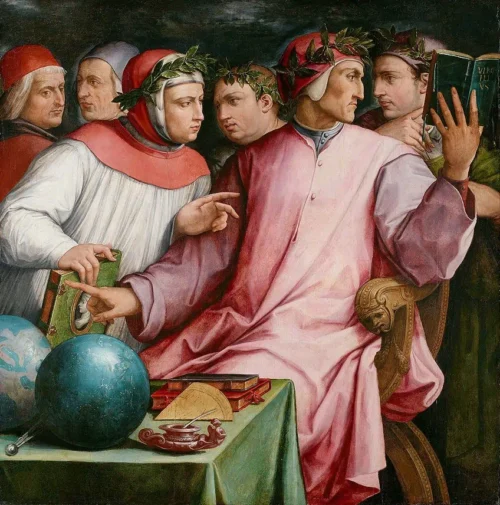
Giorgio Vasari (1569 Six Tuscan Poets)
“It is as a critique of modernity that Heidegger considers science. What is at issue is not the difference between modern and classical science, but that between Western thinking and its forgotten origin. The turn is one to ancient Greece, to retrieve a lost way of perceiving nature. This is the forgotten origin of thought, a physics of cjrucnc;, as the Greeks understood it, and that, precisely that, is obscured in “The Age of the World Picture.” We are effectively, inevitably oblivious, and it is this oblivion that Heidegger invites us to bring once more to light. Heidegger’s fundamental challenge to our modern way of thinking as such is that this way of thinking has given rise to a representational view of the world as “picture.” For Heidegger, this perspective is tied to the egoism of the modern subject, the talk of values, and the practical, world-mastering success of modern technology and science. Science, for Heidegger, is the culmination of Western metaphysics, the fruit as much of the thinking of Plato and Aristotle as of, and here Heidegger is very instructive, Christian, scholastic theology. In this context, the Galilean project perfected in Newtonian mechanics is not superceded in its essence by quantum mechanics. Both remain nothing more than (measuring) representations. The archaic Greek way of perceiving was a mode of revealing that was first and foremost a response rather than a challenge or a projection. Heidegger’s signal insight was that insofar as we take ourselves to be the heirs of the earth, to have dominion over it, we have foresworn this archaic mode of perception. In the modern age, the whole of what is turns around us as object, as the real that can be known, anticipated, and harnessed for our own projects – as if these scientifico-technologico projects made up all of what there is, as if this were the only point or aim of what is.”
Babette Babich (Heidegger’s Philosophy of Science: Calculation, Thought, and Gelassenheit)
Deep space is ‘the other’. And western scientistic societies today funnel millions upon millions of dollars into endless projects of doomed outcome. There is a hostility toward the other but a repressed one. In fact, much quantum cosmology feels like a return of the repressed. Heidegger is actually the most prescient philosopher to read on science. Interestingly Trish Glazebrook makes what I think is an error in the introduction to her book Heidegger on Science.

Siegfried Hansen, photography.
“Heidegger takes quantum theory to be simply an extension of classical physics because he has missed Bohr’s insight that the interaction between quantum objects and instruments of measurement puts objectivity itself into question. Quantum theory disrupts Heidegger’s contention that objects are reducible to the totalizing and controlling matrix of standing-reserve, a view only possible within the positivist perspective of realism where Heidegger remained. This perspective is also at work in the logic and ideology of capitalist economies, but not in Bohr’s program of experimental science that generates probabilistic results because it has rendered impossible the certainty of representation.”
Trish Glazebrook (Heidegger on Science)
But this is not strictly what quantum probability means. The representation remains, only it is the representation of the probabilistic. The entire idea of entanglement (superposition etc) only means, the representation reproduced is more abstract. Less Thomas Eakins and more Barnett Newman. I see no reason the standing reserve must be ‘realistic’ or ‘naturalistic’. And this betrays a certain lack of understanding regards what naturalism or realism means. Is Shakespeare realistic? I mean he’s most certainly not. Nor is Noh Theatre or Kathakali or even Goethe. (one of my previous posts was titled Probably, and dealt a lot with quantum theory). Logical positivism does not preclude abstract or avant garde art (read Adorno). But reading through most of the essays in the Glazebrook edited (save for Babich) one finds a strange acceptance of quantum theory. It suggests how influential quantum theory has been since WW2. And there is little real discussion of language in any of this.
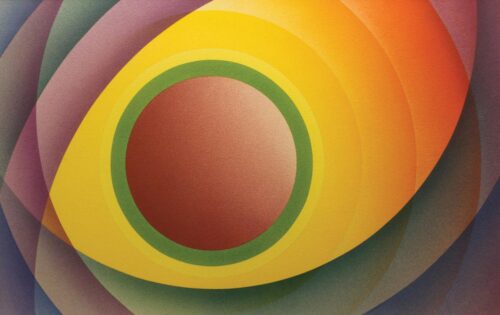
Raymond Jonson (1939)
Babich quotes Being & Time….“ontological inquiry is more primordial or original than the ontic inquiry of the positive sciences.” Today, if you read through most of the quantum based cosmology you will find very little ontological inquiry. Which is surprising since there is a good deal a nearly religious asides in all the quantum equations. But this raises the issue of math per se. Contemporary quantum theory is near totally math. This is why one runs into the shockingly reactionary politics of many physicists today. They simply don’t care. They want to get back to their equations. And those equations are part of a trajectory of science and technology that views dominion over the earth as reasonable, but more a conquest and dominion over the past, over time itself. A conquest of Being.
The search for the beginning of the Universe takes place in a distant past before consciousness (presumably). The future death of the Sun takes place long after human life. Certainly long after our life. There is a morbidity that runs through all of this (what I see as) myth making.
“ Heidegger demonstrates the nihilism of metaphysics in his philosophy of history – the history of being, which, as he shows, is the history of being’s oblivion. His attempt to overcome metaphysics is not a common-sense based positing of some different values or an alternative worldview, but is related to his concept of repetition developed in Being and Time. It consists in thinking back being to the primordial beginning of the West – the early Greek experience of what is present in presencing – and in repeating this beginning, so that the Western world can begin anew.”
W. Julian Korab-Karpowicz (The Presocratics in the Thought of Martin Heidegger)
“The two ontological problems (relationship between substantial being and the eventality of the world; access to the multiple if the elements of this multiple are unthinkable and indiscernible) cannot be solved unless we pass “on the side” of the linguistic reflection, on the side of the picture that we form for ourselves of what exists. The crucial point is that objects, which can be neither thought nor described, are represented in the picture, or, which amounts to the same thing, in the proposition.”
Alain Badiou (Wittgenstein’s Antiphilosophy)
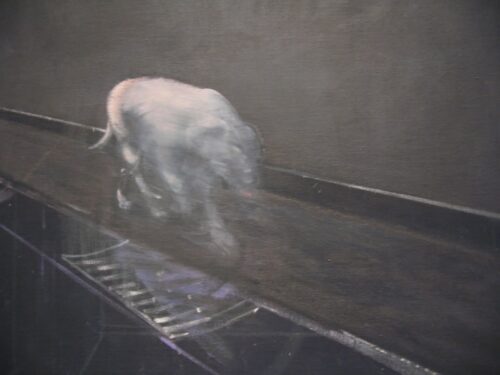
Francis Bacon (Study for running dog, 1954)
The Big Bang is a kind of birth metaphor. We cannot remember uterine life, and this forms the basis of all ‘thought’ about oblivion. It is the limit of human imagination. And in all cosmology death is somehow erased (unless you are a star or galaxy). The quantum theories are there (as I noted before and this includes Einstein’s special relativity) as the LSD of the sociology of science. There is also the Freudian ‘das ding’ (and Lacanian). For Freud this mysterious lack or absence is The Mother. And this initiates desire, a desire for ‘the mother’. For Lacan ‘das ding’ is lack itself. But without going into this (which I have written on before) the point vis a vis Heidegger is related to distance and how this is constructed for our subjectivity (to provide a very reductive explanation). And extrapolating outward in terms of quantum theory and cosmology we see (I believe) that the counter intuitive quantum equations (centering around wave function) is a form of ‘lack’. I said above that the deep past constitutes ‘the other’. There is some residual morbidity attached to cosmological models for the ‘beginning’ of the Universe. Wittgenstein would say nonsensical.
The ‘other’, or the desire of the other, is inaccessible. And this triggers cascading effects for our psyche. Ideas such as The Big Bang (in any of its versions) are attempts to provide a scientific explanation for the inaccessible. Perhaps all quantum theory does this. Quantum theory is probabilistic. It is also hugely mediated by technology.
“All distances in time and space are shrinking. Man now reaches overnight, by plane, places which formerly took weeks and months of travel. He now receives instant information, by radio, of events which he formerly learned about only years later, if at all. The germination and growth of plants, which remained hidden throughout the seasons, is now exhibited publicly in a minute, on film. Distant sites of the most ancient cultures are shown on film as if they stood this very moment amidst today’s street traffic. Moreover, the film attests to what it shows by presenting also the camera and its operators at work. The peak of this abolition of every possibility of remoteness is reached by television, which will soon pervade and dominate the whole machinery of communication.”
Martin Heidegger (The Thing, 1951)
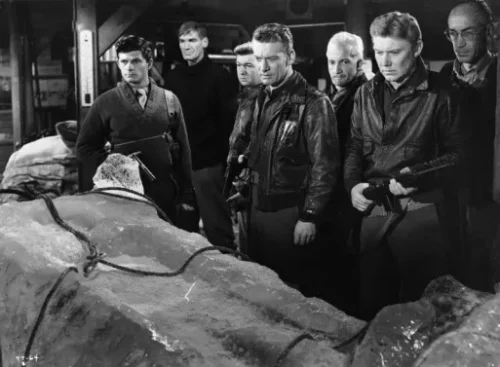
The Thing (1951, Christian Nyby, dr.)
The problem of cosmology, overall, is its ‘distance’ from us. Heidegger suggests technology brings forth science and not the other way round. But cosmology is created by that which is already known, it is caught in endlessly solipsistic formulations of language, and it ends up anti – philosorphical. Some will object that quantum theory has practical (and profitable) applications. I am not sure what that proves, however. The blowing up of fisherman and their boats by a drunken American defense secretary is also profitable, for Boeing or Raytheon. There is remarkable mathematical equations involved in all this physics, but it is hard not to see diminishing returns setting in. How many variants of the Big Bounce or Big Crunch or String brane creation or Black Holes and singularities are possible before a profound weariness takes over.
The flip side is, firstly, with Heidegger, whose Nazi enthusiasms (or at the very least cynical opportunism, though the Black Books seems to make clear he found a congenial ethos in National Socialism and its own brand of myth making) are going to forever colour our reading of his work. He was the product of a conservative and even provincial cultural milieu, in a Germany itself in the throws of multiple identity crises. The metaphysical Nazi, as Karl Lowith called him, nonetheless was a keenly deep thinker who is very hard to ignore. And Wittgenstein, who may be the purest of thinkers, but also in some sense the most frustrating. Still, I think all writers should study and read Wittgenstein at some length, and I think possible nobody has quite yet caught up with him, to fully understand what he is saying.
I have said before that theatre is a form of thought. The stage is always the site of the primal crime. Theatre precedes religion. And philosophy, per Badiou, is an ‘act’ (he is paraphrasing Wittgenstein). Science and math cannot rise to the level of act, or to a form of thought.

Vincent Van Gogh (1885)
“The notion of “science,” of course, is an old one—older than the word scientia it transliterates, as old (at least) as the epistemê of the Greeks. If it has for modern man a meaning all its own, this is because science developed a specifically new method of inquiry with the advent of modern times (VA, 54–5/169–70). What characterizes the method of modern science and distinguishes it from ancient science for which Aristotle supplied the basic formula is the notion of “research.”
William J. Richardson (Heidegger’s Critique of Science)
A final observation; das ding, that inaccessible lack that consciousness searches for, is not unlike, in its paradoxical nature, quantum mechanics. *Das ding* is the collapsing wave function of the psyche. It is both missed and irretrievable — and constantly re discovered. Quantum theory then resembles desire to a disturbing degree, But I will leave it here for now. There is a good deal more to say (even within the context of blog post).
to donate to this blog use the Paypall button at the top.
Donations also help support Aesthetic Resistance podcasts. https://aestheticresistance.substack.com/

Fascinating post, as always.
I doubt you’ll want to read it, but the best book on this complex subject is An Outline of Esoteric Science by Rudolf Steiner.
Peace.
i dont know it but I will check it out.