



Chul Hyun Ahn
“How can one learn the truth by thinking? As one learns to see a face better if one draws it.”
Ludwig Wittgenstein (Zettel)
“Bacon had died in 1626, but that did not mean that his message was out of date. On the contrary, it had a kind of actuality for eighteenth-century France which made him, to a greater extent even than Locke or Newton, a prophetic figure for the whole French Enlightenment. For Bacon was the first philosopher of science. It was not that Bacon made any scientific discoveries of his own; he simply proclaimed the doctrine that science could save us…. Once men knew how nature worked, they could exploit nature to their advantage, overcome scarcity by scientific innovations in agriculture, overcome disease by scientific research in medicine, and generally improve the life of man by all sorts of developments in technology and industry.”
Maurice Cranston (Philosophers and Pamphleteers)
“In the authority of universal concepts the Enlightenment detected a fear of the demons through whose effigies human beings had tried to influence nature in magic rituals. From now on matter was finally to be controlled without the illusion of immanent powers or hidden properties. For enlightenment, anything which does not conform to the standard of calculability and utility must be viewed with suspicion.”
Adorno and Horkheimer (Dialectic of Enlightenment)
I was thinking about how it is that this idea of ‘science’ came to be associated with moral improvement. It began, it seems, with the French Encyclopaedists, just prior to the Revolution. This idea, or the germ of it, began earlier, with the Scientific Revolution (and there is much debate about the exact dates etc, but that’s not the point) in late 16th century. Names like Johannes Kepler, Francis Bacon, Pierre Gassendi, Christiaan Huygens and Galileo. And Isaac Newton. I do not want to write a mini history of the Enlightenment here. But I do want to see how society, or western society, has arrived at its current state of scientific fetishizing. Or ‘scientism’. And what that actually means.
And more than that, how long before the European Enlightenment, since Greece at least, there has been and is a ‘seeing’ of the world as a problem — a problem in need of solving. But the problem hasn’t to do with moral improvement per se, the experience of this ‘seeing’ is more about the inherent (sic) calculative posture of human consciousness. One result is narrative or ‘plot’. The creative telling of ‘stories’. And then ideas of suspense and ‘mystery’ — that which is in need of solving. This began to peak in the 19th century, I think. Eventually in detective fiction but nearly all writers and most Hollywood producers themselves do not understand that the third act of all mysteries are the least interesting. The audience that is re-narrating is NOT solving a problem. They don’t care at all if the mystery is solved. The reader or viewer cares about the integrity of the crime, for all stories are crime stories. In terms of science the equation (and here I will have to talk a bit about math) ‘is’ the plot. When Guy Zimmerman and I discussed the legacy of Murray Mednick we spoke of the absence of ‘drama’ in his plays. The narrative in most of his plays was anti-dramatic, it was not meant to explain (solve). The plays listened to themselves. Exposition in this sense is science. Plotting is science. A Kafka novel or story with very few exceptions is just ‘there’ — there is no punch line. Pinter does not provide exposition, nor does Beckett. In Greek Tragedy the ‘story’ (plot) was already known. The re-narrating was not about the story, but about everything else.

Evelyn De Morgan
“The account given by Kant implies that science and the arts alike are valuable, and that both contribute to a morally improving culture. Theoretical science contributes to a culture of skill, making the satisfaction of human desires more efficient, and therefore helping us to become happy. Practical science—the system of morality— contributes to a culture of discipline. It tells us what ends we ought to pursue and also which of our policies of action are consistent with those ends. Trying to live by this science is what makes us worthy to be happy. As for the arts, they increase our pleasure, and the best of them do so by exercising faculties that we need for fulfilling the requirements of morality.”
Tom Sorell (Scientism)
And this is where so much goes off the rails. And these ideas have filtered down for three hundred years to infect today’s mass culture. Narrative must be distinguished (Identified) — but it must also be recognized that everything has a narrative to it. Mark Rothko has a narrative. Even Ellsworth Kelly has a narrative. Stockhausen certainly has a narrative. And, quantum physics has a narrative. And all narrative has psychoanalytic implications. (or psychoanalysis has narrative implications).
All stories are crime stories, all stories are about homesickness and exile. Ergo the stage is the ur-medium and the stage in our minds recreates the primal crime at each viewing. Hence this Kantian idea of arts and pleasure is simply repression. Denial. But more to the point is that there are two topics here; one is the legacy of reason from the Enlightenment onwards, and the second is the philosophical issue of hermeneutics and science, or rather in what way consciousness IS calculative. In what way does consciousness ‘solve’ — it is a solving organ. But with art, consciousness is retracing the formation of the psyche. In science it is doing something very different. If I try to imagine an experience that does not involve calculation I find it very difficult. (like trying to imagine the moment of my death).

Paul Insect
“January 1940: The killing of mental patients by means of gas (carbon monoxide) is tried out in the jail at Brandenburg. By September 1941, 70,723 mental patients will have been killed in Grafeneck, Brandenburg, Bernburg, Hartheim, Sonnenstein, and Hadamar, using carbon monoxide gas provided by IG-Farben. January 1940: Dr Ritter writes in a progress report to the DFG:”Through our work we have been able to establish that more than ninety per cent of so-called native Gypsies are of mixed blood…The Gypsy question can only be considered solved when the main body of asocial and good-for-nothing Gypsy individuals of mixed blood is collected together in large labour camps and kept working there, and when the further breeding of this population of mixed blood is stopped once and for all.”
Benno Muller-Hill (Murderous Science; Elimination by Scientific Selection of Jews, Gypsies, and Others in Germany, 1933-1945)
Adorno noted (and I have quoted often) that the radicalness of art is found in its uselessness. I will return to this. But first I want to return yet again to quantum theory.
“All three, Wigner, Schrödinger, and Heisenberg, however, were united in their concern with the nature and meaning of the ‘cut’ (‘Schnitt’in German) between the subject and the object in quantum physics. They recognized that quantum physicists, equipped with their bodily sensibility and assisted by a laboratory bench,claimed that micro-entities, such as electrons, could be ‘observed’ when they showed up during measurement, despite the failure of human intuition to represent their kinematic place and motion in the space and time of the laboratory. Today, we tend to look to cognitive science rather than philosophy for answers to problems of this sort, but in post-war Europe the crisis in quantum physics was seen as part of a cultural, philosophical crisis that was ushering in a new era, the ‘post-modern’ or ‘postclassical era.’”
Patrick Aidan Heelan (The Observable)
I will say firstly that its a shame (and a problem) that ‘cognitive science’ replaced philosophy. In fact this is a significant issue.

Nicasio Fernandez
“Heisenberg came to see physics, and all science, as the study of the ‘ontology’ or ‘the real’ of nature. In taking that position he was fully aware that philosophical terms such as ‘ontology,’ and ‘the real’ get their meaning from the context of their use in a community of philosophical discourse. His own way of acknowledging that fact is well manifested in his essays, which took the form of conversations with his physicist colleagues in Europe that addressed the variant meanings they each gave quantum mechanics and sought out core areas of agreement within them. In the end, from his standpoint disagreements in physical theories were always disagreements about ‘the real.’ This central issue about quantum mechanics for him could be captured by the question: Can a quantum entity that is ‘non-intuitable’ but nevertheless ‘observed’ in a laboratory measurement be ‘real’ in the ‘ontological’ sense?”
Patrick Aidan Heelan (Ibid)
This is the question (I’m not sure its only restricted to quantum physics, to be honest). But I think we need to unpack what is meant by ‘non-intuitable’. And before that, there are questions regards hermeneutics itself — at least in this context (we shall return to context). Here is a quote from John Caputo (and Caputo is a tad weird even by Heidegger scholar standards, and has a prose style that reminds me of kindergarten teachers)…still …
“So, interpreting Dasein is not a matter of simply undertaking an inspection and making an inventory of what we observe. We cannot simply look at ourselves and make some notes, the way a geologist might look at a rock or a botanist might look at a plant. Why not? Because it is a basic tendency of our being that this pre-understanding remains concealed, in the background, while we busy ourselves with what is going on right under our nose in the foreground. We are beings whose deeper Being tends to withdraw from view. We are not simply there, period, not simply present, like a rock or a plant which has certain properties. Our Being is more evasive, more self-evasive, so a hermeneutic investigation is more like detective work, looking for clues.”
John D. Caputo (Hermeneutics)
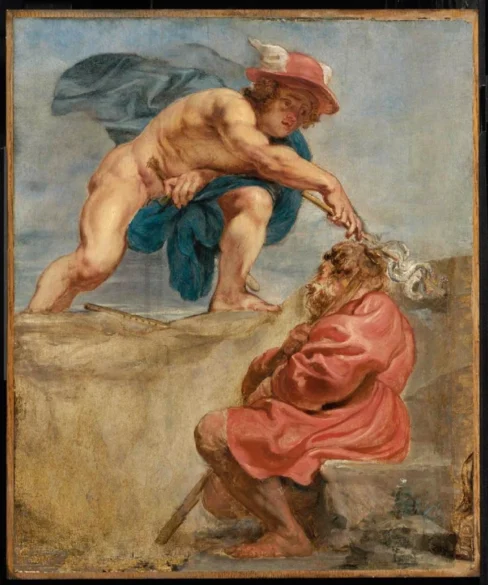
Peter Paul Reubens (Mercury and sleeping herdsman, 1632)
Amusing that the detective metaphor surfaces again. But I think what I am questioning here is best described by Heelan in his book on Heisenberg.
“At the center of Heisenberg’s insight was the notion of observability. A large part of this study will be concerned with attempting to find out what Heisenberg meant by “a quantity observable in principle”—and with tracing the modifications that his original notion underwent. However, why did Heisenberg think that quantities observable in principle were especially important in physics? The answer to this question is bound up with Heisenberg’s notion that physics was a quest for a better understanding of what nature is really like. For him, the goal and objective of physics was not primarily control or predictability or formal elegance, but the ontology of nature in a philosophical sense. Heisenberg, who was well-read in Greek and Western philosophy in general, also collaborated in philosophical discussions on physics with such as M. Heidegger and C. F. von Weizsäcker. He saw himself as a scientist who was guided by philosophy in the critique of quantum physics, arguing in particular that Plato supports quantum mechanics over Democritus, and that nineteenth-century materialism and the Cartesian model of science are refuted by quantum mechanics. Observability was an important theme for Heisenberg because of its connection with the ontology of nature. In his view not every element of a theory that serves the purpose of control, prediction, or formal elegance was ‘objective’ in the sense of belonging to nature’s ontology, but only those that are observable in principle. Only such observables for him had the right to play a descriptive role in a truly scientific account, one, namely, that described nature’s ontology.”
Patrick Aidan Heelan (Ibid)
Now I am not qualified to discuss the math of Quantum Mechanics. Which limits my scope rather severely. However there are still obvious philosophical problems inherent in the topic which I can discuss.
“The activity of describing an actual and experienced event is then an objective ontological claim about the real presence to the real observer of what is named. However, what is named has to be distinguished from the phenomenological symbol of its presence, which is here the change in the dial reading of the measuring apparatus. This dial change is also an event—one in the measuring apparatus—that can be experienced and can even become itself an objectifiable event. This is not, however, the objectifiable object which is experienced and named as the ‘objectifiable measured object’ of the observer’s measurement, even though it is something without which the presence of the named objectifiable measured object would not be known.”
Patrick Aidan Heelan (Ibid)

D. Face
Heelan himself notes that this is a knotty and difficult area. The ‘dial change’ problem. (see Crease from my last post). So most of this discussion, the one Heelan is writing about, takes place within the ‘meta context language of physics’. Again Crease “By workshop I don’t mean necessarily an actual laboratory, only a carefully supervised and regulated environment in which special things can be prepared and observed: subatomic particles and their interactions, superfluids, chemical elements and reactions, protein folding, plant uptake of nutrients and toxins, and so forth.” (Philosophy of Physics)
A carefully supervised and regulated environment. One prepared especially for THIS particular experiment. The one that moves the dial.
“The second strategic move is a counterpoint move from the choice of a descriptive linguistic framework—which is the meta-context language of choice—back to the user of that framework. The user is the describer (alternatively, the observer, the knower, or the subject). This is a move from object to subject, from observation to observer, from description to describer, from knowing to knower. An analysis of what is or can be described within a descriptive framework (the kinds of objects it can present) can lead to certain conclusions about the conditions or type of context necessary and sufficient for the valid use of the language. Employing a usage common to all quantum physicists, I call, the user of a descriptive language plus the set of necessary and sufficient conditions for its use (which I call ‘its context’) ‘the observer.’ The quantum mechanical observer then is the human subject conjoined to whatever instrument the subject chooses to use in the investigation. Sometimes the instrument is spoken of as an ‘observer’, even while isolated from a cadre of human observers trained to interpret the value of instrumental response and to give meaning to it. An unattended instrument can no more observe than it can describe. Observation entails evaluation and description, and description entails the valid application of an appropriate descriptive language.”
Patrick Aidan Heelan (Ibid)

Franz Kline
The observer is observing the dial moving. None of this really began with Quantum Mechanics. But it was Einstein who proposed a working (practical) solution to finding an absolute space/time against which the various ‘frames’ could be set. Really what he ended up proposing was a new model for what was ‘real’. And that Newtonian (classical) laws only represented the appearance of reality. Not reality itself — or not Nature itself. The (per Heisenberg) ‘closed system’ of classical physics is described by Heeland thus:
“The descriptive ontology of classical mechanics is what Heisenberg called “the ontology of materialism,” an ontology exclusively concerned with ‘objectifiable’ quantities—quantities which, in their theoretical definition, bear no logical relation to individual observers (whether these be human subjects or the instruments they use). An objectifiable quantity, consequently, is not a function of socio-historical circumstances; it is defined neither in relation to instruments, nor to measuring processes, nor as a function of how the quantity is represented in sensation or perception; it is related, however, through the equations of the physical theory to a matrix of (similarly objectifiable) physical quantities by implicit definitions. The circle of mutually related terms constitutes a hermeneutical circle of implicit definition. In Heisenberg’s language, it is a “closed theory.”
Patrick Aidan Heelan (Ibid)
Heelan adds “First, the classical observer does not interact physically with the observed object; the classical object as observed and described purports to be an object antecedent to and independent of any interaction with the observer with which it may incidentally be related.”
This is important. The object exists antecedent to the observer. I think in a sense this is what Heidegger understood was problematic. Or at least in need of more clarity.
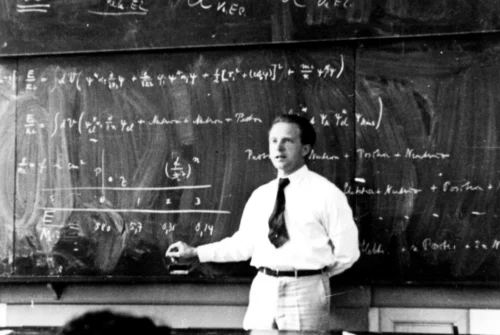
Werner Heisenberg, 1925
“Basic concepts determine the way in which we get an understanding beforehand of the area of subject-matter underlying all the objects a science takes as its theme, and all positive investigation is guided by this understanding.”
Martin Heidegger (Being and Time)
This feels very Wittgensteinian. But back to Heelan: “It was part of Einstein’s belief, shared by Heisenberg, both of whom were strongly imbued with the Platonic tradition, that mathematical structure was the ultimate measure of the real. Not merely was the real order mathematically structured but, given a correct theory, the totality of mathematically representable situations was identified with the totality of real situations.The new quantum theoretical kinematical variable X(t) was so constructed that it contained just those mathematical structures that, suitably interpreted, were thought to have measurable consequences and no more. It was constructed to provide a schema for what was “observable in principle” and hence for what was “real.” (Ibid)
And here is why both Adorno and Heidegger and Horkheimer are all correct. That the deepest reality is math is a very contested idea. And I think this must lead, all by itself, to a variety of problems at the societal level. The civilizational level. And looking at this world of physics and quantum theory it is hard NOT to see the Oedipal implications of Einstein as Father. But also that the skills associated with math are part of the road to moral betterment. Virtuosity is a prized attribute in the West.
“Note first of all the abstractness of this notion of observability. The fact that an emission (or absorption) of a certain frequency has taken place is registered by means of a localized space-time signal in some piece of apparatus that is describable in pre-theoretical terms. What is emitted (or absorbed) is described in classical electromagnetic terms. The fact of emission (or absorption) is interpreted through the quantum theory as representing a transition from one stationary energy state to another. Note how the (pre-theoretical) signal, the classically described emission (or absorption) and the existence of quantum mechanical stationary states are all observable, but each fact is described in a different language and each is observable in a different sense.”
Patrick Aidan Heelan (Ibid)

Donald Judd (1978, aquatint )
“ Bourgeois society is ruled by equivalence. It makes dissimilar things comparable by reducing them to abstract quantities. For the Enlightenment, anything which cannot be resolved into numbers, and ultimately into one, is illusion; modern positivism consigns it to poetry. Unity remains the watchword from Parmenides to Russell. All gods and qualities must be destroyed. But the myths which fell victim to the Enlightenment were themselves its products. The scientific calculation of events annuls the account of them which thought had once given in myth. Myth sought to report, to name, to tell of origins—but therefore also to narrate, record, explain. This tendency was reinforced by the recording and collecting of myths. From a record, they soon became a teaching.Each ritual contains a representation of how things happen and of the specific process which is to be influenced by magic. In the earliest popular epics this theoretical element of ritual became autonomous. The myths which the tragic dramatists drew on were already marked by the discipline and power which Bacon celebrated as the goal.”
Adorno and Horkheimer (Dialectic of Enlightenment)
Anything not resolved into numbers is illusion — but numbers are themselves mythology. The Enlightenment created those mythological beings that it had to destroy. Quantum Theory was the ultimate magic act. Nothing up my sleeve.
Heisenberg (per Heelan, with whom he worked directly) was looking for an ontology of Nature. And the need for a scientific revolution to account for Einstein’s theory of relativity. It is not easy to summarise the complexities involved here but I believe my point is examine just what Quantum Mechanics (QM) required in terms of a new paradigm and its new language. But at the core was a question(s) of observability.
Jasper Johns (1959)
Heelan explains in great detail the tensions between Bohr’s classical inclined language and the necessary new language of Einstein’s theories. But this is, finally, beyond my scope here. I will try to get to the conclusions, though.
“In quantum mechanics, the instrument as such is part of the QM observer. Since observation is a non-inferential act endorsing the reality of what is observed and described, the instrumental response plays the role, not of a premise, but of a linguistic sign, like a sentence as if ‘spoken’ by the instrument to ‘describe’ the QM object.”
Patrick Aidan Heelan (Ibid)
This is one core issue, I think. Suffice it to say multiple ‘languages’ are needed to make perceptible what the instrument records.
“In the thinking of both Heisenberg and Bohr, the type of objective knowledge that truly describes what is the case is identified with knowledge of objectifiable objects and is linked with a parallelistic epistemology; they adhere to the view that the subject to know should not contribute to the physical production of its object or to the descriptive categories used to describe the object. But with respect to the QM object, the subject is in fact involved in both the production of its object (since the object manifests itself only as a function of the measurement interaction with its environment) and in the constitution of the descriptive categories which implicate the observer in the set of relationships they intend to describe. An objectifiable object is one that is represented as prior to and independent of any relation to a knower-subject. This seems to be too stringent a demand to impose on all that is claimed to be objective and scientific knowledge, sufficient for truth (even in the sense of conformity) that what is asserted is claimed to be independent of its being asserted by this or any other knower-subject, even though what is asserted may at times involve the subject both physically (in the production of the event-object) and intentionally (in the construction of the meanings used in the event‑description). This is the kind of truth that quantum mechanics reaches.”
Patrick Aidan Heelan (Ibid)
Well, ok. This is really moving the goalposts it seems.

Roger Medearis
“We have seen that in the case of Einstein and Heisenberg, the philosophical principle governing the choice of an ontological language was that the (mathematical) theoretical framework be descriptive of reality; while the pre-theoretical frameworks are taken to belong just to phenomena or the appearances of reality.”
Patrick Aidan Heelan (Ibid)
This is an important note. The Einstein ontological language reaches the criteria of ‘real’, while non QM language does not. Heelan concludes his study by suggesting QM may be, in fact, the ultimate ontological/scientific discovery of all time — but….
“The foregoing study of the development of quantum mechanics based upon the works of one of its principal authors has revealed layers of problems, mostly of an epistemological kind, that lie not far beneath the seemingly secure and unproblematic exposition found in most textbooks and accepted by most physicists.” (Ibid)
“The generality of the ideas developed by discursive logic, power in the sphere of the concept, is built on the foundation of power in reality. The superseding of the old diffuse notions of the magical heritage by conceptual unity expresses a condition of life defined by the freeborn citizen and articulated by command. The self which learned about order and subordination through the subjugation of the world soon equated truth in general with classifying thought, without whose fixed distinctions it cannot exist. Along with mimetic magic it tabooed the knowledge which really apprehends the object. Its hatred is directed at the image of the vanquished primeval world and its imaginary happiness. The dark, chthonic gods of the original inhabitants are banished to the hell into which the earth is transformed under the religions of Indra and Zeus, with their worship of sun and light.”
Adorno and Horkheimer (Ibid)

Viktor Man
My questions about Quantum theory have to do with (per Heelan, sort of) ‘how the dial speaks’. Except the 10 billion dollar Hadron collider is not exactly a dial and most certainly would be hard to imagine as an extension of the observer — and here observers are often essentially governments (observer as an extension of the state?) and the ‘snapshots’ they ‘view’ are not done live. They view records of the past. This strikes me as quite weird, really. The monies involved in these projects certainly shapes the construction of experiments done at such places.
Here is the copy provided by the CERN council on management of the Hadron Collider:
“According to the Convention for the Establishment of a European Organization for Nuclear Research, established by the twelve founding members of CERN, the Council is the supreme decision-making authority of the Organization, composed by delegates of all its twenty-five Member States. The Council determines the Organization’s policy in scientific, technical and administrative matters, defines its strategic programmes, sets and follows up its annual goals, and approves its budget. The Council also appoints the Director-General who is the Organization’s chief executive officer and legal representative. The Council typically meets four times a year, under the chairmanship of the President, with the Director-General acting as Secretary. The Scientific Policy Committee (SPC) and the Finance Committee (FC) are the two main advisory bodies of the Council and meet in the days leading up to the Council Session. The Tripartite Employment Conditions Forum (TREF) prepares the Council’s decisions relating to the conditions applicable to the CERN personnel and comprises representatives of the CERN Staff Association, of the CERN Management and of the Member States. The Audit Committee (AC) comprises Council and Finance Committee representatives and distinguished external experts, and provides oversight of the Organisation’s governance, risk management and internal control arrangements. Finally, the Council is assisted by the Pension Fund Governing Board to which it has entrusted the oversight of CERN’s Pension Fund.”
CERN
I particularly like ‘supreme decision making authority’, a bit like the Ayatollah of Rock N Rolla….I mean could they make it sound any more Orwellian? I think that such massive scientific projects are the logical outcome of a certain trajectory in physics that was launched, obviously, by Einstein. General and Special relativity were ‘proven’ in countless experiments, and yet the observer problem remains. Consciousness as a problem, remains.

Ralph Gibson, photography.
“For enlightenment is totalitarian as only a system can be. Its untruth does not lie in the analytical method, the reduction to elements, the decomposition through reflection, as its Romantic enemies had maintained from the first, but in its assumption that the trial is pre-judged. When in mathematics the unknown becomes the unknown quantity in an equation, it is made into something long familiar before any value* has been assigned. Nature, before and after quantum theory, is what can be registered mathematically; even what cannot be assimilated, the insoluble and irrational, is fenced in by mathematical theorems. In the preemptive identification of the thoroughly mathematized world with truth, enlightenment believes itself safe from the return of the mythical. It equates thought with mathematics. The latter is thereby cut loose, as it were, turned into an absolute authority. An infinite world, in this case a world of idealities, is conceived as one in which objects are not accessible individually to our cognition in an imperfect and accidental way but are attained by a rational, systematically unified method which finally apprehends each object—in an infinite progression—fully as its own in-itself. . . . In Galileo’s mathematization of nature, nature itself is idealized on the model of the new mathematics. In modern terms, it becomes a mathematical manifold.” Thought is reified as an autonomous, automatic process, aping the machine it has itself produced, so that it can finally be replaced by the machine.”
Adorno and Horkheimer (Ibid)
Prescient I would say. And AI is another branch of the dial reading. The dial speaks, but as a ventriloquist.
The necessity for multiple ‘math languages’ has to have suggested to Heisenberg some of this underlying ‘magical’ness. And the inherent tendency, right from the start, for institutional authority to shadow and prop up the entire endeavour. Nothing in QM has ever not been institutional. And the indelible Patriarch is Einstein. Einstein and Freud share a good deal in terms of iconography.
“An observation that aims at empirical reports, or what counts as the same in the tradition of the medieval schoolman (we may think of Roger Bacon just as Heidegger also invokes him in this context), experience, “remains essentially different from the observation that belongs to science as research” (H, 81/121). For the experiment, as opposed to the contingent, empirical domain of experience, requires a pre-established rule, a stipulated law, and hence the very institutional and empirical framework of modern experimental science constitutes as such the very base-line of calculability and calculation: “to set up an experiment means to represent or conceive [vorstellen] the conditions under which a specific series of motions can be made susceptible of being followed in its necessary progression, i.e., of being controlled in advance by calculation” (H, 81/121). Because such an experiment is the expression of a projected law, one has both a criterion for and a limitation on possible results. ”
Babette Babich (Heidegger’s Philosophy of Science and the Critique of Calculation)

Hannah Hoch
“…the triumph of Christian morality, the life instincts were perverted and constrained; bad conscience was linked with a “guilt against God.” In the human instincts were implanted “hostility, rebellion, insurrection against the ‘master,’ ‘father,’ the primal ancestor and origin of the world.{ } Nietzsche exposes the gigantic fallacy on which Western philosophy and morality were built — namely, the transformation of facts into essences, of historical into metaphysical conditions. The weakness and despondency of man, the inequality of power and wealth, injustice and suffering were attributed to some transcendental crime and guilt; rebellion became the original sin, disobedience against God; and the striving for gratification was concupiscence. Moreover, this whole series of fallacies culminated in the deification of time: because everything in the empirical world is passing, man is in his very essence a finite being, and death is in the very essence of life”. ”
Herbert Marcuse (Eros and Civilization/ Nietzsche, Genealogy of Morals)
There is something in modern physics, and in science generally, but most of all in cosmology that troubles me. That haunts me, really. And I suspect it is the sense of oblivion that inheres in ideas of vast distances, vast (infinite) expanses of time, and in the black seemingly near emptiness of space. To study particles that can only be ‘observed’ by intricate (and expensive) technology, or to study the ‘origin’ of the Universe, which will include conversations about billions of years in the past and microwave traces of billions of year old explosions. Explosions the size of, well, the Universe, or to discuss the idea of black holes, is to really be having discussions about death.
“The essence of the Oedipal complex is the project of becoming God—in Spinoza’s formula, causa sui.… By the same token, it plainly exhibits infantile narcissism perverted by the flight from death…”
Norman O. Brown (Life Against Death)

Sol Lewitt (woodcut)
There is little psychoanalytic writing on modern cosmology. Which I find surprising. Einstein and Freud were born about twenty years apart, in the German/Austrian region of Europe (Freud in Freiberg in Mähren, in the Austrian Empire and Einstein in Ulm, Kingdom of Württemberg in what is now southwest Germany). Interestingly in 1931 the International Institute of Intellectual Co-operation, under the auspices of the League of Nations, asked various intellectuals and public figures to exchange letters with another leading thinker of their choosing. Einstein was the first to be asked and he picked Sigmund Freud. I have always found this interesting (especially in terms of anti Freudians out there today). And Freud agreed (they had met a few years earlier, briefly, at Freud’s son’s apartment in Berlin). They did in fact exchange letters, centring on the question Einstein asked about the threat of war and the destructive potential now achieved by technology. Einstein used language that today would be considered socialist and Freud enthusiastically agreed.
Einstein’s two papers, on general relativity and special relativity, launched modern cosmology. I feel as if the real philosophical questions are ignored (what is consciousness? for example) and instead we get discussions of an expanding Universe. And to understand this we have to imagine the universe as if it were a balloon. Dots on a balloon become further apart as the balloon inflates. Except the universe is not a balloon. And we only can know of a universe where light has been able to travel. This is my problem. If the universe is infinite then, per relativity, the expansion at the farthest reaches of the universe would exceed the speed of light, which is (theoretically) impossible. If the universe is finite then as a closed system we would always end up (in our Star Trek warp speed journey) back where we started. These are clearly the wrong questions. The paradoxes for, say, any discussion of the Doppler Shift, are near endless. And they are ‘observer’ paradoxes.
And finally, I am coming to think the role of electronic mass media is effecting human instinctual formation. The world as manufactured by media, by social media, legacy media, government media, by all of it, is a lot like that borderline cartoon that contemporary physicists create of the universe. Science is a part of this creation itself. Black holes hold a certain fascination for obvious reasons. They are primordial images of death — and the size of the so called supermassive black holes is, again, incomprehensible. (the supermassive black hole in the heart of CANUCS-LRD-z8.6 has an estimated mass of around 100 million times that of the sun. And this is not nearly the biggest of black holes). But nobody knows, really. Nobody knows what dark energy is, or if its even a ‘thing’. Same for the theoretical dark matter. The dictionary defines dark energy thus: “(in some cosmological theories) material that is postulated to exist in space but that is not observable by visible light. It is known only from its gravitational effects, and can take any of several forms including weakly interacting particles ( cold dark matter ) or high-energy randomly moving particles created soon after the Big Bang ( hot dark matter ).”

Royden Rabinowitch
But then what is gravity? Well, physicists like to say (to children) we know what it does but not what it is. (Newton had the math for gravity in 1687) My point is that there is a sort of cosmology industry at work. I do find it surprising that, apparently, governments believe there is money to be made in funding research on all this stuff. And I guess there is, and that is also disturbing.
“It must be clear that the despair and anguish of which the patient complains is not the result of such symptoms but rather are the reasons for their existence. It is in fact these very symptoms that shield him from the torment of the profound contradictions that lie at the heart of human existence. The particular phobia or obsession is the very means by which man… eases the burden of his life’s tasks… is able to… assuage his sense of insignificance…”
Roy D. Waldman (Humanistic Psychiatry)
The above quote was used by Ernst Becker in Denial of Death. If one surveys contemporary Hollywood film and TV one finds increasingly the theme of release from the burdens of the everyday. It is there is nearly all post apocalyptic (Zombie often) films and TV, in shows like Pluribus or even in Tracker. This theme is usually disguised somehow, given a justification by fighting alien invasions or plague or wholesale criminality. There is a fascist underside to most of this, too. The invention of specific threats in the form of the ‘other’ but really its about an escape from oneself.
“We must understand that there is no dark beast that we must tame, other than ourselves.”
Mark Leith (Instinct and survival: an exchange of letters between Einstein and Freud)

Eddington, Dyson, Crommelin, photo of Solar Eclipse, 1919
Babich notes of Heidegger “Heidegger attempts to pose the question of Being as a question that has been forgotten…”. Certainly there is something suspect in all physics today, at least in terms of cosmology, but maybe just in everything. Institutional support is massive for physics, and nonexistent for philosophy. Science projects represent a world (sic) in which certain kinds of facts will be available to technological ‘discovery’. Unobservable things. Black holes can’t be seen but the effect of their gravity on surrounding planets or galaxies (etc) provide evidence. But nobody knows what gravity is. But science knows the effects of gravity.
The invention of genius is ambivalent. Einstein became the poster boy for genius. He had his brand in his hair and rumbpled sweatshirts. Most physicists will tell you his equations were aesthetically beautiful, elegant, almost limpid. It was a good part of the seduction. More than that I cannot say.
“Children take a particular pleasure in hiding, not because they will be found in the end, but by the very act of hiding, of being concealed in a laundry basket or a cabinet, of curling up in the corner of an attic to the point of almost disappearing. There is an incomparable joy, a special excitement that children are unwilling to renounce for any reason. This childlike excitement is the source of both Robert Walser’s voluptuous pleasure in securing the conditions of his illegibility (the micrograms) and Walter Benjamin’s stubborn desire to go unrecognized. This pleasure and this desire are the guardians of the solitary glory revealed to and this desire are the guardians of the solitary glory revealed to children in their secret lairs. For the poet celebrates his triumph in nonrecognition, just like the child discovers the genius loci of his hiding place with trepidation.”
Giorgio Agamben (Profanations)
To donate to this blog (and to help support the Aesthetic Resistance podcast) use the paypal button at the top of the page.
https://aestheticresistance.substack.com/

Speak Your Mind